Thursday, December 1, 2022

Watchmen #2: Who likes the Comedian?


The second issue of Watchmen is all about Eddie Blake’s funeral and Alan Moore really hits us hard over the head showing just how awful the Comedian was. No more vague references to attempted rape or possibly being a Nazi. Everything is on full display here, which only makes us wonder more why Rorschach reveres him so much.


The issue begins with an introduction to Laurie’s mother, Sally Juspeczyk. She’s an instantly unlikable character — lazy, sarcastic, bitter and … oddly horny. Lauri (mostly) hates her mother and blames her for pushing her to become a superhero. But she still feels obligated to spend time with her during the Comedian’s funeral.


Adrian, Dan and Dr. Manhattan attend the funeral, but the man who wants to be there most, Rorschach, is stuck outside, pathetically marching along with his “The End is Nigh” sign. It’s really hard to view someone as heroic when they’re too cowardly to show their face at the funeral of someone they really admire. Of course, at this point in the story, we still don’t realize this is Rorschach.


I guess Dan didn’t care about risking his secret identity here? Keen observers surely would have wondered what this mild-mannered bird columnist was doing standing next to Dr. Manhattan and the former Ozymandias.


Sally shocks Laurie by being sympathetic toward the Comedian. And then she excitedly shows her daughter a porno comic about herself. Like Hollis, Sally spends all her time reminiscing on the “good ol’ days,” but instead of fantasizing about beating up bad guys, she dreams of being a sex symbol again, despite the pain that life brought her.


We then get our first flashback, a memory of Sally’s, which takes us back to a fateful meeting of the Minutemen. Moore sought to remind us of the old Justice Society of America with this team, except everyone is ridiculously stupid. There’s a guy wearing short shorts, another with an enormous dollar bill on his chest, and an idiot with impractical and unwieldy moth wings. It’s hard to fight through the nostalgia of classic superhero teams to see this for the group of morons they were. I also think the pristine artwork and the beautifully reworked colors also work to the story’s disservice here. Despite Moore’s best efforts, the Minutemen actually look kind of cool here.


Even though Sally tries to downplay the attempted rape to her daughter, her thoughts linger on that horrific night. Perhaps this is why she was unable to tell Laurie that Eddie is her real father. Within her web of confusing and conflicting emotions, the pain of that night compels her to still keep some things buried.


The Comedian had a gift for reading people. When Hooded Justice stepped in to save Sally, Eddie struck a nerve by equating this beating to a sexual fetish. As we’ll see in all the flashbacks of this issue, everyone remembers a moment when the Comedian helped them realize an uncomfortable truth. It happened for Hooded Justice. And it happened for Sally, too. While she never deserved to be attacked like that, deep down she actually did want to sleep with the Comedian.


And before we get too sympathetic for Laurie, Moore is quick to remind us that she is currently employed as little more than a concubine for the United States government — tasked with merely being a sex symbol for the most powerful being in the universe.


Our next flashback comes from Adrian Veidt, showing us the ill-fated meeting of the Crimebusters. Once again, Moore wants us to see how ridiculous these people are. Dr. Manhattan in his bizarre swimming suit and middle-aged girlfriend hanging on his arm. The downright silly costumes of Nite Owl and Ozymandius. And, worst of all, the paunchy, past-his-prime Captain Metropolis advocating for 1940s-era Boy Scout values.


It’s difficult to convey tone of voice in the medium of comic books, but in this flashback, we see Rorschach is speaking with a normal speech bubble like everyone else, as opposed to his scraggly speech bubbles in the present day. And if you look closely, you’ll also notice that his clothes aren’t dirty and stained. These changes are subtle and easy to miss, which is why I think most Rorschach fans default to this image of him in their mind — that of a more “normal” hero, as opposed to the deranged psychotic Moore wanted us to see.


It truly is laughable (and slightly distressing) to see the societal “ills” Captain Metropolis sought to combat: promiscuity, anti-war demonstrations, Black unrest. When I first read this, I felt bad for Nelson Gardner, especially as he cried over his little display and called out in desperation, “Somebody has to save the world!” But I now see how big of an idiot he was. He wanted to save the world from things it didn’t need saving from. And only the Comedian was brash enough to call out Nelson for his idiocy. Ozymandius was initially supportive of the idea of the Crimebusters, perhaps envisioning himself as their leader who could coordinate them to effect some real change in the world. But Eddie burning the map seemed to open Adrian’s eyes and inspire him to explore a new tactic.


The next flashback belongs to Dr. Manhattan, taking us back to the victory in Vietnam. The Comedian was there, even though Dr. Manhattan essentially won the war by himself.


The Comedian shudders to think of what would have happened had America lost the Vietnam War, but one of Moore’s major points in this story is to show how things could have been so much worse if America did win.


Time for another “moral lapse” from a man serving his country. Coincidentally, both women that scarred his face chose the same cheek.


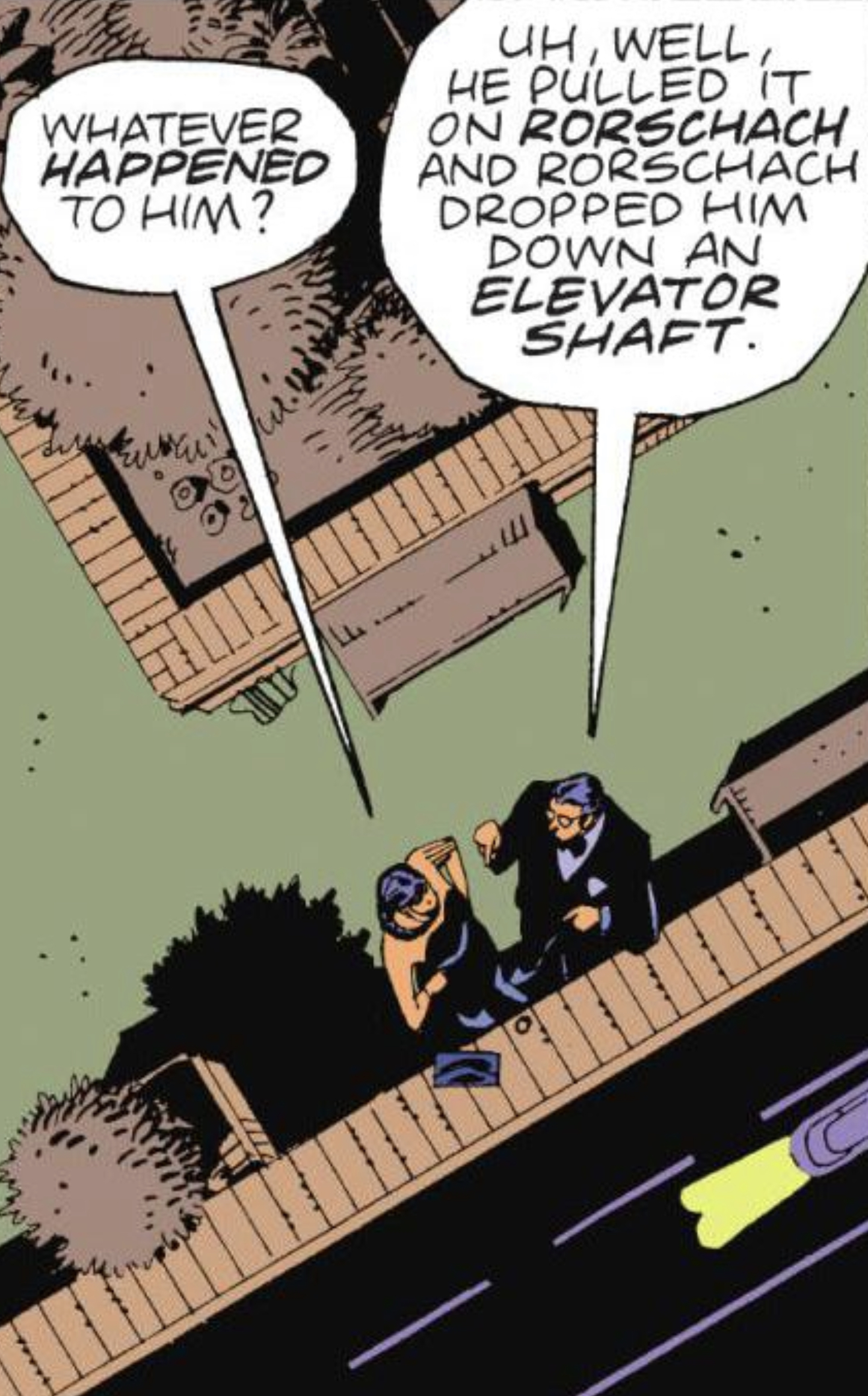
After monstrously murdering the woman pregnant with his own child, the Comedian pointed out an even more horrifying truth: Dr. Manhattan let him kill her. The most powerful being in the universe was losing his ability to care about people, and Dr. Manhattan seemed genuinely concerned to learn this about himself.
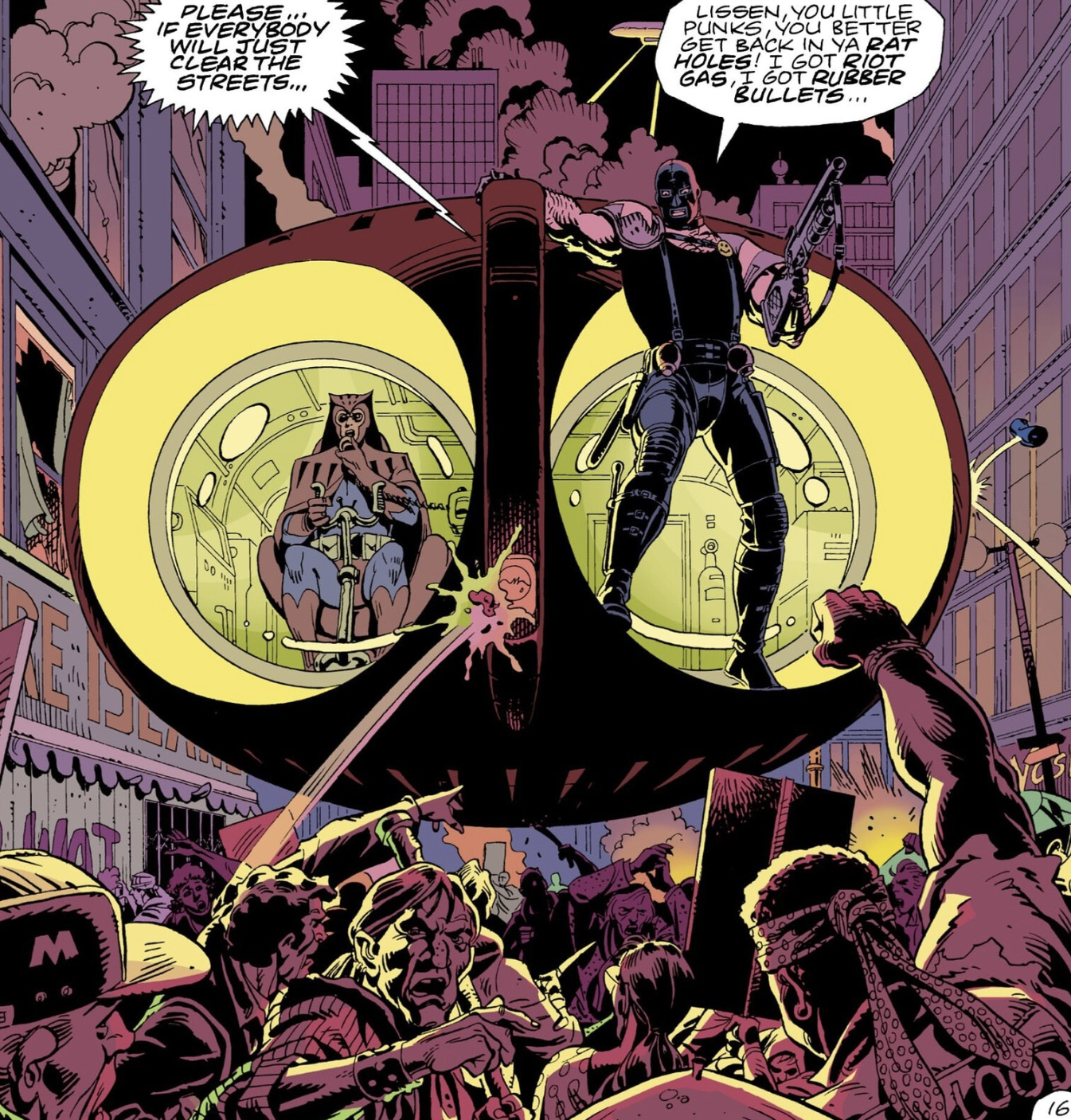

Dan Dreiberg reflects on a riot he and the Comedian stopped during a police strike, shortly before the U.S. government cracked down on superheroes.
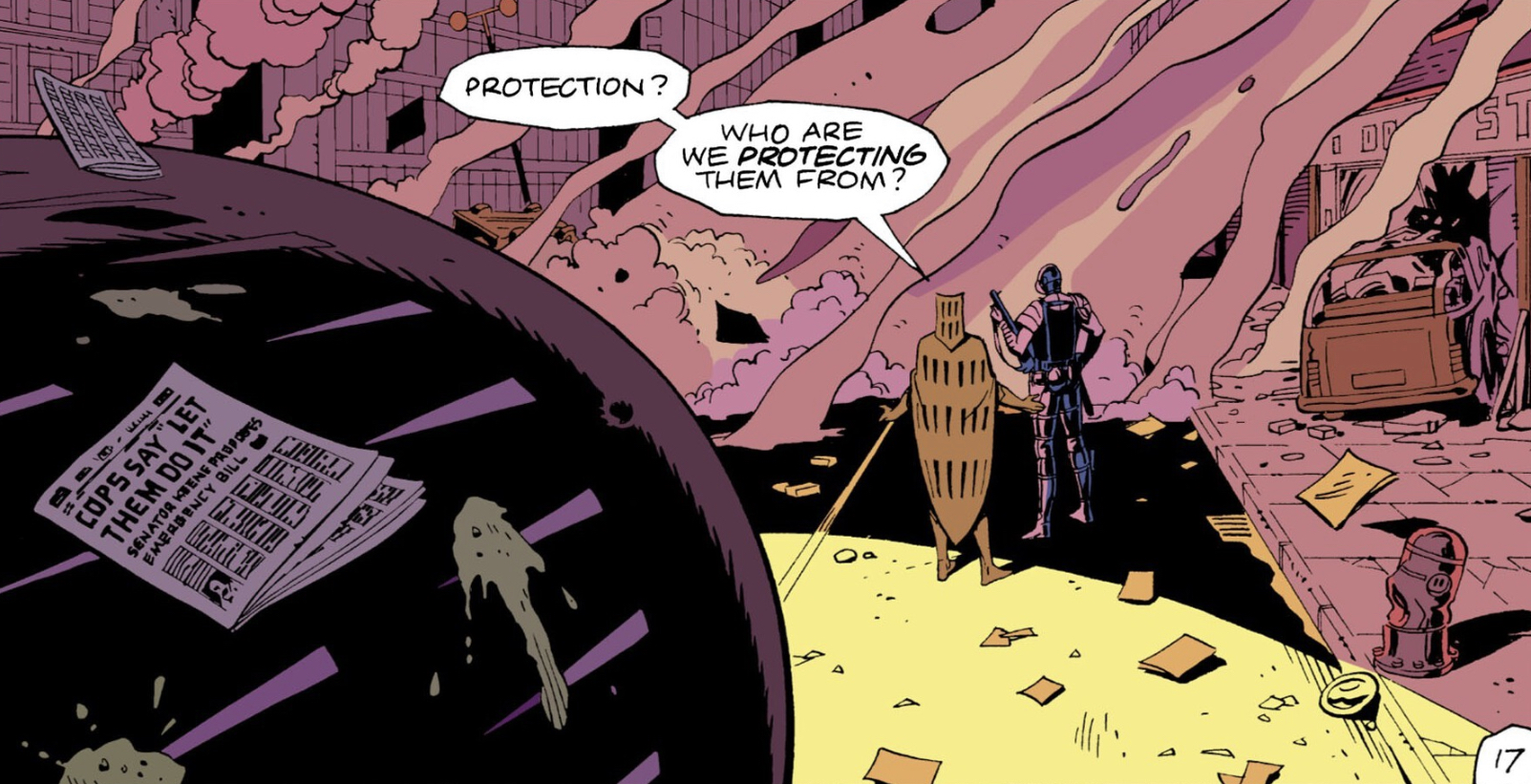

Dan is horrified by the Comedian’s government-sanctioned brutality and quickly realizes that their actions aren’t actually helping anybody.


Here, Moore is explicitly stating what he hinted at earlier. The American dream is violence, carnage and corruption. An unsettling truth that the Comedian taught Nite Owl, who responded by slipping into obscurity, depression and impotence.


There were very few people at Eddie’s funeral, but only Rorschach seemed to notice or care about the appearance of the former villain Moloch, who laid an enormous wreath of roses on the grave. It’s tough to tell which makes Rorschach angrier — the fact that a villain dared show his face at a heroes’ funeral, or that the villain was the only one who brought flowers.


I have no idea how Rorschach beat Moloch to his home and snuck in his fridge like that. It’s an unfortunately cool moment that makes us forget how psychotic and pathetic Rorschach is.


Rorschach is brutally assaulting a sickly old man, but we the readers are prone to justify it as Rorschach’s interrogation technique actually proves quite useful here. He’s very quickly graduated from breaking the fingers of a man who mocked his stench to uncovering the first tangible clue of the main plot.


It’s difficult to tell exactly why the Comedian didn’t try to stop Adrian. Perhaps he knew he’d be killed in the effort. Perhaps he was too traumatized by the horrors he saw to work up the courage to attempt something useful. Whatever the case, he felt he had to tell someone, even if the truth was buried behind veiled references packaged in a drunken stupor. And despite Rorschach’s deep admiration for the Comedian, the two of them never seemed to have much of a relationship. It certainly seems like Rorschach carries a bit of envy for Moloch — a villain — having a better relationship with his idol.


The Comedian spent his whole life reading people extremely well and reveling in the use of excessive violence to bring about order. But for the first time, he was unable to see the bigger picture, or the “joke,” as he liked to call it. In hindsight, it is kind of strange that Adrian’s plot would spook the Comedian this bad. Perhaps this was Moore overhyping the horrific nature of the grand scheme. Or maybe he was just creating a character who realized only too late that he did have a line he could not cross — that his brand of brutality that served him so well in the ’60s and ’70s was suddenly obsolete in the ’80s.


Rorschach likes to claim that he sees the world in black-and-white; i.e., right is right and wrong is wrong. But as we saw last issue, he’s quick to make some selective and contradictory exemptions to that standard. And here’s a rather surprising exemption. In his desperation to bust Moloch for something — once a criminal always a criminal — he discovers some banned placebo drugs in his medicine cabinet. But Rorschach chooses to let Moloch off the hook for the drugs. Perhaps out of pity, mingled with a sense of admiration for one who shared such an intimate moment with the Comedian. Perhaps Rorschach was motivated by his belief that Moloch could be a valuable source for him in the future. Or maybe he merely understood that this placebo thing was a bit much even for him. Whatever the motivation, this small act goes a long way toward making us overlook Rorschach’s glaring flaws.


Rorschach finally makes it to the Comedian’s grave, delivering a monologue that contains lines that Batman or even Superman would say. I would dare even call some sections of it inspirational, making it easy to forget that this was the guy who on Page 1 of this story fantasized of refusing to save people he deemed “unclean.” It’s also worth noting that Rorschach doesn’t have a flashback with the Comedian. And I think it’s because all those flashbacks were learning moments for the characters. Sally learned that she did crave and enjoy sexual attention from others, no matter the cost. Adrian learned how futile the concept of superheroes is. Dr. Manhattan learned that it’s impossible for an all-powerful being to relate to ordinary humans. Dan learned how oppressive the American establishment could be. And Moloch learned what a lifetime of violence could do to a man’s mental and emotional well-being. But Rorschach never learned anything from the Comedian. He agreed with him and admired him from a distance — too far away to receive any epiphanies like the others.


Perhaps Rorschach was only able to admire the Comedian because he was always so distant from him. Had he been closer, he might — might — have been able to realize that Eddie Blake is a man unworthy of admiration. But much like his father, Rorschach built up a false image of a hero in his mind that he idolized and justified at every chance. Disgustingly, he even implies that the attempted rape was just something that the Comedian “had to do.”


Rorschach tells a joke about the clown Pagliacci being able to bring joy to others but not himself. I don’t think Rorschach himself quite understood — but Moore certainly did — that the Comedian was sort of a reverse Pagliacci. He didn’t spread joy. Not a single person has a fond memory of him. But he did spread understanding. He helped people see uncomfortable and disturbing truths about themselves or the world. Which makes it ironic that he ultimately died because he saw something he couldn’t understand. There was no comedian around to explain to him the bigger picture behind Adrian’s plan.


All the principle characters in this issue did mourn during Eddie’s funeral. But only Rorschach mourned the man himself. Sally mourned her lost beauty. Adrian mourned the possibility of united superheroes. Dr. Manhattan mourned his dwindling emotions. Dan mourned the corruption of the American dream. And Moloch mourned a life full of regrets. Rorschach, however, mistakenly thought the world had been robbed of some great hero worthy of adoration. It’s easy to sympathize with Rorschach at the end, especially coming off Moloch’s flashback and this beautiful artwork. But readers who are willing to put in a little work will see just how fundamentally wrong Rorschach is.


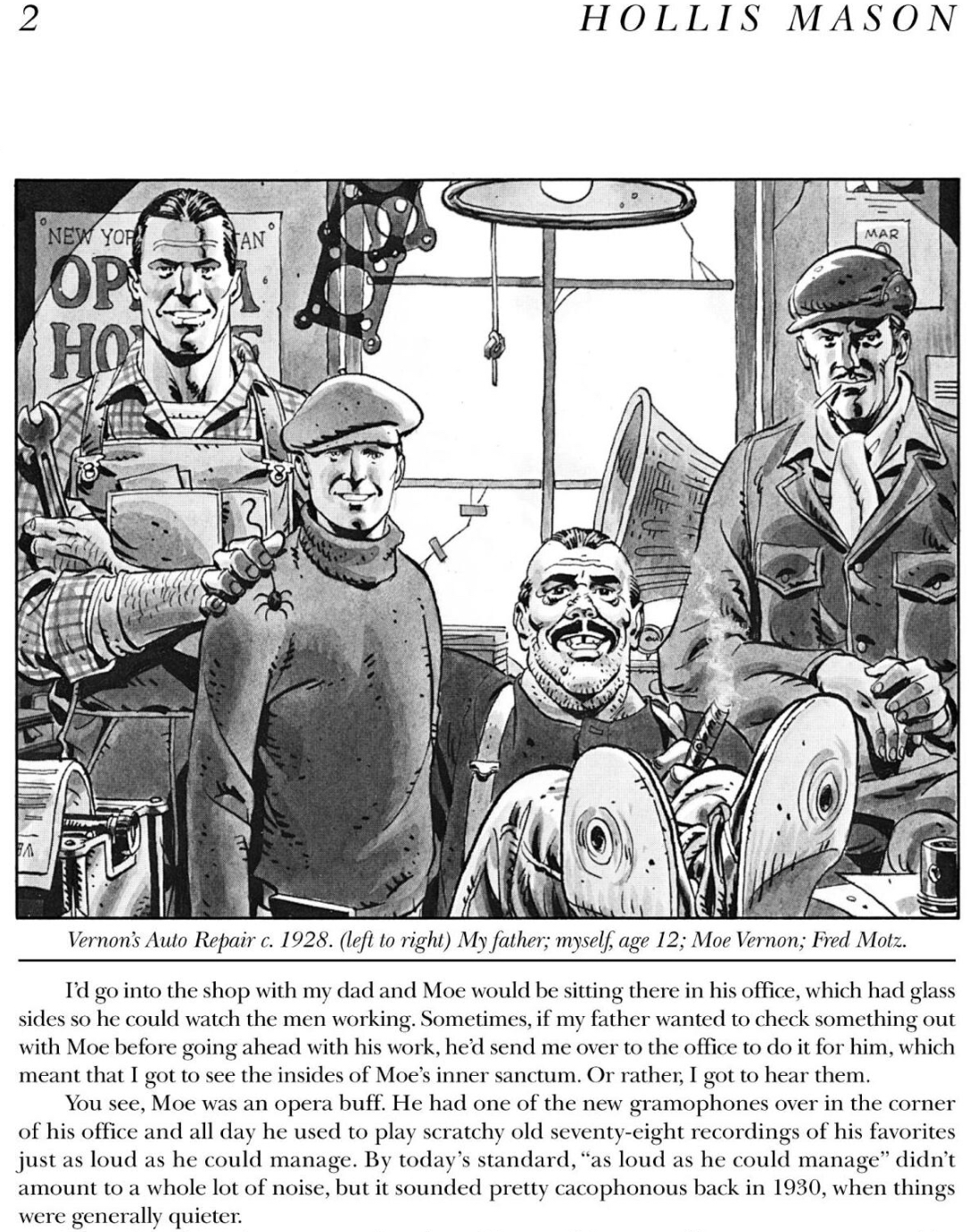
The issue ends with a few more excerpts from Hollis Mason’s tell-all book. Here we see just how arbitrary and goofy the origin of his Nite Owl persona was.


Hollis readily admits that the Minutemen were comprised of Nazis, racists and sexual deviants. He does justify them — to an extent — while simultaneously sensationalizing their faults for his book. And we understand that the younger Hollis was so enamored with the idea of being on a team of superheroes, that he was quick to turn a blind eye to pretty much anything.


No one is spared Hollis’ speculative gossip. Here he questions Hooded Justice’s sexuality, but in the rather sleazy way of distancing himself from the accusation. “Hey, I’m not saying he’s gay …”


And we finally get to Hollis’ take on the Comedian. It is technically accurate, but surprisingly terse. He does condemn the Comedian, but this book also condemns Hollis himself. He sat on this knowledge for decades before finally profiting off it with a splashy book. He blames others for the coverup that he willingly and knowingly participated in. Moore is trying to show us over and over again that there are no good guys in this story. We as readers naturally resist that notion. We’re used to cheering for good guys. We need to cheer for good guys. But this isn’t that kind of story.

Tuesday, November 22, 2022

Redrafting the Jazz: 2017


I have been cursed by a witch to repeatedly travel back through time to relive every NBA draft. Fortunately, her spell sends me directly to the Utah Jazz war room on draft night and all the executives magically know I’m from the future and will do whatever I say. Unfortunately, the curse prevents me from seeing how my advice altered the future, as I am sent back to the previous year as soon as draft night ends.

June 27, 2017 – Barclays Center, New York

Previous season:

The Jazz were coming off a fairly successful 2016-17 season. They won 51 games and reached the second round of the playoffs, where they were swept by eventual champion Golden State Warriors. Gordon Hayward had made the All-Star game and Rudy Gobert was named to the All-NBA Second Team and All-Defensive First Team. Surrounding those two was a promising core of young players — Alec Burks, Dante Exum, Derrick Favors, Rodney Hood and Joe Ingles — flanked by a couple of savvy veterans — Boris Diaw, George Hill and Joe Johnson. But there were suspicions that both Hayward and Hill (the starting point guard) would leave in free agency.

The draft:

Dennis Lindsey decided to beef up the backcourt by moving up in the draft. He traded Trey Lyles and Utah’s first round pick (No. 24) to Denver for the 13th pick, which he used to draft Donovan Mitchell. The Nuggets used the 24th pick on Tyler Lydon.

Utah also owned the 30th pick thanks to a 2013 trade with Golden State involving Andre Iguodala, and the 42nd pick from a 2015 trade with Detroit involving Enes Kanter. But instead of using these picks, Lindsey traded them to the Lakers for the 28th pick, which he used to draft Tony Bradley. The Lakers used their new picks on Josh Hart and Thomas Bryant.

And last, and certainly least, the Jazz finally decided to use their own second round pick (No. 55) on Nigel Williams-Goss.

Analysis:

The trade for Donovan Mitchell was one of the best in Jazz history. Trey Lyles was a disappointment of a lottery pick. He started 33 games as a rookie in 2015-16 and averaged 6.1 points per game. But in his second season, he only started 4 games and saw his field goal percentage drop from 43.8% to 36.2%. And in the ensuing years, he has failed to develop into a solid player or find a long-term home in the NBA. After spending a couple of seasons in Denver, Lyles has bounced around from San Antonio to Detroit and Sacramento. And the Jazz didn’t miss out on Tyler Lydon, either. He played a total of 26 games for the Nuggets before falling out the league. He did compete in The Basketball Tournament in 2021, after which he retired from basketball.

Mitchell was unquestionably better than those players. And he was hands-down the best player available at the 13th pick. All-Stars Bam Adebayo and Jarrett Allen were picked after Mitchell, but neither of them are as impressive, or would have made as big a difference for the Jazz as Mitchell. 

When he was drafted, Mitchell was expected to be a defensive force off the bench for the Jazz. But Hayward and Hill left, and Utah was suddenly without an offensive leader. Hood and Burks were too injury-prone and inconsistent to fill that role. So Mitchell inexplicably took over, setting scoring records Utah hadn’t seen since Karl Malone. He was named to the All-Rookie First Team and made three All-Star appearances during his five-year tenure with the Jazz. Unfortunately, he stopped playing defense and he never figured out how to play with Gobert and everything sort of collapsed. So Utah decided to clean house, but were quite lucky to receive a king’s ransom for Mitchell. Cleveland gave up Lauri Markkanen, Collin Sexton, Ochai Agbaji, three first round picks and two pick swaps. Time will tell if that trade was worth it, but so far, that’s a pretty impressive-looking haul.

So we’re keeping the first pick the same. But what about the other two? Well, the Tony Bradley trade turned out to be a mistake. He lasted three years with the Jazz, but only played in 70 games during that timeframe. He’s since bounced around between Philadelphia, Oklahoma City and Chicago, never making much of an impact anywhere. Josh Hart is a much better player than Bradley. True, he’s not the big man Dennis Lindsey was looking for, but he is a surprisingly solid rebounder for a guy who’s just under 6’5”. And if Lindsey just kept that 42nd pick, he could have drafted Thomas Bryant, who’s just as big as Bradley and seems to be an upgrade over him in every way.

Or I could just tell Lindsey to forget about drafting for size and simply pick the best player in the second round — Dillon Brooks. He pretty quickly became a starter for a decent Memphis team and lit up the Jazz in the 2021 playoffs. I don’t know how well he would have developed backing up Joe Ingles, or how well Quin Snyder would have liked him — he did lead the league in fouls two years in a row. There’s also a little concern about redundancy if I tell the Jazz to draft both Hart and Brooks. But at the end of the day, I believe you have to take the best players available and figure out the rest later. Maybe Snyder could have enjoyed some versatility in his lineups with Hart and Brooks. Or, worst case scenario, they become decent assets to trade for someone even better.

And last and least, Nigel Williams-Goss. He was kind of a weird case for the Jazz. They drafted him, but then let him go overseas for a bit, then brought him back, but only to play 10 games. Eleven if you count the playoffs. I think we can do a little better than that. Since I denied Lindsey his big man in Tony Bradley, I’ll present him Chris Boucher, who went undrafted, but worked his way onto the Toronto Raptors roster. He’s not as big as Bradley or Bryant, but he can block shots and shoot the 3. I think there’s a decent chance he would have made a positive impact on the Jazz.

My advice:

1. Trade Trey Lyles and the 24th pick to Denver for the 13th pick. Draft Donovan Mitchell.
2. Keep the 30th pick. Draft Josh Hart.*
3. Keep the 42nd pick. Draft Dillon Brooks.
4. Draft Chris Boucher with the 55th pick.

*Note: My efforts at changing reality will undoubtedly have unforeseen consequences. If the Lakers didn’t trade away the 28th pick, there is a good chance they could have drafted Hart in that spot. But there’s no way to tell for sure. So what I’m presenting is Plan A. Plan B would have been to bump up Brooks and Boucher to those higher slots and use No. 55 on somebody like Naz Mitrou-Long (who did end up playing 15 games for the Jazz as an undrafted free agent).

In real life, the 2017 draft was a huge success for the Jazz. They landed a franchise player without having to give up anything. But in my altered reality, Tony Bradley and Nigel Williams-Goss are replaced with Josh Hart, Dillon Brooks and Chris Boucher. I think those three players would have added a significant amount of versatility to the Jazz, enabling Snyder to build some interesting big and small lineups around Mitchell and Gobert.

But how did it turn out? I’ll never know. Because as soon as my work was done, the witch’s curse sent me back to June 23, 2016, and I have to do this all over again.

Tuesday, November 15, 2022

Watchmen #1: Rorschach isn’t a hero


I’m not sure why, but something has possessed me to resurrect a dead blog to talk about the most-talked-about comic book of all time. I tried to resist this urge. I really did. I asked myself what I could say that hadn’t already been said. But as I reread issue #1, I was reminded of Alan Moore’s discomfort at how so many people found the character Rorschach to be an inspiring hero. And that’s when I found my thesis. I still doubt I’ll be able to contribute anything original to the conversation, but I do think it’ll be fun to explore why there is such a large disconnect between Moore’s intentions and a significant chunk of his audience. 

I will examine every page of every issue of Watchmen and its adaptations, prequels and sequels, etc., to find out:
1. What Moore wanted the readers to think about Rorschach.
2. Where Moore may have failed in his mission.
3. How well other creators recaptured Moore’s vision.

So let’s get into it. Watchmen #1 came out in 1986 (one year before I was born) and was created by Alan Moore (writer), Dave Gibbons (art and letters) and John Higgins (colors). I will be working from the digital copy of this series, which features artwork that was restored by a team of eight people and Higgins’ revitalized colors that he did in 2005. And that restoration team did an impeccable job. This comic looks absolutely gorgeous on my iPad.


The story opens with shot of the bloody smiley face button from the cover before zooming out to a man spraying the enormous pool of blood off the sidewalk, while another man heedlessly walks right through the blood with a sign reading “The End is Nigh.” Forgive me for spoiling an extremely famous 36-year-old comic, but the man with the sign is none other than Walter Kovacs, aka Rorschach. 

It’ll be a few issues before we the readers learn the identity of this lunatic who can’t even be bothered to walk around the Comedian’s blood. But we do know this opening monologue is coming from Rorschach’s journal. And it’s not a pretty picture. Rorschach is fantasizing about being called upon to save the world, but choosing not to because he has deemed them unclean. He lumps together murderers, prostitutes, communists and liberals as the vermin of the world who have brought about their own deserved destruction. He doesn’t hate all politicians, though. Rorschach has high praise for former president Harry S. Truman and his dad, believing they lived by the standard that all Americans should follow. 

We’ll also find out later Rorschach’s view of his dad — and subsequently his entire outlook on life — is based on a lie. But the words on this page alone should be enough to turn us away from Rorschach. Any man who refuses to save somebody because of their political affiliation is no hero worth admiration. Unfortunately, I think the mystery of this opening creates enough ambiguity that some readers will agree with Rorschach’s words. If they knew right away that Rorschach was the doomsayer walking through blood, then they’d understand that these words were an incoherent rant of an unstable man rather than a haunting call of warning from a hero.


Edward Blake’s murder is initially investigated by a pair of detectives, who unfortunately fall out of the story fairly quickly. I think Moore should have made them the main characters, taking the readers on a tour through this world as they pieced together this mystery. A couple of ordinary human beings who never were and never wanted to be superheroes could have provided a strong contrast, demonstrating just how deranged and insane all the “heroes” in this story truly are. But since Moore made Rorschach the point of view character, many readers will naturally assume that this means he is a good guy and worthy of emulation.


We eventually learn that the Comedian was killed by Adrian Veidt, which makes the brutal and messy  method of this murder rather surprising. Adrian is a cold, calculating man, who patiently plays the long game. His nearly unlimited resources would have enabled him to kill Eddie in a much more efficient, if not less conspicuous manner. But it seems like a certain element of this murder, as suspected by the detectives, was that it was personal. True, Adrian wanted to kill Eddie to cover up his evil plan, but it also seems like he just really wanted to beat the Comedian to death with his bare hands.


Despite the fantastical nature of Blake’s death, the detectives decide to keep it quiet, hoping to not attract the attention of Rorschach, who is wanted for two counts of murder. It should go without saying that inspirational heroes should not be wanted for murder. Unfortunately, I do have to say that, because there are too many people who believe it’s not only acceptable, but cool to have a superhero who kills people. And in case anyone suspected those murder counts might be spurious charges, the story will later confirm that Rorschach has, indeed, killed at least two people while acting like a “hero.”

The detectives don’t realize that they’ve just done exactly what they were trying to avoid. Rorschach’s “disguise” is useful, as it allows him to essentially be invisible wherever he goes and occasionally learn something significant like this. Most people ignore the homeless and/or mentally ill people on the street, and Rorschach certainly appears to fall in that category in this getup. But it’s not really a disguise for him. He really does believe the end is nigh. And he really doesn’t have anything better to do with his time other than endlessly roam the streets, unconcerned with what he steps in or how dirty he gets. I don’t even think he’s actually checking his watch here — just pretending to, while he eavesdrops on the detectives.


This is the first view of Rorschach in his superhero outfit. It’s not much of a costume — just a hat, trench coat and some gloves. The one unique aspect is his mask, which we don’t fully see just yet. Even so, this is actually a really cool look — especially in the shadows like this. You can’t see how dirty and truly pathetic he is. It’s too easy to view him as a dynamic, exciting hero here, completely forgetting all the warning signs that Moore tried to give us. I know I certainly did on my first reading.


This is just an awesome image. It’s almost impossible to not be drawn in by this simple, yet practical hero, sporting a mesmerizing, one-of-a-kind mask. I think it might actually be too cool for the story Moore is telling. I guess that’s the risk of creating a satirical character — you inadvertently make something cool that you wanted to be lame. Or maybe that was always part of Moore’s plan. This story is full of unlikable characters. But none of them are simplistic, one-note characters. They are complex and layered, full of just enough redeeming qualities to keep us engaged.


Rorschach is acting a lot like Batman — the most popular superhero of all time. He used a grappling gun to scale the skyscraper, and now he’s using detective skills to investigate Blake’s apartment to confirm his suspicion that he is the Comedian. Everybody likes Batman, so it’s understandable that we’d also like heroes who do Batman things. And this is why I think it would have been better for the detectives to find the secret closet instead.


I really like how the Comedian’s costume looks like a sad, pathetic clown. It’s a grotesque mockery of Captain America. The mask may be mourning the death of the man who wore it, but it also conjures some sexual imagery, as well. The inclusion of the large weapons gives us our first clue that despite being the victim of a brutal murder, the Comedian was not an upstanding hero.


The first time I read this story, it was very difficult for me to understand why I couldn’t fully like any of the characters. But I now understand that was the point. Every one of them is flawed in some way. Even the most relatable and sympathetic characters do something that should make you cringe. On first glance, Hollis Mason is a sweet, old man, who specializes in fixing up obsolete cars and obsolete people, such as Dan Dreiberg. Of course, there’s not really any fixing going on here — just reliving the glory days, which we’ll find out weren’t quite that glorious. And Dan leaves Hollis’ feeling just as depressed and despondent as ever.


It’s pretty difficult to convey how disgusting a character is in a comic book. Gibbons can’t draw stink lines or buzzing flies around Rorschach. That’d be too cartoony. Instead, we have to primarily rely on the dialogue to let us know just how gross he is. Look at the sound effects of him eating cold beans straight from the can: “Chlop. Thlup. Shorp. Lep.” Not only is he breaking into Dan’s house and eating his food without permission, but he’s doing it in the sloppiest, laziest way possible. And he’s not doing this because he’s in a rush — he was sitting around waiting for Dan. Rorschach simply doesn’t care about hygiene, health or decency, for that matter.


These sugar cubes Rorschach is taking? Not for any grand purpose. He’s just going to munch on them raw throughout the rest of the story. That’s not normal. That’s not cool or quirky. But … it’s easy to overlook little moments like this when we’re caught up in the mystery and trying to figure out who all these people are. Plus, Rorschach is kind of funny.


Turns out, Rorschach was wrong. There was no conspiracy to kill all superheroes. And in hindsight, it is rather strange that he immediately jumped to that conclusion, especially since Blake’s murderer didn’t expose him to the world as the Comedian. You could say that Rorschach was simply being paranoid, or you could look at it as Rorschach forcing the issue to seem bigger than it really is. As we’ll see, the Comedian’s death hit him really hard. And maybe he felt that if he presented it to his old colleagues as a conspiracy, they’d be more motivated to help him avenge his idol.


Nite Owl was one of the hardest characters for me to wrap my head around when I first read this. I really wanted to like him, but I just couldn’t. His costume seems cool at first glance, but is actually pretty stupid when you get down to it. Same with his flying ship. An impressive piece of technology, for sure, but rather dumb-looking. But Dan’s biggest flaw is that he doesn’t do anything. All his gear gathers dust in his basement, while he reminisces on days gone by with his idol and occasionally submits a boring article about birds to a magazine.


Rorschach’s repugnant flaws keep building up, but since this story is so dense, it’s easy to miss a few. Instead of taking responsibility for poor hygiene, he retaliates against his landlady, accusing her of having children from five different men and cheating on welfare. On my first read-through, I had no reason to doubt Rorschach. But now, after realizing that so much of worldview is based on a lie, and how quick he is to lump together all the sins he despises onto people he disagrees with, I’m a bit more skeptical of his words. Note that I use the word “sins” in a very broad sense. Rorschach surprisingly is not religious. Usually his type of conservatism goes hand-in-hand with religion. But I suppose many religions died off in a world with Dr. Manhattan. But even without the religion to anchor his views, Rorschach’s beliefs are the same. He assumes his landlady cheats on welfare because — in his eyes — she is unworthy of receiving welfare due to her multiple sexual partners.


The bartender is terrified to see Rorschach and begs him not to kill anybody. This is a frightening glimpse of our “hero” — not a cool one. The bartender wouldn’t have said that if Rorschach didn’t have a reputation of being a murderer. It wouldn’t even be far-fetched to suggest he had killed in that very bar.


Rorschach doesn’t care for his personal hygiene, but he does seem rather sensitive about it. His entire act of interrogation in this bar was merely him breaking a couple of fingers of a man who joked about his body odor. As he leaves, Rorschach (in his diary) accuses the patrons of distributing child pornography. They might have been, but we don’t know for sure. Pedophilia is a common accusation conservatives like to make of others, usually because it’s the worst thing they can think of and they can’t come up with a legitimate complaint about their enemies. Since Rorschach is the type of man who lumps liberals together with murderers, it seems in line for him to make these kind of assumptions without any evidence.


Rorschach next visits Adrian Veidt, not realizing he’s speaking with Eddie Blake’s murderer. When Adrian casually says the Comedian was practically a Nazi, Rorschach becomes incredibly defensive, arguing that he can’t be a Nazi because he worked for the United States government. When Rorschach says he might as well be called a Nazi, too, Adrian seems to repress a laugh. This is Rorschach unwittingly “telling on himself.” He doesn’t fully understand what fascism is, nor how closely his views are related to it. But he does know that the word Nazi is a supreme insult that evokes anti-American connotations. His response is a fairly typical one among fascist-leaning conservatives who haven’t studied enough history.


It’s very easy to dislike Adrian right away. He is the embodiment of vanity, surrounded by action figures of himself in a massive, sparkling office. But the newspaper on his desk reveals his true concern. Despite the presence of Dr. Manhattan, the Soviet Union still hasn’t backed down and threats of nuclear war are higher than ever. And that threat influenced every decision Adrian makes in this story. In fact, if his methods weren’t so monstrous, he probably could have been considered the hero.


Once again, Rorschach is lumping together every negative quality he can think of to describe someone he doesn’t like. There is no reason to suspect Adrian of being gay, other than Rorschach’s reductive worldview that pampered liberals are also homosexuals. I know homophobia was a lot more common and socially acceptable back in 1985, but it was still wrong. And Moore is using it as one more defect in Rorschach’s character.


At last we meet the fabled Dr. Manhattan, introduced to us as an unfathomable naked giant blue man. Of course, I don’t think it’s right to even call him a man. He looks like a man, but he barely acts like one. He is much more accurately described as a god, albeit a dispassionate one. A god who sees no difference between an alive person and a dead one. His girlfriend, Laurie Juspeczyk, is appropriately shown as an afterthought. A minimal presence in the background, ostensibly brought in to keep Dr. Manhattan happy, but not given anything to actually do.


And here we see perhaps the biggest contradiction in Rorschach’s philosophy. Lauri is glad the Comedian is dead because he attempted to rape her mother. But Rorschach dismisses the allegations from Hollis Mason’s tell-all book and essentially says that even if the Comedian did attempt to rape someone, it doesn’t matter, because his service to the U.S. trumps everything else. Lauri is right to be enraged by this reference to “moral lapses,” especially coming from a man who spends so much time complaining about prostitutes and sexual immorality. A lot of people think Rorschach sees the world in black-and-white; i.e., right is right and wrong is wrong, no compromise. And Rorschach even believes that’s what he does, too. But he doesn’t. His cognitive dissonance has created a pretty glaring compromise in his outlook, much like so many conservatives today. Far too many people are so willing to readily surrender their values if it means putting another Republican in office.


Dr. Manhattan teleports Rorschach away, and it’s easy to feel sympathy for him as he walks away in the rain. Rorschach has struck out. None of his former colleagues are concerned by the Comedian’s death, let alone his baseless conspiracy theory. But I think Rorschach is more dejected that none of the others are grieving like he is.


Dr. Manhattan is easily the most frustrating character in this story, as he possesses the power to do practically anything, yet chooses to spend his time obsessing over the most insignificant matters. It’s no surprise that’s Rorschach’s visit had no effect on him, but it did have an effect on Laurie, prompting her to reconnect with Dan. In his own haphazard way, Rorschach is putting the band back together, which is something we want to see, and another reason why we might root for him.


It certainly is rich to see Rorschach vow to never compromise almost immediately after he compromised his morals to defend the Comedian. I don’t blame readers who miss this display of cognitive dissonance, though. I did. This is a big story. Twelve issues of 32 pages each and most pages have nine panels. It’s easy to miss things.


I think the greatest thing about Watchmen is the combination of Moore’s engaging story with Gibbons’ detailed art. He doesn’t waste a single panel, always finding ways to expand the story in the background — or, in this case, foreground. This alternate 1985 has some interesting advances in technology, thanks to Dr. Manhattan. Restaurants can serve turkeys with four legs. Most cars don’t run on gas anymore. Everybody’s smoking these space-age cigarette/pipe things. And, for some odd reason, homosexuality seems to be more socially acceptable than it did in the real 1985. This surprises me, as the staunch conservative Richard Nixon was able to turn Dr. Manhattan’s victory in Vietnam into essentially a lifetime presidency for himself. Nevertheless, something about this world enabled these two gay men to publicly display their affection for each other without fear of repercussion. And you have to know our old pal Rorschach views this as a massive problem of society.


Laurie, like all the main characters of this story, is complex and confounding. And not entirely likable. In this first issue, we learn her mother was sexually assaulted by the Comedian, and that she essentially fell into the superhero life and tasked with standing around watching Dr. Manhattan work all day. Like Dan, her lack of initiative is frustrating. Also like Dan, she has a darker side. The two of them ended their dinner by laughing at Rorschach killing a mentally ill man in cold blood. We should not be inspired by any of these people — especially Rorschach.


This miniseries includes a lot of supplemental material that may not be entirely necessary, but is still interesting. It’s rather impressive that Moore took the time to actually write several chapters of Hollis Mason’s controversial tell-all book. I do laugh, however, at the note that this was “reprinted with permission of the author.” Who’s printing this? And just when did Hollis grant this permission?


Hollis was introduced in this story as a kindly old man who likes to fix up old cars and reminisce over days gone by. And the first couple of pages of his book perpetuate that image.


Hollis then launches into a bizarre tale of a jokester mechanic who was listening to “Ride of the Valkyries” while wearing fake breasts when he learned his wife had robbed him and ran off with his friend. What does this have to do with anything? Hollis tells us on the next page.


Hollis chose to open his book with this strange, sad tale of suicide only because he wanted to get the readers’ attention. And that’s rather fitting for a man who chose to write a tell-all book to begin with. Yeah, he might seem like a kindly old man, but he’s not above capitalizing off other people’s tragedies.


This story is a deconstruction of superhero mythology and Moore spent a lot of time thinking about what would motivate ordinary people to become masked vigilantes. Each character has their own motivation. Hollis’ was primarily a desire to live in a more simplistic world.


Hollis even admits that being a superhero was a juvenile fantasy. Moore is trying to give us permission to disdain these characters, to view them as infantile idiots. But that goes against the fundamental principles of most readers of this story, who have likely spent years consuming and enjoying superhero content. We’re predisposed to root for the guy who puts on a cool mask, scales skyscrapers with a grappling gun and finds clues the police couldn’t. In fact, we’re so predisposed to that idea, that we instinctively dismiss all warning signs about that character as mere quirks or interesting character flaws. We have to actively work to understand that Moore has given us a story with fatally flawed, thoroughly unlikable characters.

It’s hard work to understand what Moore was saying. But the effort is worth it. I’m glad he didn’t dumb down this story. Otherwise it wouldn’t be nearly as rewarding on a reread.

Thursday, May 21, 2015

Supergirl


You may have heard about a new Supergirl TV show. If you haven't, then make sure to watch the trailer on YouTube (I think it shows a bit too much, but it looks good, anyway). But did you know that Supergirl once starred in a major motion picture more than 30 years ago?

Following the disaster of Superman III, the eccentric Salkind family, which own the movie rights to everything Superman, decided to try to revive the franchise with a Supergirl spinoff. Following the same formula of Superman: The Movie, the Salkinds went with an unknown to star in the lead — Helen Slater, who would later provide the voice of Talia Al-Ghul in Batman: The Animated Series. But, as with Superman, the top billing went to the villain, portrayed by a well-established Academy Award-winner — Faye Dunaway. And to round out the cast, the Salkinds chose one more big name to serve as the leader of an alien community — Peter O'Toole, who never won an Academy Award, but was nominated a record seven times for the Best Actor award.

Unfortunately, the Salkinds struck out on just about every other aspect of this movie. Christopher Reeve turned down an offer to cameo in this film, as did every other Superman character, except for the always-eager Marc McClure (Jimmy Olsen). And despite his failure with the third film, the Salkinds actually wanted Richard Lester to return as director. But he wisely turned them down, leaving Jeannot Szwarc in charge, a Frenchman whose main claim to fame prior to this was Jaws 2. And, of course, John Williams did not return to write the score, giving the job to the accomplished Jerry Goldsmith, who actually did a fairly decent job here.

Supergirl was released in 1984 with a budget of $35 million. It only earned back $14 million and earned Golden Raspberry nominations for the most accomplished cast members — Dunaway (Worst Actress) and O'Toole (Worst Actor). The film currently holds a 7 percent rating on Rotten Tomatoes, and is all but forgotten and ignored by even the biggest Superman fans. So why is this movie so bad? Let's find out.

I always start each review by giving the movie a 5 out of 10, then adding or subtracting points along the way. But I dropped this movie's score down to a 0 rather quickly, and never had any reason to raise it back up. So I'll do my best to provide a synopsis for this mess of a film, and then I'll hit on my main complaints. Keep in mind, however, that this movie doesn't make one bit of sense, so my synopsis won't be very good.


We begin in Argo City, which is apparently a Kryptonian settlement in "inner space" (Earth and everything else is in outer space). Argo City is a bit more vibrant and alive than the Krypton we saw in Superman: The Movie, although it does feel rather hippie-ish — everyone's barefoot for some reason. The city's founder is Zaltar (Peter O'Toole), who is hanging out with Kara Zor-El (Helen Slater) and using some sort of magic wand to sculpt what he calls an Earth tree. I think he needs to work on his research, because his "tree" looks nothing like any tree I've ever seen.

Anyway, Zaltar then shows Kara the Omegahedron, a small, spinning, glowing sphere that is apparently one of two power sources for Argo City. Zaltar has taken this essential power source without permission in order to feel "inspired" as he creates his art. He uses the Omegahedron to make his "tree" slightly glow purple or whatever, and he explains to Kara that the Omegahedron can't actually make things come to life, but it can make things appear to be alive. He then creates a braclet for Kara and gives her the wand and sphere as he idly talks to her parents about his plans to visit Earth, or perhaps Saturn or Venus. Such a journey used to be impossible, but Zaltar points out a new spaceship he created that can make the trip.

Kara, meanwhile, spreads out on the ground like a child half her age and creates a dragonfly-like creature. She uses the Omegahedron to animate the insect, which begins flying around uncontrollably until it bursts through the thin membrane protecting Argo City. The Omegahedron is sucked out of the hole, and Kara almost is as well, but Zaltar saves her by patching up the hole with his wand. However, with the Omegahedron now lost to outer space, Argo City is doomed to die in a few days.

Without saying a word, Kara jumps into Zaltar's ship and takes off after the Omegahedron, and no one really tries to stop her. Zaltar explains to Kara's parents that she will survive the journey, but be forever changed. He, however, takes full responsibility for the catastrophe and basically volunteers to be sentenced to the Phantom Zone.

We then cut to Earth, where we meet Selena (Faye Dunaway), a witch-in-training, having a picnic on a tiger rug with her mentor/boyfriend Nigel the warlock. Just as Nigel complains that Selena is too impatient, the Omegahedron lands right in the middle of their picnic. Selena seizes the sphere, and instantly feels great power emanating from it. She proclaims this to be the key to unlocking her potential and takes off, leaving Nigel behind. As she drives away, the radio makes a quick announcement about Superman heading off on a peace-seeking mission in a galaxy a trillion miles away.

Kara then emerges from the lake a short time later, suddenly wearing her full Supergirl outfit for some reason. She is amazed to find she can crush rocks with ease, make flowers bloom with her ... heat vision? ... flower vision? ... and, most importantly, fly. And fly she does, performing aerial acrobatics Superman would never dream of attempting, and taking a quick tour around the world, becoming most interested a group of wild horses. After getting all that out of her system, she discovers her bracelet glows in proximity of the Omegahedron. But just her luck, the bracelet stops working when Selena places it in a strange dragon-shaped container for some reason. And would you know, that container just happens to be made of lead?

And now things really start to unravel. Supergirl's first night does not go well, as she has to fight off a couple of creepy truckers. But this one slightly dark moment is soon forgotten in this rather light-hearted and kid-friendly movie. Supergirl spends the night in the forest, literally sleeping next to a cute bunny rabbit. She's awoken by a nearby softball game being played by an all-girls school, to which Supergirl decides to join. She somehow transforms her super-outfit into a school uniform and makes her long blonde hair short and brown.

Kara visits the principal to enroll in the school, but he won't let her in without a letter of recommendation. Luckily, their meeting is interrupted by Nigel the warlock, who just happens to be a math teacher at the school, and is complaining about the poor behavior of the girls. The principal leaves with Nigel for just a minute, which is more than enough time for Supergirl to quickly type up a letter of recommendation from her cousin, Clark Kent, and sneak it into the principal's files. When he comes back, she tells him to check the K folder, and when he sees everything is in order, he leads "Linda Lee" to her room with Lucy Lane, who, you guessed it, is the never-before-mentioned little sister of Lois Lane. Lucy has a big poster of Superman, who Supergirl recognizes as her cousin. The two roommates talk about how they each have a family member working at the Daily Planet. Oh, and for added measure, Lucy happens to be dating Jimmy Olsen.

Oh, and as for Selena? She's set up base in an abandoned haunted house/amusement park with her ... friend? ... sister? All I know is she's a slow-witted lady who's supposed to be funny (the equivalent of Otis to Lex Luthor). Selena repeatedly talks of using the sphere for world domination, and she repeatedly shuns away Nigel, who tries to warn her of Supergirl's arrival and of meddling with objects beyond her understanding. But Selena's first priority is securing a boyfriend. She is smitten by the local gardner, whom all the school girls have a crush on because of his hunky looks and penchant for working without a shirt on.

For some reason, Selena decides to save the sphere's power and instead conjures a complicated and easily-failable spell to make the gardner, Ethan, fall in love with her. The spell will make him fall in love with the first person he sees, but it initially puts him into a strange trance, and he wanders away from Selena. Instead of chasing after him, she takes control of a bulldozer and tries to scoop him up. All this is happening in the middle of town, where Supergirl is out with Lucy, Jimmy and the gang at Popeye's Chicken. They all see the unmanned bulldozer running amok, and the only person who tries to stop it is Lucy. She jumps inside and tries to take control, but she is somehow knocked out. Jimmy may have taken a picture or two.

Finally, after standing idly by for far too long, Linda Lee sneaks off to the bathroom and emerges as Supergirl. But instead of helping her unconscious roommate, she saves the hunky boy, trapped inside the bulldozer's bucket. She rips the bucket off, and for some reason flies it rather far away. And for another unknown reason, she decides to turn back into schoolgirl Linda Lee before opening the bucket to save Ethan. And would you believe it, but Ethan spent all that time wandering around without seeing another soul until Linda. So he falls in love with her, which Selena sees through her magic mirror.

So Selena summons the "power of shadow," which conveniently happens to be an invisible monster. The monster is sent after Linda Lee, but is met and easily defeated by Supergirl. I think Selena then took the Omegahedron out of the dragon-box at this point for some reason, because Supergirl was finally able/willing to track it at that point. She follows the signal back to the abandoned amusement park, where Ethan also happens to be with chocolates and flowers, looking Linda there for some reason. And then ... ugh ... it just gets so stupid. I guess Supergirl and Selena get into a brief fight, but then stop for whatever reason.

When Selena realizes even the Omegahedron isn't powerful enough to defeat Supergirl, she reluctantly recruits Nigel, who provides her with a tribal wand that pure, unadulterated evil. Using the two devices together, Selena is able to get Ethan to fall in love with her, and banish Supergirl to the Phantom Zone (which Selena somehow knows all about). Supergirl goes flying away in the pane of glass just like General Zod. But after some time, she steps away from the glass to find a bleak, dark world where her powers don't work. After sitting and crying for some time, she falls into a tar pit, but is rescued by Zaltar.

However, Zaltar has quickly given up on life and become a drunken mess. In her most heroic moment of the movie, Supergirl shows Zaltar the error of his ways and convinces him to help her try to escape the Phantom Zone. And the escape turns out to be rather straightforward. They just have to crawl/climb up to the top of the cave or whatever. Sure, I guess it's kind of intense, with some sort of whirlwind, and Selena somehow manages to summon a few fireballs that completely miss her targets. Ultimately, Supergirl is able to escape, while Zaltar "tragically" falls to his death in the whirlwind.

Meanwhile, Selena finally got around to starting to take over the world, beginning with creating a gigantic mountain with a castle on it in the middle of the town. She also somehow takes control of the police. But several school girls, led by Lucy Lane, begin picketing against Selena, brandishing signs that say things like, "Dorm G Against Selena!" Selena sends the police after them, and Jimmy Olsen shows his heroic side by saying, "Uhh, Lucy? I don't think this is a good time to express yourself ..." and, "Hey! You can't arrest me! I'm Jimmy Olsen, a member of the press!" Selena then puts the two of them in round cages next to the betrayed Nigel, whom Selena cursed to wear slightly shabby clothing.

Supergirl then arrives for the final fight, and Selena once again summons the "power of shadow." I guess the enhanced magic of the evil wand helps, because this time we actually see the monster, which is a really crappy looking dragon. It attacks Supergirl and the screen gets all wonky and distorted, leading me to wonder whether this is a physical or psychological attack. Either way, Supergirl spends some time moaning and crying, and saying, "I can't! I can't!" She then hears Zaltar in her head, saying, "You can!" This gives her the confidence to ... I don't know ... create a big whirlwind that just ... sucked up Selena and her friend/sister who never did anything.

I honestly have no idea what happened (and I watched this twice), but somehow Supergirl caused the two bad guys to go away and the mountain and castle and everything vanishes. Nigel, however, gets off scot-free, despite actually playing a role on the wrong side of this event. Anyway, with the Omegahedron in hand, Supergirl says goodbye to Ethan, Lucy and Jimmy, and returns to her ship in the lake. She returns to Argo City in inner space as credits role, and I guess the lights grow a bit brighter, somehow implying that she may have saved her people.


So yeah, that's pretty much Supergirl. I did skip the really pointless scenes of Supergirl at school, learning she could suddenly solve complex math equations, and had a couple of random encounters with a bully, including one in the shower. And I'm sure there is a bunch of other stuff I'm missing, but it's all pretty stupid and pointless. So here are my top five complaints with the film:

1. Nothing makes sense.

They simply refuse to explain anything. We know that Zaltar created Argo City, but we don't know how or why. Was it related to the destruction of Krypton, or was that just a coincidence? And does Supergirl know that her cousin is not only on Earth, but is also both Superman and Clark Kent? And why did she become Supergirl in the first place? I could go on and on, but I think you get the idea. So many basic elements of this plot were presented without the slightest hint of explanation.

2. Supergirl is stupid.

I don't mean the concept of the character is a dumb one. I'm totally fine with the idea of there being a Supergirl in every media available. But in this movie, the character Kara Zor-El was presented as an idiotic simpleton. For some stretches on Earth, this makes a bit of sense as she's trying to adjust to Earth culture, and doesn't understand why girls pierce their ears and such. But in Argo City, her home, Kara should have appeared more intelligent. To put it bluntly, she basically acted like a special needs child. I don't want to offend anyone, but that was the impression I had. And throughout the whole movie, Supergirl very rarely displays any intelligence in a useful manner.

3. The villain is a witch.

Superman and magic rarely work. He, and his family of characters, are scientifically based. And the first three movies of this series understood that, using villains that had their roots in science, or the alien planet Superman is from. But in this movie, we are presented with an actual witch, who is able to conjure actual spells and demons. Her power did not derive from the alien technology of the Omegahedron like I initially suspected, but rather that scientific artifact was able to enhance her powers. But only so much. Ultimately, she needed to rely on an actual evil magic wand to truly threaten Supergirl. The problem here is that the audience was abruptly required to stretch their imagination in strange, new ways. Nothing magical had been previously established in this film series, so when it was suddenly introduced, it felt out of place and unsavory.

4. Awful special effects.

After helping the world believe a man could fly in the first Superman film, the Salkinds then did everything they could to make the world forget that in their following three films. Each subsequent installment had a lower budget and worse effects. And that problem could not have been more blatant here. Supergirl's big fight scenes involved invisible monsters and strange image distortions. And the flying looked so, so bad. It always looked like she was flying in front of a projection screen. And when we very first saw her as Supergirl, I swear I could see the wire lifting her out of the water. It really was that bad.

5. A serious lack of urgency.

Argo City allegedly could only survive for a couple of days without the Omegahedron. So Supergirl should have been quite focused on finding it, like searching non-stop for this device. Even when her convenient tracking bracelet conveniently fails to penetrate lead, she still should have been out looking for this life-saving power source. But she chose to just casually meander around Earth, fly with the horses, sleep with the bunnies, and for some bizarre reason, set up a secret identity at a girls school. Only after goofing off for quite some time does she eventually get around to saving her family and friends. And she's not the only one. Selena, who was initially described as impatient, puts off her plans of world domination for the majority of this movie, as she inexplicably devotes so much of her time and energy on this worthless gardner boy. Why isn't anyone focused in this movie?

In conclusion, this was a truly horrible film, and everyone is right to ignore it. I don't hate it as much as Superman III, which I believe created the greater sin, but this is every bit as bad. It was so bad, it caused the Salkinds to sell the movie rights to Superman, which turned out to be a good thing in the long run. And the good news for the Supergirl TV show is that this movie set the standard so low, that no matter what they do, it will be better than this disaster.

Final score: 0

Sunday, April 19, 2015

Batman: Under the Red Hood


Batman: Under the Red Hood came out in 2010, was directed by Brandon Vietti and stars the voices of Bruce Greenwood (Batman), Jensen Ackles (Red Hood), John DiMaggio (Joker) and Neil Patrick Harris (Nightwing). The story is a retelling of the death and return of Jason Todd, the second Robin. The original story in the comics is very long, complicated, convoluted, and confusing. So how did this movie handle it? Let's find out by adding and taking away points as we (and I mean I) go through the film.

The first point I'll add is for John DiMaggio's portrayal as the Joker. I know that Mark Hamill is the definitive voice of the Joker, but he can't and shouldn't voice him in every single movie. DiMaggio's gruff style was absolutely perfect for the tone of this film and the Joker's character design. This is a Joker with a little meat on his bones — someone who's capable of beating Robin to death with a crowbar and take a pretty mean beating at the end of the movie. I don't think anyone could have done a better job than DiMaggio with this Joker.

I'll then raise the score to a 7 for the simplification of Jason Todd's death. In the comics, this was a long, sprawling stupid tale of Jason searching for his mother. He narrowed it down to three possibilities, all of whom happened to be in the Middle East. And when he finally meets his real mom, it turns out she's working with the Joker, but then the Joker betrays her, and it's a big, long, unnecessarily dumb mess. This movie wisely cut out all that crap, focusing only on the essentials. And not only that, but they did a great job with the death scene itself. It had just the right amount of violence without becoming too gruesome.

Now I have to take away a point for the dialogue during the Amazo fight. Neil Patrick Harris was a great choice as Nightwing, but everything he said here was so, so stupid. When they first see Amazo, Batman explains it has the ability to mimic the powers of super humans, to which Nightwing asks, "What kind of super humans?" What kind of a question is that? What do you think, Nightwing? He also kept reacting to everything Batman did like he'd never worked with him before. But in case there was any confusion, a random thug on the street is able to explain everything: "That's Nightwing ... the first Robin." How does this guy know that?! It's odd that such a strong movie would have one scene filled entirely with forced, unnatural and expositional dialogue.

But I will bring the score back up to a 7 for the great flashback montage of Jason Todd's career as Robin. We got to see all the different costumes, and, more importantly, witness Jason become more and more violent with each passing year. This, like so much of this movie, was simple and effective.

Now I have to go back down a point because of all the out-of-place villains. This is a Batman story, so Joker, Ra's al Ghul, the Black Mask and a Riddler cameo are all welcome and wonderful. Amazo was pushing it, and the cybernetic ninjas went over the edge. What the heck were these things? How did they work? And why did the filmmakers feel the need to include some shiny lasers and lightsaber-esque swordplay? Keep the story grounded and realistic. That's when Batman's at his best.

As I said earlier, one of the great strengths of this film is its simple and effective moments. One particularly subdued, yet impactful moments was Alfred dropping his tray when he learned Jason Todd was alive. They didn't over do it, which is what makes it so great. We're at a 7 again.

And now we're at an 8 for the fantastic scene of Joker killing Black Mask's men. He quietly asks for a drink of water, then suddenly, quickly and efficiently uses that glass to prove that he is the biggest bad there is. Add on top DiMaggio's casual and laughing nature about the whole thing, and you've got a nice little masterpiece of a scene.

The best solution is always the simplest one. When DC wanted to resurrect Jason Todd, they did so in an extremely sloppy way. It involved an alternate version of Superboy punching a hole in the wall of reality. This caused Jason to wake up in his grave, somehow break through the coffin and dig through six feet of dirt. That was stupid. The greatest achievement of this film is that it helped us all forget that. Ra's al Ghul and his Lazarus Pits are already well established and accepted within the Batman universe. Having Ra's revive Jason is perfectly in line with his character and is a much more natural fit as a Batman story. I don't mind stories with alternate realities and whatnot, but those type of stories don't work well with Batman. This version does work, so I'll raise the score another point.

Sadly, this movie doesn't end on a high note. These filmmakers unwisely outdid themselves in earlier action scenes with Amazo and the cybernetic ninjas. So when they got down to the climax between three non-superpowered individuals — Batman, Red Hood and Joker — they had to take things to unrealistic extremes to seem better than what they'd done before. The fighting gets really over-the-top at the end with people being punched through walls and shattering toilets with faces. Try to smash your face into your toilet. No matter how hard you do it, you're not going to shatter that toilet without first shattering your skull. And then to top matters off, we have Batman dodging bullets. They went to great pains to show in slow motion that the gun was fired before Batman even started to move. Superman can do that. The Flash can do that. Batman cannot do that. So I have to regretfully dock this otherwise great movie a final point.

Final score: 8

Sunday, October 12, 2014

Planet Hulk


Planet Hulk came out in 2010, directed by Sam Liu and starring Rick D. Wasserman as the Hulk, Lisa Ann Beley as his girlfriend Caiera, and Mark Hildreth as the Red King. This movie is based off one of the few Hulk stories I've read, which shares the same name. Sadly, the balance of the story, World War Hulk, was not adapted into a sequel for this movie.

At first, I was skeptical with how good a Hulk story could be without Bruce Banner. But the comic managed to pull it off, giving me hope for the movie. I was also happy to see the animation was a step up from some of the earlier Marvel animated films. So let's see what my final verdict here. As a reminder, I start with a score of 5 out of 10 then add and subtract points throughout the movie.

I have to take a point off for the disappointing beginning. In the comic, the all-powerful team called the Illuminati decide to send Hulk to a different world after a particularly bad rampage. That pretty much happens here, except we don't get to see the whole Illuminati. Iron Man and Dr. Strange are clearly visible, but the other two — Mr. Fantastic and Professor Xavier — are reduced to ambiguous shadows that may or may not be those heroes. This isn't the movie's fault — it's Marvel's fault for splintering its properties and killing its strong sense of shared continuity for all movies. However, it is this movie's fault for not giving us a compelling reason to send Hulk into space in the first place. Iron Man (played again by the lackluster Marc Worden) gives a very dry monologue, briefly describing Hulk's powers in the broadest of terms but not fully explaining why the Hulk could not live on Earth anymore. I know this movie had a lot of story to get through in a short amount of time, but I think they could have used the opening credit sequence to show the Hulk destroying New York or something like that.

But I will bring the score back to a 5 for the strong sci-fi world this film portrays. I love the religion, the corrupt government, the gladiator arena, the variety of alien races and even simple things, like the talkbots. What a quick and simple way to explain why everyone is speaking English. This movie almost can stand alone as a great science fiction story without any connection to the Marvel universe. However, I wouldn't be reviewing it if it wasn't connected to Marvel.

I'll add another point for the great action scenes here. The fighting was captivating, the animation was stellar, and the violence took full advantage of the PG-13 rating. I particularly like the bug people being squished like bugs, and one of them had his eyeballs squeezed out of his head. It was a bit gruesome, but not as disturbing as it could have been. The violence and action enhanced the movie, giving it the gritty edge the story demanded.

Now it's time to bring the score back down to a 5 for the mistreatment of my favorite character from the comic, Miek. As his name implies, he is a meek, small bug man. But he undergoes the largest transformation in the story, literally growing into a larger insect toward the end. He also became the Hulk's most devoted follower, carrying that devotion to the point of fanaticism. And it was Miek who set up the events in World War Hulk because he felt the demands of justice had not been met. All this was taken out for time constraints (and most of it would have come in the nonexistent sequel, anyway). But the little we did get of Miek in this movie was quite frustrating to me. During the scene when each of the gladiators tells their story, Miek tries to tell his story three times, but constantly gets cut off. Why won't anyone let him tell his story?

I will give a point for the spikes. They are great. A little like deadly, parasitic aliens, and a little like zombies, they were a truly frightening threat. And it was quite traumatic watching a young Caiera have to kill her infected family, including her younger sister in her arms.

But now I have to take a point off for the biggest complaint of the film — replacing Silver Surfer with Beta Ray Bill. Again, this is a result of Marvel giving the rights of Silver Surfer to a different company, but in this case, they really needed to work out some kind of deal. Because Beta Ray Bill, the odd horse-Thor, is a poor substitute for one of Marvel's most powerful beings, the Silver Surfer. The scene didn't have near the impact it did in the comics.

Well, that's enough negativity. The score rises to a 6 for the Red King. He is a wonderful villain, maliciously ordering the gladiators to kill their friend and, even worse, engineering the threat of the spikes to set himself up as a hero. I loved his giant gold armor, his attitude, his voice, everything. And his death was satisfying. All in all, everything I want from a villain.

And I'll add one final point for the most tragic scene in the movie — a young girl disintegrating in Caiera's arms. That poor woman is just destined to have children die in her arms. But it was a captivating visual and an emotionally touching scene, lending this story more depth than one might normally expect from an Incredible Hulk story. Yeah, we sacrificed the classic conflict with Bruce Banner and his inner monster, but we got something entirely different and wonderful with this story.

All in all, Planet Hulk is a very good movie. With a few adjustments it could have been a truly great movie. And if Marvel would have made World War Hulk as a direct sequel, with the same animation and voices, that would have been a great movie as well.

Final score: 7