Monday, October 22, 2012

The Avengers


Brought to you by popular demand, I finally got around to reviewing the most-hyped movie of the year, Marvel's The Avengers. I don't think anybody was going to think this wasn't a Marvel movie, but in the roughly 6.7 million commercials that promoted this movie daily, insisted on saying Marvel as much as possible. But that's beside the point. The Avengers, the culmination of five separate movies, is the first of its kind — a major superhero team-up. How did Marvel deliver pull off this blockbuster that was hyped and promoted for years and years? Well, let's see ...

Perhaps the biggest question the movie needed to address was who was going to be the villain. If you're going to team up the near-invincible heroes from five separate movies, then you were going to need a pretty major threat for them to fight. Obviously an alien invasion is really the only way to go, but it give it some meaning it would have to feature a singular, recognized villain as well, preferably a returning villain either working with or controlling the army. Let's review our options. Iron Man (the most popular character and default leader) "accidentally" killed his two villains, Obadiah Stane and Ivan Vanko, and neither one of them really would have worked too well in this scenario anyway. The Hulk did fight the Abomination, who lived, and the Leader was "born" in that movie, but to use either one of them would have required too much backstory and explaining, I think. The Leader probably could have worked here, but since we never really saw him officially become the Leader, they really would have had to completely go through his origin story, which would have taken too long. Captain America had the Red Skull, who apparently got beamed up to Asgard, or something like that. Having him somehow take control of an alien army and waging war on Earth would have made perfect sense (and would have been awesome), but it would have taken too long to explain. Remember, this was already a pretty long movie with a lot of stars who needed an equal amount of screen time and background information, so less-complex characters was necessary. That still doesn't mean I'm completely happy the Red Skull was overlooked.

Ultimately, there was one and only one choice for this movie's villain. Thor's mischievous brother, Loki. He didn't get much of a backstory, here, but he really didn't need it. We know he left Asgard, somehow found this alien army, and teamed up with them to wage war on Earth. That's all we needed to know and it worked. But the best reason to use Loki was because he, played by Tom Hiddleston, is freaking awesome. It also helps that he's an indestructible god so you can smack him around as much as you want when he gets to you with his mind games. One of my favorite Loki lines was "An ant has no quarrel with a boot." That's a very Loki thing to say, and a very Marvel thing to say, as well, which is a good thing. Loki in all his mischievous ways will raise the score to a 6.

I almost took a point off for the Black Widow's terrible Russian. I didn't notice it the first time I saw this movie, but now I can't help realizing how awful it is. I mean, I could speak better Russian. Come on, Natasha Romanoff (Scarlett Johansson), make an effort to actually sound like the Russian you're supposed to be. Luckily, Agent Coulson bailed her out by making the scene fun with his his casual bouncing and bobbing to the sound of Widow taking out the bad guys. However, be warned, Black Widow. You are on thin ice.

I suppose now is a good time as any to address the elephant, er, Hulk in the room, that being Edward Norton not returning to his role as Bruce Banner and the Hulk. Now, I really don't have anything against Mark Ruffalo, he was perfectly adequate in his role. But Norton made Banner a captivating tragic character in The Incredible Hulk, which is easily one of the top two Hulk movies of all time. All kidding aside, I really was quite upset to hear Norton wouldn't be in this movie. From what I understand, he wanted the part, but the producers didn't want him because he was "difficult to work with." I'm sorry, but for something this big, I say put aside your differences and make this really the best movie ever with perfect continuity through all six movies. Oh well, what are you going to do about it? Wait, I know! I'm going to take away a point! I know it's harsh, but I have to. Don't worry, a little nitpicking here won't affect the final score ... or will it?

Now, I love Samuel L. Jackson as Nick Fury as much as the next guy, but I have to say that they just made him too darn nice in this movie. In the comics, Nick Fury is an extremely shady and untrustworthy character. His first priority is always the protection of his nation, but he doesn't care what it takes to reach his goals. He is willing to offend everyone, break every rule, even suffer extreme casualties as long as he feels it's for the greater good. He has backup plans upon backup plans and everybody really only works with him reluctantly and as a last resort. None of those things were true here. They tried a little of it by having him try to develop tesseract weapons, but it seemed really half-hearted and ultimately didn't play that big of a role in the movie. Sorry, Samuel L., but I have to take off a point for you. It's not your fault, it's just the writers liking Nick Fury too much to try to make him the complex, unlikable character he normally is.

Now it's time to get back to adding points. With the enormous time constraints this movie had, most of the heroes didn't get to see their girlfriends at all. Thor is very briefly shown a picture of Jane Foster and told she was safe. In a deleted scene, Captain America found the phone number of the now-90-year-old Peggy Carter, but he could bring himself to call her. And poor Hulky never once had Betty Ross' name even mentioned. But luckily, there was just enough time to show the best girlfriend, Pepper Potts. Her scene was brief, but charming; mostly because of Tony's "His first name is Agent" and "Why is he Phil?" Thanks to their great chemistry, the score is back up to an average 5.

One great thing about this movie is we really got to see Captain America adjusting to life in the 2000s for the first time. Not only did a lot of references slip past him, but he had to deal with new, impossible technology and the awkward situation of having people hero-worship you, and Agent Coulson was the perfect person to fill this role. This little moments made me smile, so I added another point.

But while I'm talking about Captain America, I need to discuss the wardrobe malfunction. Coulson said they made some "modifications" to the original suit, but what he meant to say was they made it worse and completely stupid in every possible way. I don't know why they didn't use the same suit from the first movie or have confidence in his chain mail look from the comics. Instead, they ended up with something incredibly fake-looking, which only got worse when I realized his helmet wasn't a helmet at all, but actually a hoodie. Who thought that would be a good idea? Honestly! Now, I previously threatened to take a point off every time this stupid costume came on screen, but I am feeling unusually charitable today, so I will only deduct one point for this most egregious flaw.

Now, this movie did a really good job of quickly explaining almost everything, but a few things slipped through the cracks, notably the arrival of Thor. The only explanation we got was Loki briefly mentioning something about Odin using "dark energy" to send him to Earth. I'm sorry, but I need something more than that. After being told it would be nearly impossible to return to Earth, I think we deserved a better solution to this problem. My suggestion: have the Red Skull escape Asgard and create/discover a way to return to Earth, which Thor uses to follow him. I know this would have taken a lot of time to set up and show, but I would have preferred it to the vague reference to "dark energy." The score is down to a 4 for Loki's mischievous and rather lazy explanation.

As much as we like to see our favorite heroes team up, we love to see them fight each other, which this movie did not ignore at all. It's just really a fun way to gauge how strong everybody is and see how their powers work with each other. In their first fight, we saw that Iron Man can absorb Thor's lightning, Thor can crush Iron Man's suit with his bare hand, and Captain America's shield can withstand a blow from the mighty Mjolner. I will add a point for this fight.

While I'm at it, I'm going to add another point for the surprising amount of humor in this movie. It was never over-the-top or distracting, but genuinely funny and allowed everyone at least one moment. From Captain America excitedly catching the flying monkey reference to Thor trying to describe an Asgardian beast to Tony Stark being Tony Stark, this movie was full of some great laughs.

But the laughter stops there, as I take the score back down to a 5. Who's to blame? None other than the Black Widow. Didn't I say she was on thin ice? I totally lost all respect for her during the stupid interrogation scene she had with Loki. This was supposed to give us some heart-warming background to her and show off her great spy skills by gleaning important information from a super villain. OK, first of all, I don't care one bit about her "red ledger." Now, heading into this movie, Marvel had the Big Four with Cap, Iron, Hulk and Thor, but they tried really hard to make it the Big Six with Widow and Hawkeye, when they really didn't need to. Instead of spending time explaining how Thor came to Earth, they chose to try to get us emotionally connected to Black Widow by alluding to her "tortured" past and "secret" love life with Hawkeye. I'm sorry, but it just didn't do it for me. My second main complaint with the Loki scene was the "shocking" information that Loki wanted the Hulk. Uh, wasn't that rather obviously implied when Loki was put in the Hulk's cage and he said, "This cage wasn't built for me"? And this cleverly-acquired bit of intel never really played a part in the story, anyway, so what was the whole point of that? Sorry Black Widow, but you are the weakest link. You can't speak Russian to save your life, I don't care about your background, and you never really do anything interesting all movie. "Ooh, look at me, I can jump off Captain America's shield!"

Let's get back to something good before I get too upset. The second fight between our heroes was the Hulk vs. Thor. This was a great one because of one wonderful little detail. After taking a big punch from the Hulk, Thor slowly pulls himself up, summons his hammer, and smiles. Yeah, you know Thor would enjoy this fight. And we do too. I also really liked watching the Hulk attack that jet and catch the pilot's ejector seat. That was pretty cool. We're back up to a 6.

I'll add another point for the overall attack scene on the S.H.I.E.L.D. helicarrier. When we first saw it, I knew it was going to be destroyed, and it practically was. But what really impressed me was how they were able to find something for everybody to do and keep things diverse and interesting. Another one of my favorite highlights from this was Captain America jumping and swatting down a grenade while his theme music played in the background. I think Captain America is my favorite Avenger — even if his costume does suck.

The best part about the helicarrier fight was how it ended — with the death of everybody's favorite character, Agent Phil Coulson. Some people didn't want him to die (and still believe he might be alive somewhere), but I really liked the fact that he died. Not only was it a meaningful death that provided motivation to our heroes, but it was kind of a necessary step for Marvel to take. Quite frankly, Coulson had become too popular, and it could have turned into a cheesy, stupid situation had they caved in to his popularity and expanded his role into something he's not. It happens all the time in comics. Luckily, we were spared that, and Coulson got to go out a hero by taking on Loki himself and dying with a classic Coulson one-liner: "Oh, that's what that does." For his deadpan bravery, I'll raise the score to an 8.

There was one part about the helicarrier fight that I didn't like that much, and I'm not sure who's to blame for it. It's the part where Black Widow hits Hawkeye in the head and he rather quickly wakes up from Loki's spell. So, that's all it took? A blow to the head? But Loki took over people by touching their heart, which implied to me that he was taking over their souls. But for some reason, this didn't work on Iron Man, presumably because he had an artificial heart. But does he not have a soul? But then again, all it took to break the spell was knocking someone in the head, so what does touching someone's heart have to do with it at all? The more I think about it the more confused and upset I get, so I'll do what I always do in these situations — take a point off!

I'm going to take another point off for an overused, unnecessary cliche. When Iron Man's getting ready to confront Loki, he tells Jarvis to prepare the Mark VII, which Jarvis immediately warns is not fully tested and unready for combat. Dang it, Jarvis! I'm sick and tired of you telling Tony not to use his new suit when we all know full well that it's going to work just fine. Just once, Jarvis, would you trust your master on this one? He's not going to tell you to prepare a suit if it's not ready. Or, maybe we could have it the other way around, by Jarvis warning Tony and having the suit completely unable to function because Jarvis was right for once. But instead, we got treated to the usual: "No, sir, you can't use that, yet" and then showing Tony use it perfectly. This one line made me mad enough to drop the score to a 6. Get with the program, Jarvis. If Tony Stark can create new technology in a cave, he can make a suit that puts itself on him as he falls from a building.

Now this point is actually a rare instance where I changed my mind. Initially, I was upset with Bruce Banner's line of always being angry. I prefer the out-of-control Hulk that nobody can stop, even with special Hulk-busting armor. But this movie wasn't really the time or place for that. (Hopefully they'll get to that in these movies.) I dropped my anger about this newfound control of the Hulk for two reasons. The first, was me remembering the end of The Incredible Hulk, where we see Banner begin to control the beast. So I guess it stands to reason that between that movie and this one, he more or less gained complete control of the Hulk. Not my favorite situation for the character, but a plausible one all the same. The second reason was that he said this line at a really cool moment in the movie. Punching that giant snake thing and having the Avengers, well, assemble fully for the first time was pretty cool. So instead of taking a point off for this, I'm actually going to add a point.

As much as I hate Black Widow, I have to say that I like what they did with Hawkeye here. When you think about it, he really has a stupid power. Wow, you're good at archery. But they made it interesting with his high-tech quiver and "trick" arrows and all his no-look shots. I also appreciated how they gave him a finite amount of arrows so we saw him collecting arrows during slow parts in the battle and it became kind of intense when he ran out. For this pleasant surprise, I'll bring the score back up to an 8.

The score will rise to a 9 for this one reason: HULK SMASH LOKI! As Stan Lee would say, 'nuff said!

I didn't like the nuclear bomb thing at the end. Or more specifically, I didn't like how it was the secret council that ordered Fury to launch the nuke. The Fury I know would be suggesting to the council to launch a nuke and then doing it anyway after they and Maria Hill protest. I almost took off a point for this, but seeing Nick Fury pull out that bazooka was pretty cool, so we'll stay put.

The closing TV montage was really nice. We saw people mourning the casualties and offering different opinions on the Avengers. It even had a little bit of emotion to it, which will enable me to give this movie a score of 10 without resorting to cheap bonus points. Oh, and did somebody say Stan Lee? "Superheroes in New York? Give me a break!"

Final score: 10

Monday, October 8, 2012

The Laughing Fish


Continuing the trend of awesome Volume 2 episodes, "The Laughing Fish" is perhaps the best Joker episode in the entire DC Animated Universe. It was the 34th episode produced and 46th aired on Jan. 10, 1993.

It's always great to see the Joker, especially in a wild, intricate plot like this one. There really is no logical reason for what he's doing and it probably took months of preparation to pull off, which is classic Joker. This story is adapted from several classic comic books, with perhaps the most important element coming from Batman #1 in 1940. In that story, the Joker announced exactly who he would kill and when, and despite the best efforts of the police and Batman, the Joker would always pull through. Of course, on this TV show, nobody dies, but they come about as close as they could get. Naturally, I have to add a point for this perfect Joker plot.

I'll add another point for Joker's terrible, low-budget, yet hilarious commercial. I loved how he insisted on shoving fish into Harley's mouth and having his henchmen dress up like little kids for no reason. This Joker not only wants to terrorize Gotham and spread chaos, but he is equally devoted to making people laugh.

Another great thing about this episode is it is actually kind of scary. There's a lot of tension built while waiting for the Joker to strike, and making someone laugh uncontrollably is always a creepy idea for me. Like I said, the victims in this episode didn't die, but they were stuck with unnatural, grotesque smiles on their faces for a while, which was still plenty unnerving. The score is now an 8.

Joker's attack on his second victim was also pretty cool. They did a good job of not showing who was talking, so we didn't know at first that Batman had switched places with the copyright bureaucrat, so watching Batman start laughing and having his face stretch into that smile was another great scary moment. We're up to a 9.

I'll add one final point for Detective Bullock doing some real detective work. He's sometimes relegated to being the comic relief — the fat guy always eating donuts and pizza. But here, we're reminded that he is actually a good detective, and he even found the Joker's hideout before Batman did. We also got to see the reason why Batman is needed. Bullock, a normal guy, can do a lot against super villains like the Joker, but at the end of the day, he couldn't escape the Joker's trap with the shark. It takes a superhero like Batman to truly take down a super villain. So not only was this the perfect Joker episode, but it also is a wonderful episode in terms of showing us the purpose of the Batman.

Final score: 10

Sunday, October 7, 2012

Robin's Reckoning


Today I get to review a very special episode of Batman. Of course, all these episodes are special, but this one is especially special. We never got an official origin episode for Batman, but we did get a great two-parter origin for Robin. "Robin's Reckoning" was the 32nd and 33rd episodes produced, but sadly the 51st and 53rd episodes aired. To make matters worse, the poor kids of the day had to wait a whole week to see this story concluded — Part I came out on Feb. 7, 1993, and Part II was shown on Feb. 14. I don't know what kind of moron thought it would be OK to split up the Emmy-winning masterpiece.

Part I

The episode begin with the Batman-Robin relationship at its finest. The two of them are on a stakeout and a bored Robin asks Batman a bunch of questions, who only answers, "Uh-huh." We also get to see the difference in their fighting styles. While Batman is serious and works to intimidate the villains, Robin is downright giddy and openly mocks the bad guys with a "Come on, you can do it ..." line. One point awarded.

I'll bring the score up to a 7 for the flashbacks. Not only did we see a young Dick Grayson and his parents in the circus, but younger versions of Bruce, Jim Gordon, Harvey Bullock and Alfred (who pretty much looked exactly the same). I also liked how the whole circus was like a big family for Dick. He had a great relationship with the elephant and acquired the nickname "Boy Wonder" here, while developing amazing acrobatic skills that came in handy for fighting crime.

I'll add another point for the death of Dick's parents. The story goes that the animators wanted to make it a little more gruesome, but censors made them hold back. Later, producer Bruce Timm said he was glad that happened because the censorship forced him to make something even more effective. The result was classy, yet still tragic, by just showing the cut rope swinging back and forth and the reaction of the crowd, notably Dick and Bruce. This show also did a good job of addressing why Dick came in to live with Bruce, which many versions of this story really gloss over. Here, they explained that Dick was a material witness and needed to hide with Bruce for protection. They never did say if Bruce adopted him after that or what, but I don't think it really mattered here.

I'm always a sucker for seeing Batman do undercover work in disguise, so I have to add another point here. But more than that, I loved seeing how focused and angry Batman was with interrogating people to find the killer of Dick's parents. Bruce knows exactly what Dick is going through, and I think he was doing what he wished someone would have done for him when his parents were killed.

The score will come up to a perfect 10 for the wonderful use of Batman in the shadows and the similarities this episode had to the amazing comic book, Batman: Year One. That book set a new, awesome standard for Batman, and emulating that style in a cartoon is a real treat. It also works especially well with this younger version of Batman, who is perhaps a little more energetic than the version we normally see.

Final score: 10

Part II

I'll bump the score to 6 for seeing Dick act like a hero before he put on a costume and became Robin. While he was hunting down Zucco, he saw a woman in trouble and went out of his way to try to help her. I liked to see that Dick was naturally a heroic and kind-hearted boy who didn't need any special training in this, the most important area of being a superhero.

I loved seeing the fear of the Batman in Tony Zucco. He lived in a constant state of paranoia because of the Dark Knight and unloaded an entire machine gun clip into the ceiling because he thought he heard something. That is the effect Batman has on criminals. One more point awarded.

I'll add another point for the contrast of Robin's attitude from Part I. Instead of being happy and cheerful, he becomes angry, dark and almost evil. And it's actually kind of cool, as scary as it is. It's hard to say if I was more worried that Robin would try to kill Zucco or that he would ditch Batman and become Nightwing. Of course, he does do that much later, but this episode started sowing the seeds for that breakthrough.

The score will rise to a 9 for the final, emotional reconciliation between Batman and Robin. The two parts together make a deeply emotional journey, while still having an exciting adventure story. The first part, however, was more emotional and action-packed than the second part, which, for whatever reason, just wasn't quite on that same level. Maybe having Batman hurt his leg kept him out of too much action, or maybe they didn't make a big enough deal of him being hurt. Either way, Part II just wasn't quite enough to earn a perfect score from me. But it still was pretty amazing, though.

Final score: 9

Monday, October 1, 2012

The Cape and Cowl Conspiracy


This next episode is somewhat interesting, but also rather frustrating at the same time. But not every episode can be supremely amazing, so I guess I should cut it some slack. "The Cape and Cowl Conspiracy" was the 31st episode produced and 25th aired on Oct. 14, 1992.

The main villain in this episode is Josiah Wormwood the Interrogator. Batman says his name like we all know who is, but this is his first and only appearance, and he does not exist in any other media. I'm all for creating new characters as long as they are well explained and original. Wormwood was neither. He really was just a watered-down Riddler. They easily could have used the Riddler for this story, but instead they created a meaningless and forgetful villain who acted exactly like him. For that, I have to take a point off.

I'll now bring the score down to a 3 for the overly complex (and boring) plot. The whole thing boiled down to Wormwood stealing some bearer bonds and Batman trying to find them — the long, hard way. First of all, what the heck are bearer bonds? I don't know that now, and I sure didn't know what they were when I was a kid! During the whole episode, you can't help but ask yourself: "Wait a minute, what is Batman doing here?" And once you start to wrap your mind around it, you then ask: "Well, if he just needs to know where these bonds are, why doesn't he just hold him upside down over the edge of a skyscraper? That usually seems to work in situations like this." But instead, Batman decided to play this long game with Wormwood. And while some of it was kind of fun, it ultimately felt unnecessary.

Wormwood puts Batman in two death traps. The first required him to break out of a train before it ran over a woman. He got out in time to save, but she turned out to just be a hologram. So Wormwood is this master villain who can't even find a real woman to tie up and put on some train tracks? Is he too big of a wuss to potentially kill an extra innocent life? And when you think about it, to create that hologram, he would have had to film a woman tied up on the ground and screaming. "Wait, Mr. Wormwood, why do want me to do this? Are you filming a movie or something?" "Just shut up and pretend a train is going to run you over!" We're down to a 2 for this nonsense.

But I will add a point for Wormwood's second death trap in the wax museum. It was very intricate and showed he had thought through Batman's actions and was able to counter him at every turn. The melted  wax rendered his utility belt useless, and once he destroyed the giant lamp, it activated toxic gas. It really seemed like Batman was trying to get out that one, but simply couldn't. He actually lost. But he was prepared for it, which brings me to my next point.

Batman had a second mask underneath his cowl. He is always prepared. I also like to think that he usually wears two masks because his cowl could easily come off at anytime (of course, we'll later see this idea thrown out the window the first time he meets Superman, but that's for another time). But ultimately, I enjoyed the idea of Batman purposely losing one battle so he could ultimately win the war. We're back up to a 4 now.

I'll add another point for a really cool moment where Baron Wacklaw Josek is revealed to be Batman in disguise. Not only do I love the idea of Batman being a master in disguise, but Josek was voiced by the incredible John Rhys-Davies. Great stuff happening all around!

Unfortunately, the episode didn't end there, as it should have. It really seemed like the creators wrapped everything up too quickly, then suddenly found they had an extra two minutes kill, so they put in a very slow, very stupid fight scene with Batman and Wormwood and key and a weight room and a swimming pool. At this point, I didn't care (or really know) what they were fighting about and I just wanted the episode to end. This filler fight was almost as bad as a Bleach fight scene where everybody's just kind of standing around and the good guys are having a really hard time until the very end when they win easily. Yeah, that's what happened here. That cost the episode one more point.

Final score: 4

Wednesday, September 26, 2012

Perchance to Dream


This is where Volume 2 of Batman: The Animated Series really starts rolling, especially when it comes to the deep, introspective looks into Batman's mind. We have already seen a little psychoanalysis of Bruce and Batman in this show, but in my opinion, this episode takes the biggest leap forward in this regard. "Perchance to Dream" was the 30th-produced episode and 26th-aired on Oct. 19, 1992.

I just love the premise of this episode. After a brief car chase, Batman is quickly knocked out. He wakes up in his bed and everything is wrong. He, Alfred and the audience are all confused, and it's wonderful. Unlike "Eternal Youth," the producers didn't show the villain and then try to keep it a secret. We didn't know the Mad Hatter was behind this until the very end, which is exactly how a surprise is supposed to work. Anyway, I'm going to add a point for this great setup.

I'll bring the score up to a 7 for the subtle foreshadowing. If you pay attention, you'll notice that all of the signs are in gibberish well before Bruce realizes he can't read anything. Details like this really enhance the repeated viewing experience, and no one loves to re-watch these shows more than me.

Of course I have to add a point whenever I see Leslie Thompkins. She is just such a wonderful character, and this episode really demonstrates her importance. Bruce trusts her above everybody else. When he thinks he's going crazy, he doesn't talk to Alfred or Selina about it — he goes straight to Leslie. I also really enjoyed Leslie's analysis of Bruce. She said that he'd grown tired and dissatisfied with his life of leisure so that his mind created an alternate reality where he was somebody who really made a difference in the world — Batman. Of course, from her perspective, Bruce wasn't really Batman, but a lot of what she said can be easily applied to the real Bruce. Yes, he became Batman to avenge his parents, wage a war on crime and prevent future tragedies. But I also think he did it to put some meaning into his life. He probably often feels like the billionaire Bruce Wayne hasn't earned or accomplished anything, but when he puts on his cape and cowl, he can directly see the results of his labors and feel like he is making a positive impact on the world.

I'll raise the score to a 9 for probably one of the scariest moments in the whole show: Bruce deciding he isn't Batman and accepting his new dream world. Of course, it didn't last too long (little kids would be confused/upset and this episode was a little constrained for time), but it really was the closest we've come to the "death" of Batman so far. If he decides he likes living with his parents and being engaged to Selina, then there would essentially be no more Batman. I would have liked to see them extend this, perhaps over a two-parter, but that probably would've been too hard on little kids who wouldn't understand why Batman stopped being Batman but there's still another Batman out there.

This episode will earn a perfect 10 because it is a great thinker. At the end, it leaves you tons of wonderful questions to ponder over. First, there's the relationship between Bruce and Batman. Do they really resent each other? Does Batman see Bruce as a lazy, worthless billionaire? Does Bruce see Batman as an obsessed lunatic who has ruined his chance at a normal life? You can also ask a bunch of questions about reality and happiness. Will we be truly happy if we have everything we've ever wanted? Are we willing to live in a world of lies because it's more pleasant? And then there's the Mad Hatter, who orchestrated this whole event. Could he really be considered a bad guy in this episode? Even though it was just a dream, he really did give Batman everything he wanted. So many directions to go, so many philosophical debates to have from this wonderful episode!

Final score: 10

Sunday, September 23, 2012

Eternal Youth


Today I start the second season of Batman: The Animated Series. Of course, this is only according to the production order and DVD organization. According to the airing schedule, Season 1 lasted 60 episodes, Season 2 was 10 episodes, Season 3, also known as The Adventures of Batman & Robin, was 10 episodes, and a small Season 4 showed the last five episodes they had sitting around before the production team went on to make Superman cartoons. Then two years later, The New Batman Adventures produced two seasons with 13 and 11 episodes, respectively. It would be kind of fun to go through all these episodes in their airing order, but I prefer to see the progression through the production order (which is also easier for me to do). So here begins Volume 2 of the Batman DVDs, which is where the show really hit its prime. Unfortunately, this episode is not a good example of that.

"Eternal Youth" was the 29th-produced episode, but was oddly bumped up to be the 16th-aired episode on Sept. 23, 1992. (Wow, I didn't even intend this, but today marks the 20th anniversary of this episode's airing!) But I imagine the main reason it was bumped up in airing order was because it is the second official appearance of Poison Ivy, even though she did make several non-speaking cameos in Arkham Asylum and Scarecrow-induced hallucinations.

But even though Poison Ivy had been seen before, the producers of this episode must have thought Poison Ivy was still a relatively unknown villain. That's the only reason I can find for having them hide Ivy's face for half the episode, even though it was painfully obvious who was going around turning people into trees. Honestly, who else would turn people into trees? There was no surprise to keep or any great "reveal" when they finally showed the face of the red-headed woman wearing green tights. I have to take a point off for that.

But I will bring the score back to an average 5 for a nice Bruce Wayne scene. Bruce is at home working out when he gets a phone call about a company he's involved with starting a slash-and-burn operation in the rainforest without his permission. Here, we got to see the strong, angry side of Bruce the businessman, who was equally upset about harming the environment as he was about letting that deal slip past his attention until it was too late. I love having a Batman who doesn't immediately know everything and a Bruce who shows he deserves to be the head of a multi-billion dollar company.

The score falls back to a 4 for the unusual and unexplained appearance of Maggie Page. Who is she? Where did she come from? Apparently she's Alfred's love interest, but how and why? I'm all for expanding Alfred's character, but I would like a little background, please. I didn't really feel one way or the other about Maggie, I just wasn't sure where to place her in the Batman world. For better or worse, we never saw her again.

I'm going to take off another point for the ridiculous, overly-elaborate plot of this episode. So let's get this straight, Poison Ivy escaped Arkham, somehow came across millions of dollars to buy and set up an elaborate getaway spa for the rich and famous, just so she can turn them into trees for their crimes against nature. I'm all for Poison Ivy targeting leaders of environment-harming companies, but couldn't she have done that without the massive spa? This just felt too over-the-top, even by Ivy's standards. Things only get stranger when she sends the tape to Bruce, to punish him for the slash-and-burn operation, but Alfred and Maggie show up instead. After a few days, Ivy lets them go home for some reason. Later, they show up at the spa again, and Ivy immediately turns them into trees. I don't get it — if you were hoping to target Bruce Wayne, then why not wait for him, or insist that only he can use the spa's coupon. But if you were going to turn Alfred and Maggie into trees anyway, then why let them leave in the first place? Sloppy writing.

Speaking of sloppiness, I have to take the score down to a 2 for overall sloppy writing and animation. Things just looked bad and rough, and the little details that normally make the show so great were missing here. One example is having Poison Ivy's henchgirls spray down her victims without wearing gas masks or anything. Wouldn't they be at risk of turning into trees as well, especially with the extra-concentrate dose they hit Batman with? Come on, guys, step up your game.

I will bring the score back up to a 3 for the relatively decent ending. The giant tree at the end was pretty cool and exciting, but even better was the final scene where Bruce showed his sense of humor by giving Alfred and Maggie a potted plant while they were recovering from being trees. It was a nice little moment between Bruce and Alfred similar to the end of the April Fools Day episode. Alfred's usually the one giving Bruce a hard time, but every now and then the Dark Knight can strike back with a playful joke.

Final score: 3

Sunday, September 16, 2012

BYU vs. Utah 2012


And Chris Hill wants to end this?

Despite how ugly and messy it was, this truly was a classic BYU-Utah game for the ages. I've never seen a game end like that. It had plenty of drama and controversy to last three years (at least it's going to have to). For something this epic, I felt I needed to get everything out in blog form to find out where BYU went wrong and who is to blame.

Let's start with a quick recap of the game:

On BYU's first possession, a false start (one of eight) took away a 4th-down conversion, forcing the Cougars to punt, which they did rather poorly. Several Cougars slipped down or ran past Utah's Charles Henderson, who returned the punt 57 yards to set up an easy Jon Hays touchdown pass.

On Utah's next possession, they put together a rather impressive 14-play drive that included a fake punt and took seven and a half minutes off the clock. It ended with a 37-yard field goal attempt, which BYU blocked.

At the start of the second quarter, BYU put together a pretty impressive drive that included a 4th-down conversion, but it ended with Justin Sorensen missing a 44-yard field goal. He shouldn't be blamed too much, though, as he had to deal with a high snap and it was his first attempt of the season after coming back from a back injury. But the real loss on this drive was the injury of Houston Reynolds, one of BYU's best offensive lineman. After he went down, I noticed a marked increase in false starts and a drastic decrease of pocket time for Riley.

The Cougar defense was able to force the Utes to punt away quickly, which would be expected with them missing Jordan Wynn and John White IV, and JD Falslev had a nice 33-yard return, which was wasted after BYU fumbled the ball twice. The first was caused by miscommunication (something that haunted BYU all day): Nelson dropped back for a pass, but Mike Alisa was expecting a handoff and knocked the ball out of his hands. The second fumble was a result of the pocket collapsing and Nelson forgetting Dave Kruger was right behind him. The drive was shot, but BYU was able to pin the Utes inside their 1-yard line.

Again the strong BYU defense forced a quick Utah punt, and Sean Sellwood's shanked kick only went 23 yards, setting up a Riley Nelson touchdown pass to Cody Hoffman. Hoffman did push off the exact same way the Utes did against Utah State last week, but the refs didn't call it, so what're you going to do?

But the end of the second quarter was really frustrating for BYU. Pinned at their own 8-yard line with a minute left, the Cougars shot themselves in the foot with back-to-back false starts. Facing a 3rd and 16 from the 2, Bronco had to call not one, but two timeouts before Nelson could throw the ball away to narrowly avoid a safety. This was just one more example of how sloppiness killed the Cougars.

The third quarter is where things really began to fall apart for BYU. Utah was able to put a lot of pressure on Nelson by rushing just three guys, but when they rushed four — look out! Nelson had a near-fumble that was later ruled an incomplete pass, then Alisa also came close to fumbling soon after. Now, some fans will blame Riley Nelson for this loss, but I think he played really hard and made some great plays. I also take into consideration the rumor I heard that he was a game-time decision with back spasms. That said, however, I do blame Nelson entirely for the interception he threw. Facing a 3rd and 3 at midfield, Nelson threw the ball ... right to Utah's Ryan Lacy. This gave Utah a short enough field to get a 48-yard field goal.

BYU's next possession was a complete disaster. But it wasn't just the one play. Nearly everything went wrong before it. A bad snap caused Nelson to have another near-fumble incomplete pass. Then he actually fumbled it later on an option play. BYU did recover it, but Bronco felt they were rattled enough to used his first timeout on a 2nd and 4 with 4:38 left in the third quarter. Turned out BYU really could have used that timeout later in the game. The timeout really didn't settle down the Cougars, who were later called for another false start and then had a major communication breakdown right after that. Nelson was in the shotgun, looking to his left, probably speaking with someone on the sideline, when his trusty center randomly decided to snap the ball. Nelson barely saw it coming and let it slip through his hands. Alisa got to the ball, but instead of smothering it, he tried to scoop it up, only to push it further toward the end zone. Finally Mo Lee picked it up and there wasn't a Cougar in sight to catch him. That was the play of the day that completely changed the game. Before that, BYU was playing sloppily, but they were still in it. But after it, they kind of gave up a little bit. My proof is what happened immediately after.

BYU's drive started off with an unsportsmanlike conduct penalty and false start penalties number 7 and 8. Henderson dropped the punt, but there were no Cougars around to make him pay for it or prevent him from returning it 18 yards, putting the Utes in good field position, who only needed one play for Jon Hays to complete a 39-yard touchdown pass. Even a pass interference couldn't stop Utah from scoring. This felt like 2011's 54-10 all over again.

But something interesting happened in the fourth quarter. Unlike the 2011 team, BYU did not give up. Riley Nelson never was, nor ever will be as talented as Jake Heaps, but he never gives up, which I think resonated through the whole team. A part of me believes a Heaps-led team would collapse after such a rough third quarter.

To BYU's luck, a couple of Utah personal fouls set the Cougars up with good field position and a couple of freshmen, Taysom Hill and Jamaal Williams, successfully ran an option play to score a touchdown. The defense then did its job, by forcing a 3-and-out with 11:30 left. But the offense didn't take advantage of this. With about eight and a half minutes left, BYU faced a 3rd and 9 from Utah's 35. Nelson dropped back to pass and Utah rushed two players, which was way too many for BYU's offensive line. Nelson was quickly sacked and the conservative Cougars punted it away.

But BYU lucked out again. Not only was the defense able to hold Utah, but they tackled Sellwood, who was worried about having his punt blocked. Riley Nelson then threw a touchdown pass to make it a 3-point game with 3:39 left.

Now BYU's defense really did have a good game. The only points they gave up came after a freak special teams play or an offensive turnover. But ultimately, the defense didn't give BYU enough to win. It didn't force a single turnover, which would have helped a lot, and it didn't get a stop when it most needed. On Utah's first play of its final drive, Hays found Reggie Dunn on a short screen pass, who somehow evaded five Cougars on his way toward a 29-yard gain. Yes, I counted five Cougars who could have tackled him, but didn't. The Utes eventually did have to punt, but by the time Nelson got the ball back, there was only 1:11 on the clock and he was at his 8-yard line. Preventing the Dunn play would have given BYU more time and better field position at the end of the game.

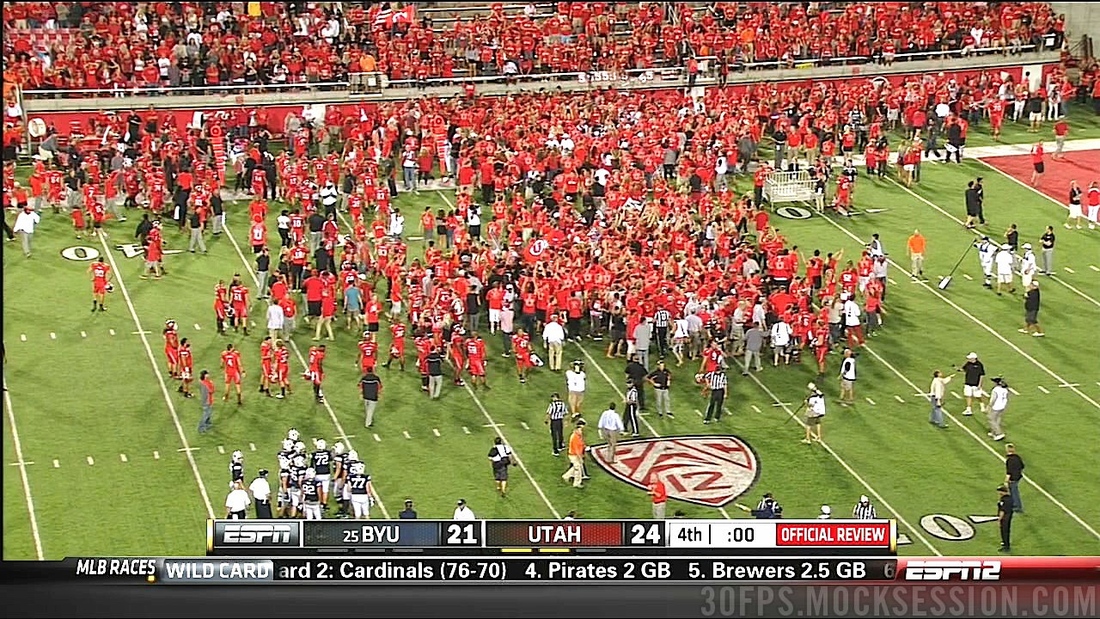
Now we get to the fun part. Nelson's 47-yard pass to Hoffman on 4th and 12 was nothing short of legendary. When that happened, I believed I was about to witness another BYU miracle. Maybe not quite like Johnny Hairline, but definitely another Andrew George. Anyway, Hoffman was tackled with 10 seconds left. Nelson spiked the ball, which somehow took two seconds to do. Whatever, eight seconds was enough. But then the clock started acting goofy. BYU was still in a huddle when it started up again, going down to four seconds before the ref stopped it and reset it. But once the Cougars got lined up, I think the clock again started a little early because Nelson snapped the ball with six seconds left. (It really took two seconds to snap the ball?) Nelson's pass was tipped at the line of scrimmage (for probably the fifth time that day) and it hit the ground with one second left. But the Ute fans didn't notice that and began storming the field.

Now I found this field-storming rather interesting. It seems like a lot of BYU fans think that Utah fans don't value the rivalry anymore. But I think all that mainly comes from Chris Hill and Kyle Whittingham. The average Ute fan wants to play BYU every year — it's only the high-up guys who care about strength of schedule and such nonsense. Of course, on paper, this was a big win for Utah — beating a (barely) ranked team without their starting quarterback or running back. But if the Utes beat someone like Washington State in similar circumstances, I don't think the fans would have stormed the field. They only did it because it was BYU and it really looked like BYU was going to win this one.

So anyway, Sorensen got up to kick a 51-yard field goal, which was blocked to little surprise to me. Why is it that BYU can't kick a long field goal without having it blocked? But once again, luck would come in BYU's favor. The field was stormed by the fans and the rest of the Utah team too soon and the refs had to clear the field for an unprecedented second time. (I believe I did hear my little brother Collin whine "Come on!" when that happened.) So BYU got one last field goal, from 15 yards closer, which Bronco felt for some reason that punter/interim kicker Riley Stephenson should take. If Sorensen would've hit the upright, I don't think I would have asked why Stephenson didn't kick it — his long is only 33 yards, and this was a 36-yarder. I did hear that Bronco said Stephenson is more accurate for shorter field goals, but I don't consider 36 yards a short kick.

But actually, a part of me is glad that kick didn't go in. Utah fans would have cried and complained for decades that that kick should never have happened, and they would have been slightly justified. True, there were a lot of people on the field, but none of them were near the action. It's not like Falslev had to push down a flag-waving lunatic to get into the end zone. As for me, I really don't care. BYU should have been able to win this game without resorting to last-second miracles.

And so now the season is over. Well, technically it's not. There's still a small chance the Cougars could win the rest of their games and beat Notre Dame in South Bend and sneak into a BCS game, but that's about as likely as Utah beating USC, winning their division and beating Stanford or Oregon in the conference championship game. And I don't think either one of those is going to happen. No, BYU will just finish with a fairly decent record and go to a mediocre bowl game, which it may or may not win, just like it has been the past eight years under Bronco Mendenhall.

So who's to blame for this collapse? First, I'll credit Utah's defense. They took BYU out of its rhythm, never letting the hurry-up or the running game get going. Nelson never had enough time to try to take a shot downfield, and receivers were rarely open when he did.

Second, I'll blame the offensive line. Yes, the Ute defense was good, but it shouldn't have had that big of an impact on BYU's offense. They got called for way too many false starts, some of which can be blamed on the MUSS; but the MUSS can't take credit for the sacks and all the passes knocked down at the line of scrimmage. BYU's big guys were just plain sloppy.

The third and final person who gets the most blame from me is Bronco Mendenhall. Simply put, he did not prepare the team well enough for this game. This game was riddled with too many fumbles (and near-fumbles), way too many dumb penalties, a lot of confusion on plays, some poor clock management and little too much conservatism. All those things go directly on his shoulders. He keeps saying "the Utah game is just another game" so much, that I think he's begun to push himself too far and is actually treating the Utah game as less than other games. To say that he doesn't care at all about beating Utah would definitely explain the last three years, where conservative play-calling led to a blocked field goal, a team that quit lost 54-10 at home, and a ranked team played too sloppy to take advantage of the short-handed Utes. Shooting yourself in the foot isn't as bad as giving up, but it's not much better. Ultimately, Bronco needs to stop pretending the rivalry doesn't matter and start treating it the way the fans and players view it, as the most important game of the year where legends are created and legacies are validated. Just ask Max Hall and John Beck. They never were considered great BYU quarterbacks until they beat Utah. Sadly, Riley Nelson will forever have the "Didn't beat Utah" line on his resume.

This season follows the same pattern Bronco has followed the past few years of starting off strong in Week 1, then looking woefully unprepared the next couple of games. This trend started in 2009 with an amazing win over Oklahoma quickly followed by a crushing defeat to Florida State. In both 2010 and 2011, he started 1-2. This year, BYU looked amazing against Washington State, but admittedly looked pretty rough against Weber State in the first quarter. Of course, Bronco will pull it together, get BYU at least eight wins and continue to perform well enough to keep his job, but not well enough to move BYU up to the next level. He just isn't that great of a coach.

And so that ends the BYU-Utah rivalry, at least for now. It really is something special that shouldn't be so easily set aside for the sake of risking a non-conference loss. Strangely, it seems like the two people who are most heavily involved in the rivalry, Kyle Whittingham and Bronco Mendenhall, don't care about it at all. If Coach Whit really cared, he'd make Chris Hill schedule game, Michigan or no Michigan. And if Bronco really cared he'd have his players completely prepared to play the game of their life when they go against the Utes. If we leave the fate of this rivalry on their shoulders, I fear it will die.