Showing posts with label BYU. Show all posts

Sunday, March 2, 2014

Jimmer is free!


It finally happened. After nearly three years of languishing away in possibly the worst team for him, The Jimmer has been freed at last. Although I do find it odd that the same franchise that was able to trade for Rudy Gay this season was unable to trade Jimmer. But a buyout works out fine here, and I actually am very excited to see if he'll get to play alongside Derrick Rose next year. Yeah, it's the Bulls, who should never be forgiven for their sins committed against the Jazz, but I actually kind of like this version with Tom Thibodeau and Rose when he's healthy. They play defense hard and always compete, and are generally a fun team to watch — even with Carlos Boozer.

I covered the BYU men's basketball team during the first half of Jimmer's junior year. He was a star on the team, but not the star. He was a very solid point guard, and we were happy to have him. But senior Jonathan Tavernari felt like he should be the star, and he certainly acted like it. I was astounded by his complete arrogance during interviews and games. He was such a tremendous ball hog, and not even that good of a shooter. In BYU's first loss that year, Tavernari went 1-for-11 from the field at Utah State. Finally Dave Rose benched Tavernari, which ignited a 15-game winning streak and really helped Jimmer take control of the team.

At that time, he was still known as Jimmer Fredette, and he was able to walk around in public in obscurity. I also worked at the BYU Creamery on Ninth East, and often served ice cream to the basketball players when they came in for practice. I was amazed, though, that none of my coworkers knew who Jimmer was. Of course, most of them were girls who had no interest in sports, but still. This was our starting point guard, and he was actually pretty good. As an ice cream scooper, I always tried to treat the customers professionally, i.e., like normal people — even the handful of apostles who visited while I was there. But with Jimmer, I had to let him know that I knew who he was and respected what he did. I didn't ask for an autograph or anything (I was covering the team for The Daily Universe then); I just empathized with him about losing to Utah State (which was the team's only loss that semester). Jimmer took my playful comments in good humor and was very nice and respectful. In fact, in my limited exposure with Jimmer, I never saw him act anyway but respectful.

Anyway, with Tavernari on the bench, Jimmer continued to improve and progress. He put together a couple of 20-point games and a 33-point game against Nevada. And then it happened. The semester ended and I was unable to continue covering the basketball team. So I kind of missed Jimmer's big game at Arizona over Christmas break. Jimmer hit nine 3-pointers, scored 49 points and added nine assists and seven rebounds for good measure. Suddenly he was a somebody among BYU fans. And I noticed that people at the Creamery began asking him for autographs. But I don't think anybody considered him a superstar at that point — just a good player who could occasionally get hot.

Well that season wrapped up with a loss to Kansas State in the second round of the NCAA Tournament. But us BYU fans were thrilled with that. BYU rarely makes it to the Tournament and hadn't even won a game there for a long, long time. On an interesting note, Kansas State guard Jacob Pullen single-handedly destroyed BYU with 34 points in that game, and I thought for sure he'd be in the NBA. But he never got drafted and has spent all his time overseas. Speaking of the Draft, there was some talk that Jimmer would try to go to the NBA after his junior season. I thought he'd be a second-rounder at best, and apparently so did he, as he pulled out from the Draft and rejoined BYU for his senior year. Now that we knew what he could do, expectations were very high.

It soon became commonplace for Jimmer to score 30 his senior year, and he became, without question, the most popular athlete on campus (it really helped that the football team was rather lackluster then). Jimmer stopped coming to the Creamery, and I began to hear stories about how it became difficult for him to go anywhere in Provo. Things really didn't start to get crazy until the Utah game. True, the Utes were in a down year, but beating the rivals on their home floor is still pretty fun. And scoring 47 points while you're doing it is even better. One of Jimmer's most memorable moments came right before halftime of that game, when he beat the buzzer to make a half court shot like it was nothing.

Jimmermania had officially begun. And it only grew exponentially with each game. Scoring anything less than 40 was an off night for The Jimmer. Here are some highlights: 42 at Colorado State, 43 the next game against No. 4 San Diego State, and a career-high 52 against New Mexico in the Mountain West Conference Tournament. That last one was particularly impressive for me because New Mexico had beaten BYU twice that season, and in that game Jimmer only shot one free throw. Everybody remembers his deep 3-pointers, but he made quite a living at the line, making 16 free throws in several games.

Unfortunately, I was unable to attend any of these games in person because I was working as a copy editor for The Daily Universe. But the benefit of that meant I was able to write a lot of fun Jimmer headlines and design amazing Jimmer packages. It was a cruel tradeoff, but I was always filled with a bit of pride to see the newspaper racks empty when Jimmer was on the cover. One of our great covers simply had Jimmer's head fill up the whole page with the words "We Love Jimmer!" below. We put a dotted line with a pair of scissors around his head, and to my surprise, a lot of fans actually did cut out Jimmer's head and use that to make their own signs. During this time, I was also serving an internship with the Deseret News, and got to work on the sports desk every Friday and Saturday night. That meant that I was working seven nights a week for a whole semester, and it nearly killed me, but the excitement of Jimmermania kept me going. I almost felt a little guilty sometimes for giving a good Jimmer headline to the Deseret News and not The Daily Universe, or vice versa, but it all worked out in the end. But it all worked out in the end. It was at the DesNews where I helped decided that Jimmermania should be one word. My biggest headline regret was shooting down "Fredette about it" at the Universe. But then ESPN used that same headline, so I was glad nobody could accuse us of copying.

Sadly, all the excitement and fun and high hopes of the greatest team in BYU history was crushed when leading rebounder Brandon Davies was suspended for an Honor Code violation. I can't blame Davies or BYU for the situation — everybody did what needed to be done — but the timing couldn't have been any worse. The Cougars did manage to reach the Sweet 16 for the first time since Danny Ainge, but they sadly fell to Florida in overtime. The loss of Davies really hurt me in this game, because it seemed like BYU could have won in regulation if they would have made one last defensive rebound. But Davies was able to rejoin BYU the next year, had a pretty decent career, and is currently on the bench of the tanking 76ers.

Well, Jimmermania ended sadly, but he did gain national recognition and won every major college basketball award there is. Unfortunately, there is no reward in college basketball that commands as much respect as the Heisman. The Wooden or the AP Player of the Year just don't sound as impressive. Anyway, building up to the NBA Draft was especially exciting since the Jazz had the 3rd and 12th picks, which were perfectly in Jimmer range. I got to cover Jimmer working out for the Jazz, which was pretty much a disastrous media circus nightmare for me. I guess the TV people got their way and insisted we interview Jimmer on the court. There were a million people there and we all had to shove and fight our way toward him, hoping that our recorders could catch his words. It was an unpleasant experience, and not one I'd like to repeat too soon. But Jimmer was very impressive during that chaotic interview. He stood tall, spoke loudly and clearly, and even joked a little bit. By contrast, Kemba Walker was also there for the workout, and he sat slunched over, seemed disinterested, and sounded (as one reporter put it) like a dog with peanut butter stuck on the roof of its mouth.

Well, the Draft soon approached, and I got the sense that Kevin O'Connor wanted nothing to do with Jimmer. But in a fun little piece for the Universe, I still optimistically predicted the Jazz would take him at No. 12. The first three picks went just like everybody thought they would, with Kyrie Irving going to the Cavs, Derrick Williams to the T-Wolves, and Enes Kanter to the Jazz. Things got shaken up a little bit after that, and then Jimmer was taken at No. 10 by the Milwaukee Bucks. But it was immediately announced that he was drafted for the Sacramento Kings. It took all night for the Kings, Bucks and Bobcats to finalize their complicated trade, but it ended up with the Kings surprisingly trading up in the Draft to grab Jimmer by paying the price of Bismack Biyombo and Beno Udrih. Meanwhile, Kevin O'Connor likely breathed a sigh of relief and happily drafted Alec Burks. It's not that Jimmer would have been a bad fit in Utah, but most likely the fans' adoration of him would have put a lot of pressure on the coach who didn't play him or the general manager who didn't draft him. But nobody expected O'Connor to waste the third pick on Jimmer, so he was able to avoid some criticism on that front.

The Kings, meanwhile, seemed to make a pretty stupid trade at the time. Udrih was coming off a career year and Biyombo had a ton of potential. Plus, Sacramento had to take on John Salmons' unfavorable contract. But at the end of the day, it all became a wash. Udrih only played with the Bucks for a season and a half before being traded to Orlando. He then signed with New York before getting cut and recently signed with the Grizzlies (Memphis was rumored to be interested in Jimmer, but they chose Udrih instead). Biyombo has not had a particularly stellar career in Charlotte, and Salmons actually didn't hurt Sacramento that much because he was included in the Rudy Gay trade. So, almost three years later, I can't call that trade for Jimmer bad or good. I will call it unnecessary, though. Sacramento already had a ton of shoot-first, pass-never guards on their roster, leaving little to no room for Jimmer.

I was devastated for Jimmer. Not only did Sacramento have a terrible roster, but the whole organization was/is a complete mess. Their owners were bankrupt and almost moved the team to Seattle. Luckily they found some new owners and a little bit of stability, but how stable are you really when Shaquille O'Neal is one of your owners? Jimmer's first coach, Paul Westphal, seemed to like him and played him big minutes in the preseason. But Westphal got into a fight with notorious head case DeMarcus Cousins, and was fired only seven games into the season. After all, decent to mediocre coaches are easy to find, but players as big and strong as Cousins are not. So even though he acts like a complete jerk and idiot at times, the Kings are hanging on to him tooth and nail. Unfortunately, all this meant bad news for Jimmer. The new coach, Keith Smart, just never played him for whatever reason. Yeah, he's not as athletic as the other guys, and his defense is pretty terrible, but is he that much worse than the other players on the Kings roster? Here are Jimmer's stats through his first three years:

Season   Games   MPG   FG%   3FG%   FT%  PPG
2011-12     61        18.6     .386      .361       .833     7.6
2012-13     69        14.0     .421      .417       .859     7.2
2013-14     41        11.3     .475      .493       .895     5.9

So his minutes per game have steadily declined while his shooting percentages have steadily risen. Jimmer actually leads the NBA in 3-point percentage right now. I do want to put a disclaimer on those stats, though. The improved shooting is most likely due to the decreased competition Jimmer regularly faces. He usually only plays in the garbage minutes, when the game is already decided and both teams have the scrubs in. Nobody in those minutes are particularly good, and they're usually not trying very hard, not wanting to get hurt or too sweaty in a 20-point contest. So the defenders Jimmer has been facing more recently have likely been rather lackluster. I don't mean to discount anything Jimmer's done, I think it is still very impressive, but I want to help encourage some critical analysis of statistics. Most people work under the assumption that every minute of every NBA game is identical and an accurate indicator of a player's abilities. But anybody who watches the NBA has to admit that certain games and parts of games don't matter as much and are not played at the same intensity as the highest level of NBA games are. This is why I hate the per-36-minute stat. It is a little better than the completely nonsensical per-48-minute stat, but it still artificially increases most bench players' production. Sometimes they're just not able to play with as much energy for a longer period of time, and sometimes they do worse when they play against starters instead of bench players.

Anyway, what I'm trying to say (if I'm saying anything at all) is that I love Jimmer and I think he's a great player who has never really had a chance to prove himself. He doesn't have a lot of games with Chicago this year, but they will make the playoffs, giving Jimmer some good experience at that level. Hopefully Derrick Rose will be back next year and Jimmer will be there with him and turn into a major contributor on a contender. I would have loved to see him on San Antonio or Oklahoma City, but Chicago has a lot of potential, as well. Hopefully Jimmer will be able to resurrect Jimmermania and not become the next Adam Morrison.

Sunday, September 16, 2012

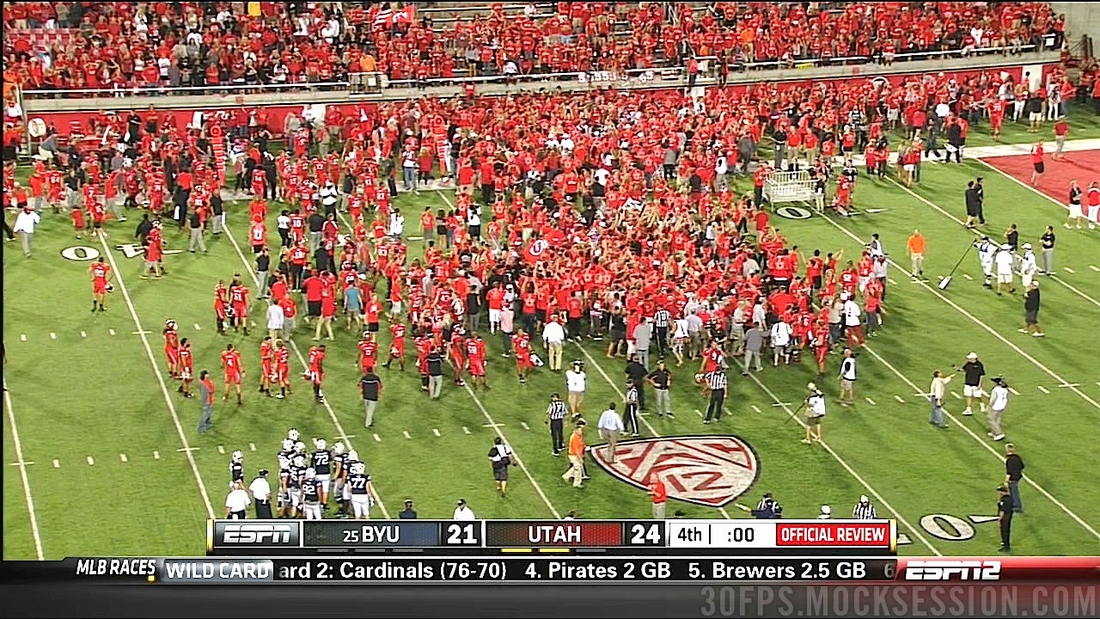
BYU vs. Utah 2012


And Chris Hill wants to end this?

Despite how ugly and messy it was, this truly was a classic BYU-Utah game for the ages. I've never seen a game end like that. It had plenty of drama and controversy to last three years (at least it's going to have to). For something this epic, I felt I needed to get everything out in blog form to find out where BYU went wrong and who is to blame.

Let's start with a quick recap of the game:

On BYU's first possession, a false start (one of eight) took away a 4th-down conversion, forcing the Cougars to punt, which they did rather poorly. Several Cougars slipped down or ran past Utah's Charles Henderson, who returned the punt 57 yards to set up an easy Jon Hays touchdown pass.

On Utah's next possession, they put together a rather impressive 14-play drive that included a fake punt and took seven and a half minutes off the clock. It ended with a 37-yard field goal attempt, which BYU blocked.

At the start of the second quarter, BYU put together a pretty impressive drive that included a 4th-down conversion, but it ended with Justin Sorensen missing a 44-yard field goal. He shouldn't be blamed too much, though, as he had to deal with a high snap and it was his first attempt of the season after coming back from a back injury. But the real loss on this drive was the injury of Houston Reynolds, one of BYU's best offensive lineman. After he went down, I noticed a marked increase in false starts and a drastic decrease of pocket time for Riley.

The Cougar defense was able to force the Utes to punt away quickly, which would be expected with them missing Jordan Wynn and John White IV, and JD Falslev had a nice 33-yard return, which was wasted after BYU fumbled the ball twice. The first was caused by miscommunication (something that haunted BYU all day): Nelson dropped back for a pass, but Mike Alisa was expecting a handoff and knocked the ball out of his hands. The second fumble was a result of the pocket collapsing and Nelson forgetting Dave Kruger was right behind him. The drive was shot, but BYU was able to pin the Utes inside their 1-yard line.

Again the strong BYU defense forced a quick Utah punt, and Sean Sellwood's shanked kick only went 23 yards, setting up a Riley Nelson touchdown pass to Cody Hoffman. Hoffman did push off the exact same way the Utes did against Utah State last week, but the refs didn't call it, so what're you going to do?

But the end of the second quarter was really frustrating for BYU. Pinned at their own 8-yard line with a minute left, the Cougars shot themselves in the foot with back-to-back false starts. Facing a 3rd and 16 from the 2, Bronco had to call not one, but two timeouts before Nelson could throw the ball away to narrowly avoid a safety. This was just one more example of how sloppiness killed the Cougars.

The third quarter is where things really began to fall apart for BYU. Utah was able to put a lot of pressure on Nelson by rushing just three guys, but when they rushed four — look out! Nelson had a near-fumble that was later ruled an incomplete pass, then Alisa also came close to fumbling soon after. Now, some fans will blame Riley Nelson for this loss, but I think he played really hard and made some great plays. I also take into consideration the rumor I heard that he was a game-time decision with back spasms. That said, however, I do blame Nelson entirely for the interception he threw. Facing a 3rd and 3 at midfield, Nelson threw the ball ... right to Utah's Ryan Lacy. This gave Utah a short enough field to get a 48-yard field goal.

BYU's next possession was a complete disaster. But it wasn't just the one play. Nearly everything went wrong before it. A bad snap caused Nelson to have another near-fumble incomplete pass. Then he actually fumbled it later on an option play. BYU did recover it, but Bronco felt they were rattled enough to used his first timeout on a 2nd and 4 with 4:38 left in the third quarter. Turned out BYU really could have used that timeout later in the game. The timeout really didn't settle down the Cougars, who were later called for another false start and then had a major communication breakdown right after that. Nelson was in the shotgun, looking to his left, probably speaking with someone on the sideline, when his trusty center randomly decided to snap the ball. Nelson barely saw it coming and let it slip through his hands. Alisa got to the ball, but instead of smothering it, he tried to scoop it up, only to push it further toward the end zone. Finally Mo Lee picked it up and there wasn't a Cougar in sight to catch him. That was the play of the day that completely changed the game. Before that, BYU was playing sloppily, but they were still in it. But after it, they kind of gave up a little bit. My proof is what happened immediately after.

BYU's drive started off with an unsportsmanlike conduct penalty and false start penalties number 7 and 8. Henderson dropped the punt, but there were no Cougars around to make him pay for it or prevent him from returning it 18 yards, putting the Utes in good field position, who only needed one play for Jon Hays to complete a 39-yard touchdown pass. Even a pass interference couldn't stop Utah from scoring. This felt like 2011's 54-10 all over again.

But something interesting happened in the fourth quarter. Unlike the 2011 team, BYU did not give up. Riley Nelson never was, nor ever will be as talented as Jake Heaps, but he never gives up, which I think resonated through the whole team. A part of me believes a Heaps-led team would collapse after such a rough third quarter.

To BYU's luck, a couple of Utah personal fouls set the Cougars up with good field position and a couple of freshmen, Taysom Hill and Jamaal Williams, successfully ran an option play to score a touchdown. The defense then did its job, by forcing a 3-and-out with 11:30 left. But the offense didn't take advantage of this. With about eight and a half minutes left, BYU faced a 3rd and 9 from Utah's 35. Nelson dropped back to pass and Utah rushed two players, which was way too many for BYU's offensive line. Nelson was quickly sacked and the conservative Cougars punted it away.

But BYU lucked out again. Not only was the defense able to hold Utah, but they tackled Sellwood, who was worried about having his punt blocked. Riley Nelson then threw a touchdown pass to make it a 3-point game with 3:39 left.

Now BYU's defense really did have a good game. The only points they gave up came after a freak special teams play or an offensive turnover. But ultimately, the defense didn't give BYU enough to win. It didn't force a single turnover, which would have helped a lot, and it didn't get a stop when it most needed. On Utah's first play of its final drive, Hays found Reggie Dunn on a short screen pass, who somehow evaded five Cougars on his way toward a 29-yard gain. Yes, I counted five Cougars who could have tackled him, but didn't. The Utes eventually did have to punt, but by the time Nelson got the ball back, there was only 1:11 on the clock and he was at his 8-yard line. Preventing the Dunn play would have given BYU more time and better field position at the end of the game.

Now we get to the fun part. Nelson's 47-yard pass to Hoffman on 4th and 12 was nothing short of legendary. When that happened, I believed I was about to witness another BYU miracle. Maybe not quite like Johnny Hairline, but definitely another Andrew George. Anyway, Hoffman was tackled with 10 seconds left. Nelson spiked the ball, which somehow took two seconds to do. Whatever, eight seconds was enough. But then the clock started acting goofy. BYU was still in a huddle when it started up again, going down to four seconds before the ref stopped it and reset it. But once the Cougars got lined up, I think the clock again started a little early because Nelson snapped the ball with six seconds left. (It really took two seconds to snap the ball?) Nelson's pass was tipped at the line of scrimmage (for probably the fifth time that day) and it hit the ground with one second left. But the Ute fans didn't notice that and began storming the field.

Now I found this field-storming rather interesting. It seems like a lot of BYU fans think that Utah fans don't value the rivalry anymore. But I think all that mainly comes from Chris Hill and Kyle Whittingham. The average Ute fan wants to play BYU every year — it's only the high-up guys who care about strength of schedule and such nonsense. Of course, on paper, this was a big win for Utah — beating a (barely) ranked team without their starting quarterback or running back. But if the Utes beat someone like Washington State in similar circumstances, I don't think the fans would have stormed the field. They only did it because it was BYU and it really looked like BYU was going to win this one.

So anyway, Sorensen got up to kick a 51-yard field goal, which was blocked to little surprise to me. Why is it that BYU can't kick a long field goal without having it blocked? But once again, luck would come in BYU's favor. The field was stormed by the fans and the rest of the Utah team too soon and the refs had to clear the field for an unprecedented second time. (I believe I did hear my little brother Collin whine "Come on!" when that happened.) So BYU got one last field goal, from 15 yards closer, which Bronco felt for some reason that punter/interim kicker Riley Stephenson should take. If Sorensen would've hit the upright, I don't think I would have asked why Stephenson didn't kick it — his long is only 33 yards, and this was a 36-yarder. I did hear that Bronco said Stephenson is more accurate for shorter field goals, but I don't consider 36 yards a short kick.

But actually, a part of me is glad that kick didn't go in. Utah fans would have cried and complained for decades that that kick should never have happened, and they would have been slightly justified. True, there were a lot of people on the field, but none of them were near the action. It's not like Falslev had to push down a flag-waving lunatic to get into the end zone. As for me, I really don't care. BYU should have been able to win this game without resorting to last-second miracles.

And so now the season is over. Well, technically it's not. There's still a small chance the Cougars could win the rest of their games and beat Notre Dame in South Bend and sneak into a BCS game, but that's about as likely as Utah beating USC, winning their division and beating Stanford or Oregon in the conference championship game. And I don't think either one of those is going to happen. No, BYU will just finish with a fairly decent record and go to a mediocre bowl game, which it may or may not win, just like it has been the past eight years under Bronco Mendenhall.

So who's to blame for this collapse? First, I'll credit Utah's defense. They took BYU out of its rhythm, never letting the hurry-up or the running game get going. Nelson never had enough time to try to take a shot downfield, and receivers were rarely open when he did.

Second, I'll blame the offensive line. Yes, the Ute defense was good, but it shouldn't have had that big of an impact on BYU's offense. They got called for way too many false starts, some of which can be blamed on the MUSS; but the MUSS can't take credit for the sacks and all the passes knocked down at the line of scrimmage. BYU's big guys were just plain sloppy.

The third and final person who gets the most blame from me is Bronco Mendenhall. Simply put, he did not prepare the team well enough for this game. This game was riddled with too many fumbles (and near-fumbles), way too many dumb penalties, a lot of confusion on plays, some poor clock management and little too much conservatism. All those things go directly on his shoulders. He keeps saying "the Utah game is just another game" so much, that I think he's begun to push himself too far and is actually treating the Utah game as less than other games. To say that he doesn't care at all about beating Utah would definitely explain the last three years, where conservative play-calling led to a blocked field goal, a team that quit lost 54-10 at home, and a ranked team played too sloppy to take advantage of the short-handed Utes. Shooting yourself in the foot isn't as bad as giving up, but it's not much better. Ultimately, Bronco needs to stop pretending the rivalry doesn't matter and start treating it the way the fans and players view it, as the most important game of the year where legends are created and legacies are validated. Just ask Max Hall and John Beck. They never were considered great BYU quarterbacks until they beat Utah. Sadly, Riley Nelson will forever have the "Didn't beat Utah" line on his resume.

This season follows the same pattern Bronco has followed the past few years of starting off strong in Week 1, then looking woefully unprepared the next couple of games. This trend started in 2009 with an amazing win over Oklahoma quickly followed by a crushing defeat to Florida State. In both 2010 and 2011, he started 1-2. This year, BYU looked amazing against Washington State, but admittedly looked pretty rough against Weber State in the first quarter. Of course, Bronco will pull it together, get BYU at least eight wins and continue to perform well enough to keep his job, but not well enough to move BYU up to the next level. He just isn't that great of a coach.

And so that ends the BYU-Utah rivalry, at least for now. It really is something special that shouldn't be so easily set aside for the sake of risking a non-conference loss. Strangely, it seems like the two people who are most heavily involved in the rivalry, Kyle Whittingham and Bronco Mendenhall, don't care about it at all. If Coach Whit really cared, he'd make Chris Hill schedule game, Michigan or no Michigan. And if Bronco really cared he'd have his players completely prepared to play the game of their life when they go against the Utes. If we leave the fate of this rivalry on their shoulders, I fear it will die.

Tuesday, January 17, 2012

The End of the Universe

I normally reserve this blog for light, fun posts about sports and superheroes (hence the name), but this is something I need to get off my chest. I've been wanting to write about the virtual destruction of The Daily Universe ever since I heard about it, but I needed some time to cool down and try to remove myself from the situation. When that didn't work, I decided to write this post anyway.

For those who may not know, The Daily Universe, the BYU newspaper that I worked at for pretty much my whole college career, is moving from a daily to a weekly. To make matters worse, they also decided to fire the full-time Daily Universe staff, many of which were good friends of mine.

I'm not at BYU anymore, so I don't know all the details of this, but I have been reading quite a bit about it and everything just makes me more mad and depressed. The most infuriating part in all this is the conflicting and near-hypocritical messages coming from the BYU faculty. For years, BYU proudly boasted of the award-winning Daily Universe and used it as a hallmark to show how strong its journalism program was. Now, it's suddenly become "an expensive heirloom."

The topic of finances is also a tricky and confusing one. The faculty continues to vehemently argue that this move was mostly for the students and the ever-changing curriculum, yet they can't stop themselves from talking about how much money the DU has been losing. But the DU is a lab, right? So why is money so important? I spent so much time at BYU learning how essential journalism is to society, and now that same school is telling me it's not financially sustainable. Why can't the faculty take a courageous stand and keep the paper going for journalism's sake?

They didn't have to take such a drastic action. They could have simply started printing 10,000 less copies each day, or cut one or two staff positions instead of all of them. Or they could have asked BYU for funding. I might be completely wrong about this, but I always thought the DU was supported by ad revenue. If it wasn't receiving any money from BYU, then it should have been an independent voice. But it wasn't. It was always concerned with offending or potentially putting BYU in a negative light. So since it has already been little more than a PR publication of BYU, then it should receive BYU funding to continue to allow students to work on a daily newspaper.

But BYU has never really liked The Daily Universe, and I don't think I need to start rehashing all the reasons why. Suffice it to say, I never really felt like the DU was an environment where reporters could freely report on what they wanted. I also felt like I could never really complain about any editorial decisions because a) I didn't know who to complain to, b) I felt like nothing would change regardless of my opinion, and c) I was legitimately worried about losing my job if I made the wrong remark at the wrong time to the wrong person. When you think about it, that is not a very healthy workplace environment.

I now find it ironic how some of the faculty are upset with being criticized by their students. They were the ones who taught the students to think critically and skeptically, so they shouldn't be surprised when this thought process is applied toward them. For being the communications department, they sure don't know how to communicate very well. I never really understood where they were coming from, and I never felt like they understood where we as students were coming from. All too often, some faculty member who I had never seen do anything with the DU would come in and make some arbitrary decision without realizing how things really worked in the newsroom, especially at night when everyone but the copy desk is gone. Usually these decisions were stupid, but harmless, like insisting the TV should always show the DU website to somehow inspire the reporters to write better stories somehow. But sometimes they would be pretty annoying.

One thing I complained about quite a bit was the Wordpress thing. The theory behind it was to get stories online immediately, which is a nice idea. Except it didn't happen. Stories still weren't published until 4 or 5 p.m. and my job as a copy editor only became more difficult. More often, I would come into work and have nothing to do because I had to wait for someone to pull the stories from Wordpress to give to me. Then we would make edits on the story and had to go back and replace the story that was already online or just leave the unedited version. And don't even get me started with all the technical difficulties it went through. The system didn't work because it was forced on the newsroom by people outside the newsroom. At least that's how I perceived it.

The Daily Universe had plenty of problems. One of them was the very nature of the paper being a lab. More than half the reporters each semester didn't care and it showed. No amount of editing can cover up a reporter who is only there for the class credit. Another thing that always bugged me was how the front page wasn't decided until 3:30 p.m. that day. We almost never had any advance notice to plan anything neat or design interesting graphics. Yet despite all that The Daily Universe was still a great paper that continually won award after award. And despite all the complaints and frustrations I had with the DU, I stuck with it because I enjoyed it. So to try to get rid of the negativity, I'll end this rambling post with some fond memories.

The first time I made the front page was with a story about fantasy sports, which inspired someone to write a letter to the editor to complain about trivial stories being on the front. This only made me happy, because it showed that people were paying attention.

I loved covering the basketball team (Jackson Emery was one of my favorites to interview) and sitting next to women's coach Jeff Judkins during the games. I still remember the nervous thrill of covering my first Jazz game.

I laughed when an extremely sad and confused fan called the DU to ask us why Max Hall said he hated Utah. I was sad when cross country stories I wrote didn't make it in the paper and their coach would call and complain.

One of my most thrilling moments in the newsroom was when Alex Hairston jumped up and shouted, "Riley Nelson's out for the season!" Right behind that was Alex's exclusive interview with O'Neill Chambers. The most devastating moments for me in the newsroom were the retirement of Jerry Sloan and Brandon Davies' honor code violation.

I loved calling Chelsea's headlines dumb and just messing around with everyone — even when they called me Dylan. I will miss talking NBA with Rich and finding out how big of jerk Hubie Brown is.

Some of my best work came from working long nights (without being paid) and churning out some great sports stuff with Brandon. Jimmermania, the NBA Draft, the "Rivery" Guide, and more were some really nice things that people really did read. Whenever Jimmer was on front, paper stands would empty by noon. Only Harry Potter and Osama Bin Laden inspired that kind of readership.

My all time greatest memory with the DU will definitely be my trip to Mississippi with Professor Carter and Luke Hansen. It was a once-in-a-liftetime opportunity and it deeply saddens me when I think that future students may not have that same opportunity.

So goodbye DU. Stop talking about exciting new opportunities and giving the readers the news the way they want it. Students don't want to take the time to log on to universe.byu.edu. Stop saying this will allow you to have more "long form journalism" — that doesn't even mean anything. This is a bad move, so don't try to make it sound good for all our sakes.

Of course, the answer to this dilemma was right in front of us all along. If the DU increased its sports coverage and wrote more entertaining stuff, maybe it could have got better ads and stayed alive. More in-depth coverage of the basketball and football teams would have been better than stories about folk dance in Poland and Hungary. Maybe sports could have saved The Daily Universe.

Wednesday, December 7, 2011

Has independence been worth it?


Since this is my last week at The Daily Universe, I asked them if I could write a viewpoint. I had a hard time keeping it to around 900 words, but it was a lot of fun to write.

The 2011 BYU football season will be one to be remembered. Although it won’t always remembered for the best things.

So many things happened this season, it’s hard to know where to begin to sum it up.

For me, I will avoid Jake Heaps and all of the other exciting stories from this year, and instead will go back to the beginning and talk about independence.

When Utah announced it would go to the Pac-12, BYU fans didn’t have too long to feel left out, because BYU became an independent school soon after. This led to all of us Cougar fans immediately talking ourselves into independence.

We would be free from the Mountain West and its low-quality opponents and even lower-quality TV stations. We would have the freedom to schedule games against better teams and in more lucrative destinations. We would be in a better position to play in a BCS game.

Or so we thought.

The season started with a one-point win at Ole Miss and a one-point loss at Texas. We were pretty optimistic at that point, and had been praising independence for allowing us to travel to such high-profile places.

And then we played our first home game of the season against our rivals — the Utes.

The game started with fireworks, a 100-yard American flag and the marching band playing the theme from Independence Day. And then they kicked the ball off.

Ugh …

Independence slowly started to lose its luster. Especially when rumors started to swirl about BYU joining the Big 12. We started to dream about being in a power conference, but those dreams were quickly squashed, and we had to start talking ourselves back into independence.

But by that point, things were fine. Riley Nelson had saved the season and things were fun and entertaining. Until we started to get tired with late-start games in cold months against mediocre-at-best opponents.

I know of at least one fan who has owned eight expensive season tickets for many years and decided after the New Mexico State game (which started at 8:15) that he’d had enough. He lives north of Salt Lake City, and with the terrible traffic, getting home at a reasonable time to wake up early for church is just too difficult.

Not all Cougar fans had experiences that bad, but many began dreaming about the joys of conference play when the Big East came calling.

Meanwhile, the Utes were having an exciting finish to their first Pac-12 season. Although they started off with four big conference losses, through a strange series of events, they found themselves still in contention for a spot in the Pac-12 championship game. Ute fans excitedly stayed up late at night to watch Cal and Arizona State play, while BYU had no such connections to any other teams.

Unfortunately (or fortunately) the Big East deal fell through just in time for us to go back to praising independence for allowing us to travel to Hawaii.

So now the season is over, and it’s time to ask ourselves if being independent has been worth it so far.

One of the main reasons BYU went independent was to increase exposure, and I think BYU has done a good job of this, but it may be a bit overvalued.

Yes, having more games on ESPN and BYUtv has been nice, but having late kickoffs and thousands of empty seats in LaVell Edwards Stadium has not been. How many people around the country actually tuned in to ESPNU at 8:15 p.m. to watch BYU play New Mexico State?

Hopefully BYU will soon be able to stop justifying everything with the near-meaningless buzzword “exposure” and will begin to talk about playing and beating the best teams in the nation.

From a competition standpoint, I don’t think anything has changed from last year. Had we stayed in the MWC, we still would have played TCU, and we would have played Boise State, but maybe not Texas. Some of our “weaker” opponents this year from the WAC really aren’t any worse than some MWC teams, either.

But here’s one problem with independence: Last year, in the MWC, BYU would have needed to go undefeated to make it to a BCS game. This year, BYU would have had to go undefeated to make it to a BCS game. So far, independence isn’t helping on that front … yet.

In the upcoming seasons, BYU will be playing Notre Dame, Boise State, Georgia Tech, Houston and several other big teams. With the Cougars playing these tough teams, they might be able to sneak into the BCS with a one-loss season.

But under independence, most of BYU’s big games will come early in the season because big teams want to save November for their conference rivals. What concerns me about this is Bronco Mendenhall’s track record.

In five of his seven seasons, BYU has started with a record of 1-2. If the Cougars seriously want to go to a BCS game, they need to put an end to these slow starts. Now.

My verdict? Independence is not the long-term solution. Eventually fans will get tired of 10-win seasons and meaningless bowl victories. Eventually we’ll get sick of coming close but being snubbed by the BCS like Boise State. Until we can join a BCS conference, we’ll have to stay independent and keep telling ourselves it’s the best option.

Independence isn’t pretty, but it’s all we’ve got.

Monday, October 10, 2011

Heaps is better, but Nelson should start


After covering the San Jose State game on Saturday, I decided to write a viewpoint about the recently re-opened quarterback controversy at BYU. We didn't have room to put it in the paper yesterday, but it might go in today.

Even though we’re now halfway through the season, the BYU football team is still struggling with a basic question that was supposedly answered last year: who should be the starting quarterback?

During Saturday’s 29-16 win over San Jose State, BYU decided to use Riley Nelson as the main quarterback. In the team’s best interest, I believe BYU should continue to use Nelson instead of Jake Heaps, even though Heaps has more talent and potential.

Heaps was originally named the starter last year, but did he really earn it? Before Nelson went down with a season-ending shoulder injury, BYU had no idea who should be the team’s quarterback.

Heaps won the job by default, which probably caused him to relax a little bit. You hear BYU players and coaches constantly praising Nelson for his work ethic and leadership, but not so much for Heaps.

Heaps still is one of the most talented quarterbacks in the nation and still has tremendous potential. If he was living up to that potential, then we wouldn’t be having this discussion right now.

But Heaps has gotten off to a rather lackluster start. Through four games, he threw only three touchdown passes and five interceptions. BYU went 2-2 through that stretch, but those two victories really belong to the defense and special teams.

Then came the Utah State game.

Heaps started off well enough, benefitting mostly from a couple of pass interference calls, but then things turned sour in a hurry. BYU had to call a quick timeout on first down and then got called for a false start right after the timeout. Who is more at blame for this, Heaps or offensive coordinator Brandon Doman?

Whoever’s fault it was, the problem was evident: BYU’s offense was not on the same page.

Soon, Heaps was overthrowing and underthrowing his receivers, who often didn’t seem to know the pass was coming their way. Mistakes like this had plagued BYU all season, but for them to be so prevalent in Game 5? How long should it take for a quarterback to develop?

Finally Doman decided to make a change. In comes Nelson and the rest is history. It wasn’t always pretty, but he did lead BYU to the win. Most impressive was the game-winning drive, on which Nelson accounted for all 96 yards, either through the air or on the ground.

On Saturday against San Jose State, Nelson not only got the start, but also got to play the whole game for the first time in his BYU career. By halftime, he matched Heaps’ touchdown pass total with three. Nelson also led BYU to a season high 29 points and the largest margin of victory this year at 13 points.

But is a 29-16 victory over San Jose State really that impressive?

The Spartans finished 1-12 last year, and have only beaten lowly New Mexico State and Colorado State this year. Plus, they didn’t have their top running back, Brandon Rutley, on Saturday night. He’s not just their top rusher, but their heart and soul, averaging more than 100 yards per game and scoring six touchdowns in five games. These guys aren’t quite the same as Texas or Utah.

BYU should have been able to win this game with LaVell Edwards starting at quarterback.

But Nelson was the quarterback and he did play well. He got a little help when an unforced safety made up for his fumble on the 3-yard line. He then took advantage of the good field position by finding tight end Richard Wilson for a touchdown.

But Nelson did commit a few mistakes that Heaps wouldn’t have made, especially one play where Nelson scrambled and backpedaled to about 15 yards behind the line of scrimmage and had to quickly throw the ball away to avoid a major sack. Problem was, he didn’t throw the ball away, but instead simply heaved it toward the middle of the field and was lucky no one intercepted it.

In the end, Nelson threw two interceptions and had two other passes that should have been intercepted. He also lost a fumble to bring his total to three turnovers to go with his three touchdowns.

Despite all that, Nelson really was better than Heaps has been this year. He did a lot of good things that Heaps doesn’t do, like running for first downs when receivers were covered and the pocket collapsed. Nelson also has a knack for finding wide-open receivers; whereas Heaps’ completions are usually thread-the-needle passes to double-teamed players.

And most importantly, Nelson was able to energize the crowd and his teammates and get the win. People just seem to respond better to Nelson than Heaps.

BYU made the right choice by starting Nelson and playing him the whole game. And the right choice for the team will be to continue with Nelson as the quarterback for this year and maybe even next.

But won’t this hurt Heaps’ development? Maybe. But how does continual poor play that draws ire from teammates and fans help a quarterback develop? Maybe Heaps’ best option is to watch from the bench and work harder in practice to try to beat Nelson.

BYU has the potential to be a really special team in a couple of years with Heaps as the quarterback. He still is young enough to become the next Ty Detmer or Steve Young. But until he develops into that, fans want to see wins.

Not all of us fans are so callous as to demand a win every game, but we do want to see effort and progress, especially after paying good money to watch the team.

Right now, for whatever reason, it looks like Nelson is putting forth more effort than Heaps. And until that changes, he should remain the starting quarterback.

Monday, September 26, 2011

Gary Sheide: BYU's forgotten quarterback

So I found out at the last minute that I'd be covering the BYU-UCF game and had to scramble for a story idea (we had two other reporters already writing about the game). While in the press box, they announced Gary Sheide would be available for interview at halftime, so I jumped on it. I really liked writing this story, but what keeps it from being a great story is the lack of art (for some reason neither of our two photographers chose to take a picture of him) and a lack of quotes (we could hardly hear each other with the marching band playing so close).

Pop quiz: Who was LaVell Edwards’ first award-winning quarterback?

It’s not Gifford Nielsen, Marc Wilson or Jim McMahon.

It’s also not Virgil Carter — he played at BYU years before Edwards became head coach.

No, the correct answer is Gary Sheide.

Haven’t heard of him? You’re not alone.

Somehow, Sheide has remained largely forgotten by history, despite being Edwards’ guinea pig for a pass-oriented offense and starting a trend that earned BYU the nickname of “Quarterback U.”

On Saturday, Sheide was inducted into the BYU Athletic Hall of Fame, nearly four decades after his playing days at BYU were done. Four other Cougar greats were also inducted, including former men’s volleyball coach Carl McGown, track and cross country star Courtney Pugmire Meldrum, golfer Andy Miller and women’s volleyball player Mariliisa Salmi.

In Edwards’ second season as BYU’s coach, he needed to replace the nation’s leading rusher, Pete Van Valkenburg, who ran for 1,386 yards and led the Cougars to a 7-4 record in 1972. Instead of replacing Van Valkenburg with a dominant running back, Edwards decided to build his offense around the quarterback and a drop-back passing game — something unheard of in college football at the time. His candidate for this experiment: Sheide, a quarterback from Diablo Junior College.

In 1973, Sheide completed 60 percent of his passes while throwing for 2,350 yards, 22 touchdowns and 12 interceptions. He was second in the nation in completions per game (17.7) and third in total offense (234.3 yards per game). However, BYU finished with a 5-6 record — the only losing season in Edwards’ 29-year career.

In 1974, Sheide had 2,174 yards, 23 touchdowns and 19 interceptions. More importantly, he led the Cougars to a 7-4-1 record, which was enough to win the WAC championship and give BYU its first bowl game appearance — the Fiesta Bowl, where BYU lost to Oklahoma State, 16-6.

Sheide was named the WAC MVP, was an All-American honorable mention, finished eighth in the Heisman voting and became the first of seven Cougars to win the Sammy Baugh Trophy, awarded to the nation’s best passer.

In 1975, the Cincinnati Bengals drafted Sheide in the third round with the 64th overall pick. However, a shoulder injury prevented him from ever playing a game in the NFL. Instead, he became a businessman, gym teacher, high school football assistant coach and color analyst for BYUtv, all while fading into history and becoming BYU’s forgotten quarterback.

Last year, BYU held a large quarterback reunion with Carter, Nielsen, Wilson, McMahon, Steve Young, Robbie Bosco, Ty Detmer and Steve Sarkisian. Sheide was invited, not as an honored guest, but as a paying customer. Deseret News columnist Lee Benson wrote about the snub, which Sheide believes may have been influential to him being inducted into the BYU Hall of Fame this weekend.

But why did it take nearly 40 years for Sheide to receive this honor?

Perhaps his resume was just not impressive enough. He ranks 13th on BYU’s career passing yards list (4,524), but he’s only 1,353 yards ahead of current Cougar quarterback, sophomore Jake Heaps. He has the second-most touchdown passes in a game (6), but so does six other former Cougar quarterbacks.

Maybe Sheide just got lost in the shuffle of all the other great BYU quarterbacks. He didn’t put up mind-boggling stats like Detmer, he didn’t have a Hall of Fame career in the NFL like Young and he didn’t win a bowl game with a last-second miracle like McMahon. He wasn’t a first-team All-American and he only won 12 games in two years.

Statistically, Sheide was good, but not great, which may have hurt his legacy over the past four decades. Measurable statistics and awards stand out better over time than intangible qualities like being a pioneer of a storied offense.

Over the years, there have been a few stories about Sheide being the forgotten quarterback at BYU and how he deserves to be included in every great quarterback list. But as soon as it was announced he would be inducted into the BYU Hall of Fame, the interest and attention seemed to fade.

At halftime during BYU’s 24-17 win over UCF on Friday, the media were allowed to interview Sheide, but only two reporters went down to the field to talk to him. Perhaps he was more interesting as BYU’s greatest snub and forgotten hero, and now that he is being remembered and properly honored, there’s nothing more to say.

Sheide himself didn’t have much to say — maybe because the marching band began playing its halftime show nearby, or maybe because he simply likes to deflect the attention off himself.

He showed no signs of bitterness or resentment for being forgotten for 37 years, and repeatedly emphasized his gratitude for the award and the distinction of being labeled as the first great quarterback of the LaVell Edwards era.

“It’s a real honor,” Sheide said. “This is a special treat for me.”

He also enjoyed reminiscing about big wins over Utah and then WAC-powerhouse Arizona State during his career.

“We had a great team those years with a lot of great players,” he said. “We made some memories that’ll last forever.”

So now, after remaining in obscurity for so long, Cougar fans younger than 50 may now begin to understand the impact Sheide had on BYU. Without him succeeding in Edwards’ then-revolutionary approach, greats like McMahon, Young and Detmer might never have come through BYU.

No longer the unsung hero or BYU’s biggest snub, Sheide is now properly put in the category of gone, but not forgotten. Better late than never.

Tuesday, September 6, 2011

There and Back Again: A Reporter's Tale


This is an awesome picture our photographer, Luke Hansen, got of Kyle Van Noy forcing the game-winning fumble. It was a great play to end a great game and even greater trip. I've already posted my three stories I wrote for The Daily Universe — this is a more detailed account of my trip as a whole.

So the genesis of this trip began a month ago. I was staying late, helping put together some Education Week stuff, when I got a call from Professor Carter, asking me if I'd be interested in going to the Ole Miss game. Later I found out I was chosen to go because the sports editor here has never really shown much passion for writing stories, and since I couldn't be the sports editor, this was kind of my consolation prize. And I'll admit, it was a pretty darn nice consolation prize, especially since this is the only away game we get to send anybody to.

The actual trip began early Friday morning. Professor Carter picked me up at 4:45 a.m. to catch our 7:05 flight to Atlanta. Along with me and Prof. Carter was his 14-year-old son, Joshua, and our photographer, Luke Hansen. They were good travel buddies.

The flight to Atlanta was smooth and quick. I got to watch some Sports Center and SpongeBob on the way. From the plane, I was amazed at how many trees there were in the South. Now I know why so many non-Utahns complain that Utah doesn't have any trees.

Atlanta was a nice airport, and I got to eat at Popeye's for the first time. It was like a casual KFC staffed with friendly, sassy black women — just like in the commercials. After that, we caught an 18-minute flight to Birmingham, Alabama.

At Birmingham, we rented a car, which was fancy hybrid. It was key-less, and we had a hard time figuring out how to start the car, so we found a worker, a black guy with shoulder-length dreadlocks. He came out and said, "Oh, that's a hai-bred" in a really sweet Southern accent. Apparently we were starting the car, it just didn't make any noise.

The drive through Alabama was nice. In Utah, if you go driving anywhere for more than an hour, you quickly run into a whole lot of nothing. But not there. Everywhere we went was decorated with large, beautiful trees and rolling, green hills. We did go past some areas that were hit with a tornado a year ago, and they were still pretty beat up.

When we crossed over into Mississippi, we began playing Elvis songs to prepare ourselves for our stay in the town of his birth, Tupelo. Strangely enough, the songs seemed to have more impact out there. I think I appreciate the King a little bit more now.

Our hotel was small, but nice. Right next door to it was an authentic Southern diner called Huddle House, where we quickly ate before heading to the fireside. I had a very messy and very tasty hamburger and the waitress was a bit surprised when none of us ordered an ice tea. In the parking lot, an old guy got a little perturbed with our New York license plate (I'm not sure why it was New York). When we told him we're not from New York, he said, "Alright, that's OK. We don't mind Yankees coming through here, but we don't want 'em to stay."

We got to the fireside a little late, but we were lucky to find a parking spot. The entire building was jam-packed. I've never seen so many people crammed into a stake center. The fireside itself was actually really good and uplifting.

When it ended, they asked everybody to help put the chairs away, so they could mingle with the football players. It was nothing less than a miracle how quickly that happened. We're Mormons, and we can move a lot of chairs in a hurry when we need to! After the mingling, I quickly interviewed Bryan Kariya before he had to board the bus, and a little girl asked me for my autograph. I declined, but I can see why she thought I was a football player. :)

After that, we went back to the hotel and I began writing my story. I wanted to use a lead about Elvis, but was worried it might be cheesy. I tested it out with my travel buddies, and they liked it, so I went for it. The next day, a communications professor I don't normally associate with, sent me an email out of the blue, telling me I had a nice lead. So I guess that means it wasn't too cheesy.

The next morning, we woke up early, had a nice breakfast in the hotel, and went to the Elvis Presley Birthplace Museum. We didn't pay the $12 to go inside the museum, so we just took the free walking tour. I will be writing a full story on this later for The Daily Universe, so I'll just say that it was a relaxing and interesting way to start the day. It's fun to remember that all larger-than-life celebrities were once just ordinary people.

Driving to Oxford, we listened to the local sports radio. They picked BYU to lose, saying maybe Ty Detmer's team could have won in Ole Miss, but this one won't. At the end of his segment, he said, "Now remember, whatever happens to your team today, make sure you get up and go to church on Sunday."

We first went to Oxford, which is beautiful little town that reminded me a lot of my mission. In the town center is a large, classical courthouse with columns and everything. Around the courthouse are a lot of small shops with banners saying, "Go Rebels!" "Are you ready?!?" and "Hotty Toddy!" Playing up the Oxford angle, there is also a red double-decker bus and a red British phone booth. Everyone we met was very nice and welcoming. I can never say enough about the wonderful hospitality of Oxford.

When we got to the campus, we were completely overwhelmed. There was so many people and tents and tables and grills and TVs and satellite dishes and candlesticks and chandeliers! Luke didn't know where to start taking pictures and I didn't know who to talk to first. Luckily for me, most people would just walk right up to us and start talking. We weren't the enemy in their eyes, we were guests and they wanted to treat us right. After a while, it became perfectly natural to just walk up to somebody and start talking with them, or join someone watching the Utah State game. (Most Ole Miss fans wanted Auburn to lose, but a few didn't want the SEC to be embarrassed.) The only bad thing with talking to people was that I couldn't quote a lot of them because of their mild profanity. They never said anything offensive, it's just how they talk.

All the pictures and words in the world do not adequately describe what it was like to walk around the Grove. We wandered around for hours and still didn't see everything. The Grove is a large park at the entrance of the campus, and it serves as the heart of the tailgating party, but for every tent in the Grove, there is another one off it on some patch of grass on campus. But despite the sheer volume of people, it was very organized. There were emergency lanes running through the Grove and a few other areas that have NO TENTS sings. These few free spots were usually occupied with kids playing football.

Like I said in my story, the Grove is a major social event. Everybody wants to look their best, especially the ladies. They have to have the best spread, the best centerpieces and wear the best clothes. The only bad thing about the Grove, one fan told me, is that too many people don't want to leave it and forget about the football game. I guess that's what happens when your team only wins one conference game a year.

Some neat things I got to see include the family from the Blindside movie and the school's journalism building. The building itself was beautiful (like all the other buildings on campus). I especially liked one hall that had six TVs showing different news channels and front pages of the paper. However, I do have to say that their student newspaper is of a lot lower quality than ours. Just saying.

The highlight of the Grove was the Walk of Champions. Dedicated by the 1962 team that went 10-0 and won the national title, the Walk of Champions is a brick walkway through the middle of the Grove. A couple of hours before the game, the football team walks down it in single file, just wearing warmup gear, so you can see their faces. I've seen BYU fans get excited to see football players, but never anything like this. During the Walk of Champions, I could feel a tremendous amount of love and adoration for the players. It's really hard to describe.

The marching band was also there, but they seemed kind of sloppy to me. I guess it is the first game of the season, after all.

For lunch, Prof. Carter got us tickets to the BYU tailgating party. Apparently they had fans from 23 different states and Canada buy tickets. They also had to cap the number at 1,000, just to give you an idea of how many BYU fans were there. We had barbecue chicken sandwiches, coleslaw, pork & beans, very tasty lemonade and homemade ice cream. It was pretty nice, but I tried not to eat too much because I knew I'd be fed in the press box.

Heading up to the stadium, we met former Cougars Austin Collie and Dennis Pitta, both now in the NFL. The stadium at Ole Miss is just a little smaller than BYU's, but it's more impressive, knowing that Ole Miss the school is considerably smaller than BYU. The stadium has one huge video screen, a nice scoreboard bar running around the top (kind of like at the EnergySolutions Arena) and they even have some nice bushes and shruberies on the edge of the field. It is a very nice stadium.

The game started with clips of School of Rock and Kung Fu Panda 2 being played on the screen, followed by Jack Black appearing and saying, "Ole Miss fans, you might know me from School of Rock and Kung Fu Panda, but I have just one question for you: Are you ready?!?" This question starts the Hotty Toddy chant, which I couldn't print in the paper, but will put it here.

Hotty Toddy, gosh almighty
who the hell are we? Yeah
Flim-fam, bim-bam
Ole Miss, by damn!

Ole Miss fans yell this so loud and so fast. It really is quite powerful when the whole stadium does it. We heard it a lot in the Grove, but 55,000 people yelling it is something else. I kind of wish I wasn't in the press box so I truly could have experienced it.

Being in the press box was rather odd. I think I enjoy covering basketball games a lot more — you feel more part of the crowd. I was also expecting to have a TV in view, but I didn't. However, I was right on the 45-yard line and could see exactly how many yards were gained on each play. Sitting on my left was Dick Harmon and Jeff Call of the Deseret News, on my right was supposed to be someone from KSL.com, but they never showed up, which was great because we were rather cramped. Dinner was lasagna, which was rather nice.

At the start of the game, they reminded us that we weren't supposed to cheer in the press box. I thought this was rather odd, but sure enough, somebody started cheering when Ole Miss had a 44-yard punt return in the first quarter. He was quickly quieted and there was no further issues during the game.

The game started slow and ugly. At halftime, Jeff Call said, "We sure came a long way for one field goal." However, things did improve in the fourth quarter, and we escaped with a win. While I was getting quotes and whatnot, Prof. Carter and his son went back to the Grove, where they said one drunk fan did go after them a little, but everyone else was very nice and gracious in defeat.

We woke up early on Sunday and drove to church in Jasper, Alabama, which is just outside of Birmingham. Just like in almost every other church in the world, the walls here are covered in that scratchy brown stuff. The branch there was really small, maybe 20 or 30 people, which also reminded me of my mission. Everybody there was really happy to see us and treated us like royalty. We missed sacrament meeting, but they let the four of us take it in the branch president's office.

We then rushed to Birmingham, flew back to Atlanta, had a four-hour layover (which gave me some time to work on my stories), then had about another hour delay on the plane because the navigation computer or something was broken. So I didn't get home until midnight on Sunday, and it took a while to recover from not sleeping for so long, but it was entirely worth it. I can't wait to go back!

BYU begins independence story with win over Ole Miss

This is my story about the game that appeared in today's paper.

OXFORD, Miss. — One of the reasons the BYU football team went independent was
to gain greater exposure and tell its story to a wider audience.
On Friday, the Cougars held a fireside in a church building packed with more than
1,000 people. Several football players told stories from their full-time LDS missions
and coach Bronco Mendenhall explained that football isn’t everything for this team.
On Saturday, in front of a crowd of 55,000 (and an even larger ESPN audience), the
Cougars proved they can play as well as they can talk, by emerging with a 14-13
victory over Ole Miss.
Linebacker Kyle Van Noy, who made the game-winning fumble recovery, saw the
game as a great opportunity for BYU to spread its message.
“It’s just good to do it on national TV and tell everyone our story,” he said. “Everyone
one of us has a different story on the team, but you combine all our stories together
and it creates one big one.”
Van Noy certainly has a story to tell after Saturday’s game.
With the Cougars trailing 13-7 with a little more than five minutes left, the
Rebels found themselves pinned at their own 21-yard line, facing a third-and-27.
Quarterback Zack Stoudt dropped back to attempt a long pass, but was soon caught
by Van Noy.
“I kind of just came and chopped down at the ball,” Van Noy explained. “And it
happened to come out and bounced off his thigh.”
What went through his mind when he saw the ball rolling toward the end zone?
“Pick it up!” Van Noy laughed. “It’s not panic — it’s adrenaline to scrap for the ball. …
I just got lucky.”
Van Noy’s touchdown provided some much-needed scoring for the Cougars, who
had difficulty moving the ball at times, especially in the first half. During two
quarters of play, BYU couldn’t even put the ball in field goal range, and went into
halftime with a 3-0 deficit.
“You can’t take away what Ole Miss did defensively,” said coach Bronco
Mendenhall. “We contributed by not having as clean of play as we would have liked.
That kept some scores off the board. It shows us that our execution can and needs to
improve going into next week.”
The third quarter started a little better for BYU, until Ole Miss defensive back
Charles Sawyer intercepted the ball at the 4-yard line and returned it all the way
back for a touchdown.
“We made some mistakes,” said BYU quarterback Jake Heaps. “You look at my
turnover, my pick-six. … You can’t have those kinds of turnovers when we’re driving
down like that.”
It wasn’t until the fourth quarter, after Ole Miss added another field goal, when BYU
was able to put together a successful drive. With 9:52 left in the game, Heaps found
Ross Apo for a 19-yard touchdown pass to make the score 13-7.
“We came together when it mattered at the end of the fourth quarter,” Heaps
said. “We put it together, and I’m proud of our team.”
After that, it was up to the BYU defense.
The defense not only held the Rebels to just two field goals, but also limited the
offense to 208 yards of total offense. Part of this may be attributed to the Rebels’ top
two rushers, Brandon Bolden and Enrique Davis, leaving the game with injuries, and
the question at quarterback for Ole Miss.
Barry Brunetti got the start, but only had four passing yards and 13 rushing yards
before being replaced by Zack Stoudt, who finished the game with 140 passing
yards.
Although Stoudt did play better than Brunetti, he committed the game-costing
fumble that Van Noy recovered.
“At a critical time, [Van Noy] made a critical play to help us win the football game,”
Mendenhall said. “That’s how you have consistency in terms of wins and success.”
Now BYU can focus on continuing to tell its story to a national audience. Next on the
schedule for the Cougars is a game at Texas that will be on ESPN2.

Ole Miss sets tailgating standard

This is my story about the Ole Miss tailgating party. It is currently the top story on The Daily Universe website.

OXFORD, Miss. — There’s a saying at Ole Miss to the effect of, “We might lose the

game, but we’ll never lose the party.”

Coincidentally enough, that was exactly what happened on Saturday during BYU’s

14-13 win at Ole Miss.

The tailgating party at Ole Miss is considered by many to be the finest tailgating

party in the country and has even been called “the Holy Grail of tailgating” by

Sporting News. After one visits the Grove, it becomes quite difficult to disagree with

those statements.

On the night before game day, thousands of Ole Miss fans line up and wait for

the “Mad Dash” after the Grove officially opens at 9 p.m. Some begin the partying

that night, but most simply set up their blue-and-red canopies to claim their spot.

On game day, the Grove overflows with tailgaters, covering nearly every grassy

surface of the Ole Miss campus with canopies, camping chairs, grills, tables, TVs and

chandeliers.

“We like to party with class,” said Mississippi junior Steven Harris. “It’s a tradition to

be trendy.”

Appearances are especially important at the Grove. A table isn’t complete without a

centerpiece of some kind (usually flowers in a vase, but chandeliers and candlesticks

are also common). Many tents have TVs and satellite dishes powered by generators

or onsite power plugs.

“It’s not just a tailgating party — it’s a social event,” Harris said. “Everybody wants

to look their best here.”

The men wear colored shirts (sometimes with ties), the women wear fancy cocktail

dresses and the children play football on the rare patches of grass not occupied with

tents.

Many visiting fans are overwhelmed with the endless sea of Ole Miss gear, but Rebel

fans insisted the party on Saturday was nothing special.

“This is first game, we’re still getting back in the groove,” Harris said. “You should

see it here for an SEC game. When LSU comes here, it’s eight times bigger.”

When asked to explain the phenomenon known as the Grove, most fans shrug and

simply say, “It’s the Grove.”

“Everything here is about tradition,” said Ole Miss sophomore Chase

Snyder. “Somebody just started this tradition and we keep it going.”

Many Ole Miss fans don’t even see it as tailgating, but call it “going Groving.”

The party starts early, with most fans investing the entire day to football, arriving

before 9 a.m. and returning to the Grove after the game. There is live music, plenty

of entertainment and generous amounts of hospitality.

Ole Miss fans pride themselves on their friendliness and are generally happy to see

fans from the visiting teams. They treat visitors like guests instead of enemies, and


eagerly offer water for those “not used to the humidity.” Some even jokingly offered

free beer for BYU fans.

There is also a pervading sense of football excitement resonating from the Grove

before the game.

Periodically, someone will yell out, “Are you ready?”, which will be answered by

everyone in the affirmative (with some mild profanity) and the Hotty Toddy chant.

“Hotty Toddy” is a unique Ole Miss phrase, which is generally used to mean “Go

Rebels,” but can also serve as a substitute for “welcome” and “thank you.” Most fans

are unsure of the actual meaning behind “Hotty Toddy,” but some speculate it was

based off a drink of whiskey mixed with tea, served warm.

Regardless of the meaning, the Hotty Toddy chant is constantly being shouted in the

Grove, especially before the Walk of Champions.

About two hours before the game, the Ole Miss football team walks through the

Grove along the brick path dedicated by the 1962 National Champion team. Ole Miss

fans crowd around the path to shower their team with cheers of adoration, as the

players walk by in single file with their helmets off.

With all the generosity and friendly feelings at the Grove, there are, however, just

two areas that cause contention: the black bear and LSU.

In 2003, Ole Miss decided to discontinue using the Colonel Reb mascot in all official

matters. The school went for several years without a mascot, but always kept

looking for one, even once attempting to use Star Wars character Admiral Ackbar.

In 2010, Ole Miss finally decided to use a black bear as the official mascot, but many

fans are still not sold on the idea, putting up “Bear-Free Zone” signs and even a

petition to bring back Colonel Reb.

“We don’t care about being politically correct,” said Ole Miss freshman Randy

Smith. “We just want to keep the tradition alive.”

The other topic that gets Ole Miss fans’ blood boiling is SEC rival Louisiana State

University.

“LSU fans are a bunch of jerks,” Snyder said. “They’re rude and mean.”

Many Ole Miss fans had much more to say about LSU fans, but little of what they said

is suitable for print.

Staying clear of those two topics, visiting fans will find the Grove a warm and

friendly area to enjoy a pregame party. For Ole Miss fans, the result of the football

game isn’t nearly as important as having a good time and making some new friends.