Thursday, September 28, 2023

Watchmen #11: Do the ends justify the means?


Yes, it’s true I’m gettin a bit annoyed with Dave Gibbons inserting that blood splat/10 minutes to midnight image everywhere. But I absolutely love this cover. Such a minimal, yet colorfully haunting and perplexing sight for the penultimate issue.


I’ve said it before, and I’ll say it again. Adrian Veidt would have absolutely loved social media.


It is kind of cute that Adrian thinks he’s the first person in the world to think of a moral and intellectual dilemma like this. Didn’t America drop a couple of nuclear bombs on Japan in this reality?


Believing that Veidt is trying to cause World War III, Rorschach calls this the “heart of darkness.” But what would you call it when someone’s trying to prevent World War III? I guess it all depends on if you believe the ends justify the means — a philosophy that Rorschach often supports, according to the contradictory logic only he understands.


Alan Moore, like Adrian, worked really hard to conceal everything until after the “bomb” was dropped. Then it became a frenzied rush to explain every little detail all at once. But before that fateful moment was a vast, palpable silence of tension, articulated by this enormous painting of one of Adrian’s favorite stories. According to legend, the Gordian knot was an incredibly complex tangle of rope binding an ox cart to a post, with the belief that whoever untied the knot would rule all Asia. Alexander merely cut the rope with his sword. Some might say he employed an unethical tactic in solving the challenge. But Adrian praised him as a genius ahead of his time, who was able to think outside the box. I suppose it comes down to what you believe the priority was — untangling the knot or freeing the ox cart. With Alexander’s solution, the cart was freed quicker, but the rope was damaged beyond repair. With Adrian’s solution, peace may have been brought to the world, but in what condition did he leave the people?


And here it is. The moment where everything changed. Gibbons did place this panel in the middle of the page, highlighting its significance, but other than that, it’s so quiet and subdued, it’s easy to overlook.
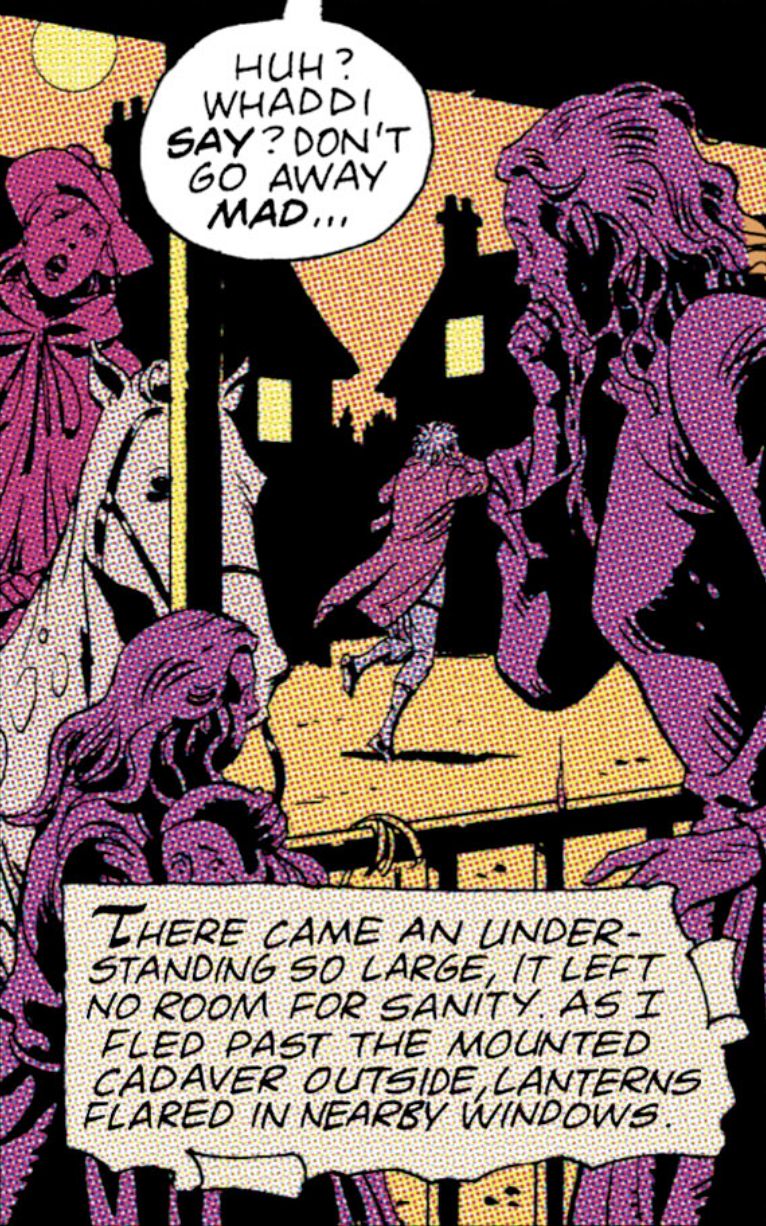

The mariner in the pirate comic is able to understand the horrors he’s caused at the end of his story. But this Watchmen story ends before Adrian can have a similar moment.


Apparently this was the only issue where Gibbons really pushed back on Moore. Adrian’s monologue was originally even longer and Gibbons couldn’t fit it all in. But this overly verbose, self-aggrandizing speechifying is an essential element to his character. Without it, many readers (myself included) might end up liking him. But Adrian’s enormous ego makes him a thoroughly unlikable character, even to those who might agree with his tactics.
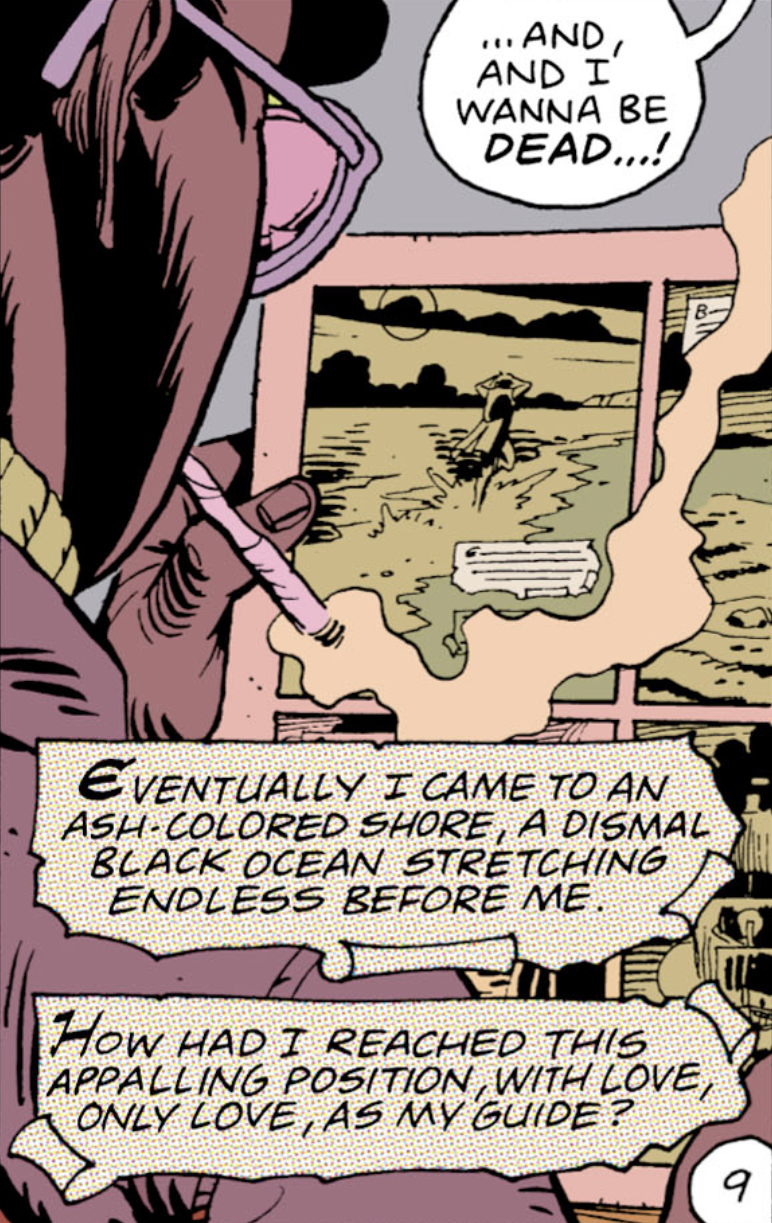

The mariner realized that he had caused the very thing he was trying to prevent. But he can’t quite understand how that happened. My simplistic explanation: He took the principle of allowing the ends to justify the means to the extreme.


Unlike Alexander, Adrian merely sought to unite the world, not rule it. But he eventually grew disillusioned with his hero once he realized how quickly Alexander’s kingdom crumbled. Paradoxically, he swiftly became enamored with the Egyptian pharaohs, deeming them “immortal.” Didn’t he realize that the pyramids only survived by the luck of their geographical location? How much of that hallucinogen damaged Adrian’s mind? Or is he actually insane like Rorschach believes? Of course, the best answer to that question is Dan’s response: With an intelligence like Adrian’s, it may be impossible to determine insanity.


Adrian’s servants were unfailingly loyal, and there was no apparent reason for him to kill them. He tries to justify this by mentioning the pharaohs who had their servants buried with him, but if he truly subscribed to that philosophy, then he would committed suicide at this moment. But Adrian wants to live and profit off his new world. I believe he was paranoid that one of his servants would eventually feel guilty and try to prevent Adrian from growing his fortune to even more obscene levels.


The interesting with this greenhouse was that Adrian designed it with a retractable roof. But down in Antarctica, there never would have been a good time to open it. Adrian always intended to destroy that greenhouse and bury his servants there. It’s a pity that none of them realized this when they helped him build it.


One final epiphany for the mariner: Davidstown was never in danger. But Adrian never realized that even with Dr. Manhattan taken out of the picture, the Soviet Union was never going to attack America. Richard Nixon would have eventually taken the “football” off his wrist, returned to the White House, and resumed business as usual. And I think that even in this alternate reality, the USSR would have eventually collapsed on its own.


It is great to see Nite Owl and Rorschach utterly intimidated by Ozymandias. We’ve seen the two of them pull off some pretty impressive stunts during this story, most recently Dan’s remarkable flight from New York to Antarctica in a tiny owl ship he built himself. Dan and Rorschach have also had their fair share of encounters with Dr. Manhattan, but Adrian unnerves them on a whole different level. It’s the culmination of this massive, technologically advanced base, combined with the sinister plot they’ve only begun to scratch the surface of, on top of what they already know about his physical and mental prowess. They’re in way over their heads here, and they both know it.


True, Rorschach is likely suffering from frostbite and pneumonia at this point, but it still is a rather embarrassing performance for him.


I still love how fluid Adrian’s fighting style is. Not a single wasted movement, everything flowing together in one seamless motion to take out the threat as quickly and efficiently as possible. All the other characters in this story are good fighters, but none of them are nowhere near this level of perfection.


This helps confirm my belief that Eddie Blake’s murder was partially motivated by revenge. I do believe that Adrian used his first fight against the Comedian to study his moves, but it still seems like he was really upset he lost. And although he can now credit the Comedian with opening his eyes, that process had to have hurt. Adrian genuinely wanted to unite the world with a team of superheroes. But instead his dream was crushed in a rather brutal, insulting way.


It’s kind of poetic (if improbable) how Moore brings all the minor characters together at Ground Zero. Refreshingly, some of these characters actually grew over the course of the story. Dr. Malcolm Long’s career and marriage are both in shambles. And just when it seemed like he had given up on humanity, he chooses to try to help some strangers in a fight on the street, unaware that this will be his final act.


This is where Adrian talks and talks and talks. Not everything he says is essential, yet it does help keep him unlikable. And I did like this bitter realization that Richard Nixon — of all people — has his name permanently engraved on the moon.


Bernard the newsman also has another bit of growth. Even though he previously gave his hat to his constant companion, he didn’t even know the boy’s name until now. After ranting about people not connecting with each other anymore, he abruptly — and sweetly — decides to follow his own advice.


This confirms my suspicion that Eddie Blake’s murder was a little bit personal. As much as Adrian tries to play it cool, he can’t help but relish the thought of Eddie’s world collapsing.


Adrian half-heartedly tries to justify killing Blake, but he really didn’t need to. Adrian knew Blake wouldn’t tell anyone what he learned, and even if he did tell someone, they wouldn’t be able to stop him. Neutralizing Dr. Manhattan makes absolute sense, but worrying about Rorschach’s delusions doesn’t. Adrian may be the smartest man on Earth, but that doesn’t put him above paranoia and petty grievances.


One of the most chilling lines in all comic book history. Perfection.


Bernard and Bernie are the first to be vaporized. Bernie read the Black Freighter comics over and over, not realizing that its author unwittingly contributed to this mass tragedy. Bernard read the headlines every day and constantly fretted over the end of the world, never dreaming that he’d literally be at the center of it.


Our supplemental material — the last of this series — is an interview with Adrian, conducted by Doug Roth, who played a role in helping send Dr. Manhattan to Mars.


From Roth’s point of view, Adrian hiring a handful of Vietnamese refugees is a noble act. But we have the hindsight of knowing Adrian always planned on killing them from the beginning. He wasn’t looking to help political exiles — he was looking for expendable cogs that wouldn’t be missed.


I don’t think even Alan Moore was bold enough to write a superhero who truly went after the root causes of crime and poverty. These are stories being published for profit by a large corporation. Understandably, they get a little queasy about anybody really challenging the status quo. So transformative ideologies like this have to be confined to the villains — even in works like Watchmen.


I had to look up the word Manichean. It basically means black-and-white, which perfectly describes Rorschach’s limited viewpoint. Yes, this is coming from the “villain” of the story, but it is Moore once again reminding readers not to root for Rorschach.

Thursday, August 31, 2023

Redrafting the Jazz: 2008


I have been cursed by a witch to repeatedly travel back through time to relive every NBA draft. Fortunately, her spell sends me directly to the Utah Jazz war room on draft night and all the executives magically know I’m from the future and will do whatever I say. Unfortunately, the curse prevents me from seeing how my advice altered the future, as I am sent back to the previous year as soon as draft night ends.

June 26, 2008 – Madison Square Garden, New York City

Previous season:

The Jazz had a strong 2007-08 campaign. Led by a solid starting lineup of Carlos Boozer, Deron Williams, Memo Okur, Andrei Kirilenko and Ronnie Brewer, Utah won 54 games and advanced to the second round of the playoffs, before losing to a very strong Laker team in six games. (And there was quite a bit of drama involving Derek Fisher, which I completely missed because I was living in the Czech Republic at the time.) But things were looking up. Kyle Korver was added to a pretty decent bench that already included Paul Millsap, Matt Harpring and C.J. Miles. The only thing the roster was lacking was a really strong traditional center.

The draft:

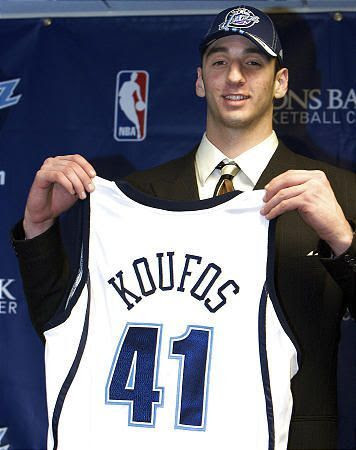
Kevin O’Connor naturally sought to fill the one void on Utah’s roster. With the 23rd pick, he drafted a Greek 7-foot freshman from Ohio State named Kosta Koufos. 

Sometimes general managers have special relationships with certain teams that they make an unusually high amount of mostly insignificant trades with. O’Connor’s special team was Philadelphia. Back in 2005, he sent them a second-round pick for a future one, which turned out to be the 44th pick this year. Not really needing or wanting an immediate impact player, O’Connor drafted a 7-foot-2 Croatian named Ante Tomic.

With Utah’s own 53rd pick, O’Connor repeated himself, grabbing another big man who could stay in Europe for a few years. This one was a 6-foot-9 Serbian named Tadija Dragicevic.

Analysis:

Koufos wasn’t a terrible pick. He lasted a solid decade in the NBA and he was even a starter for Denver for a whole season. But he only played in 84 games across two seasons for the Jazz before they packaged him in a trade for Al Jefferson. The biggest knock against Koufos was that two far superior centers were drafted after him. The very next pick behind him was Serge Ibaka, who went on to earn three All-Defensive First Team honors.

But the most intriguing player left on the board is DeAndre Jordan, who somewhat surprisingly slipped to the second round. Despite his glaring weaknesses — most notably his legendarily atrocious free-throw shooting — Jordan’s strengths earned him a spot on two All-Defensive First Teams, two All-NBA Third Teams, one All-NBA First Team and one All-Star Game.

Both Ibaka and Jordan would have been a massive upgrade over Koufos — and I don’t think they would have been traded away after two years. Ibaka is the safest pick, but I can’t turn away from the huge upside of Jordan. Would Jerry Sloan have been able to coach him? I don’t know. But I think it’s worth a shot.

As for the second-round picks, it seems like the Jazz never had any intention of bringing either of them over. Both of their draft rights were later packaged in larger trades that apparently needed one more slightly tangible asset. Which was a bummer to every Jazz fan (myself included) who had visions of another Kirilenko.

But even though O’Connor felt the roster was full, I’m going to have to insist that he use one of those picks on somebody who could come in right away. Utah’s second biggest weakness was the backup point guard position — Ronnie Price just was not getting it done. Luckily, Goran Dragic was available at the 44th pick. He was named to the All-NBA Third Team once and played in an All-Star Game. A player of that caliber definitely deserved to be brought in to training camp and given a shot to be Williams’ backup.

As for the 53rd pick, I’m going to honor O’Connor’s wishes to have someone who can wait in Europe for a little bit. But I will make an improvement: undrafted center Timofey Mozgov. He didn’t come to the NBA until 2010, and ended up having a rather similar career to Koufos — he even started a bunch of games for the Cavaliers when they won the championship. Assuming the Jazz don’t forget about him in Russia, he could have been a fairly decent player for them.

My advice:

1. Use the 23rd pick on DeAndre Jordan.
2. Use the 44th pick on Goran Dragic.
3. Use the 53rd pick on Timofey Mozgov.

I think that as long as Sloan only expected Jordan to grab rebounds and block shots, then he might have been pretty happy with him as the backup center. And I really do like Dragic’s chances of beating out Price for that backup point guard spot. Of course, I know that in real life, the 2008-09 season saw the Jazz collapse under injuries, a strained salary cap and personnel issues. And there’s nothing I could have done on this single draft night to prevent any of that. This advice was the best I could give before suddenly being whisked back in time again.

Thursday, July 20, 2023

Watchmen #10: Hurry up and wait


The end of the series is quickly approaching for Moore and Gibbons, so they need to hurry up and get all their ducks in a row. However, there’s still an obnoxious amount of pages to fill, so there’s going to be a fair share of filler here.


We are going to take quite a bit of time to show President Nixon arriving at this secure bunker. A little strange to devote this much time to him now, as he’s almost been completely absent from this story.


Fun fact, the nuclear “football” that always travels with the president is actually just an ordinary briefcase. But a metallic football with handcuffs is a more interesting visual.


Nixon’s waiting for the end and so are we. But the story can’t end until issue #12, so we need to stall just a little bit. Granted, it’s not all bad. There is a lot of interesting stuff here and it’s beautifully illustrated as always, but the narrative has kind of stalled for now.


I’m a little disappointed in this panel. It takes up two-thirds of a page for no reason at all, and it’s rather average work from Gibbons and Higgins. I know I’m holding them to unrealistically high standards, but that’s what happens when you excel at such a high level. Picky readers like me will demand absolute perfection in every single panel.


It should surprise no one that Rorschach’s only plan for detective work is to beat up alleged criminals in a bar. Surprisingly, that tactic will actually work this time.


I still am completely baffled by this whole bit of Rorschach’s landlady claiming he propositioned her. Was she actually paid to spread that lie? To what end? Rorschach was already deeply unpopular and resented by everyone except the far-right editor of The New Frontiersman. Regardless, it was somewhat surprising that Rorschach didn’t kill this woman. And I don’t think it was because of the pressing mission, or Nite Owl’s presence, or even the fact that Rorschach was slightly humbled by his experience in prison. It was the little kids reminding him of his own horrific childhood.


Ozymandias would have loved social media! But seriously, though, I love his entrance here. We don’t get a clear look of him until he’s fully dressed in his old superhero suit. And by putting it on once he arrives at his private base shows us that his Adrian Veidt public persona was the disguise. Just like Rorschach, his real identity is that of a costumed vigilante.


If Ozymandias weren’t so obsessed with the accumulation of wealth, he might actually be a somewhat sympathetic character — despite the mass murders. But he doesn’t just want to save the world. He wants to profit off the calamity he’s causing.


It makes me laugh how Rorschach is so sensitive about his odor. And how he still doesn’t value Dan’s real detective work.


Look at this! A little bit of character growth! I guess the prison did humble him after all. Well, a tiny bit. Unfortunately, these humanizing elements of Rorschach make it easier for his fanboys to idolize him.


There we go! There’s the money shot I’ve been waiting for from this art team!


The mariner begins his horrific conclusion, just as Ozymandias does. He is incapable of acknowledging or considering that his victims might be innocent. Their motivations may be different — Ozymandias is not driven by revenge — but they both succumbed to misguided notions.


I wish we could have had a few more Jehovah’s Witnesses with their Watchtower magazines in the Watchmen comic. At any rate, it’s hilarious that their talk of the end of the world completely unnerves Bernard, even though he’d been talking about it nonstop for a week.


Rorschach is soooo happy to be back to breaking people’s hands and cracking lame puns. And frankly, that’s not too different from what Batman does on a regular basis.


The revelation of Hollis Mason’s death feels a little shoehorned in here. I’m not exactly sure what purpose it serves other than to tie a neat bow on a subplot.


I guess Moore was trying to give us an emotionally compromised Nite Owl heading into the final confrontation? But that’s not what really happens. Rorschach successfully — and surprisingly — calms him down. Maybe this was Moore’s way of showing Rorschach gaining more control by witnessing his only friend lose control.


And now we get one last check-in on Adrian’s secret island. I understand why Moore kept it so secretive, but I still say we needed to see a little bit more of it.


I do love this sequence of panels. The only thing that survived the ship’s destruction was an image of the thing that will soon destroy New York.


We all know that Adrian could have done a better job at concealing his plans. In fact, he did for several years. But at this point, the endgame was already in motion, and he confidently knew he had nothing to worry about.


This was back when Computer Passwords were a new and strange idea.


I love this panel. The stunned, calm expression of Dan lit by the green of the computer screen. So simple, yet so chilling. I’m sure the temptation was to make this a much bigger deal, but I’m glad Gibbons showed restraint.


It was quite convenient that the police didn’t take Rorschach’s real journal. Moore really wanted that final scene of someone reading it. Granted, he handled this much better than J.K. Rowling did when she wanted Harry to have the Marauder’s Map again.


Look the scarecrow against the moon is another callback to the Doomsday Clock! Seriously though, I do like the haunting visual that there is no omniscient power looking out for us. Just a silent scarecrow.


Pro tip to anyone trying to expose the greatest coverup in American history: Don’t begin your manifesto by talking about dead dogs.


One of the most unique and breathtaking panels of this series. A beautiful breath of fresh air.


The absurdly magnificent airship is even graceful when it crashes. Still is really goofy-looking, though. On a completely unrelated note, I am wondering just how long Laurie spent on Mars with Dr. Manhattan. Dan and Rorschach spent a long time hiding at the bottom of the river. And this journey to Antarctica surely took even more time. Laurie’s Martian therapy session didsn’t seem to take that long. Maybe the teleportation process wasn’t quite instantaneous? That is an awfully long way to travel.


I’m really surprised Moore didn’t show Rorschach suffer from frostbite or hypothermia. He’s usually really good about keeping on top of those little details.


Think you got enough angles there, Adrian? Perhaps a couple more closeups? You apparently have an infinite amount of security cameras, so why not?


The supplemental material is papers taken from Adrian’s desk. It is quite dull and not particularly illuminating.


OK, these toys would actually be really cool. But I do understand Adrian’s hesitation to make toys based on real people, especially the murderous Rorschach.


A brief glimpse of Adrian’s post-“invasion” plans. How much did he really want to build a utopia? Or did he merely want to profit off the calamity he caused? I don’t think the two are mutually exclusive, but his relentless pursuit of money does undercut some of his loftier aims.


Was this self-improvement course a scam or a genuine attempt to improve the world? It seems like Ozymandias could have easily trained up a group of dedicated acolytes who were almost as strong as he was, and who certainly shared his insane worldview. Would have been an interesting addition, but this story was fine without it.