Saturday, October 21, 2023

Watchmen #12: The end of the beginning


Here it is. I am finally almost done with my page-by-page review of Watchmen. And this isn’t the end — it’s only the beginning of my grander goal of looking at all the adaptations of Watchmen to see how closely they fit what I perceived to be Alan Moore’s original vision.


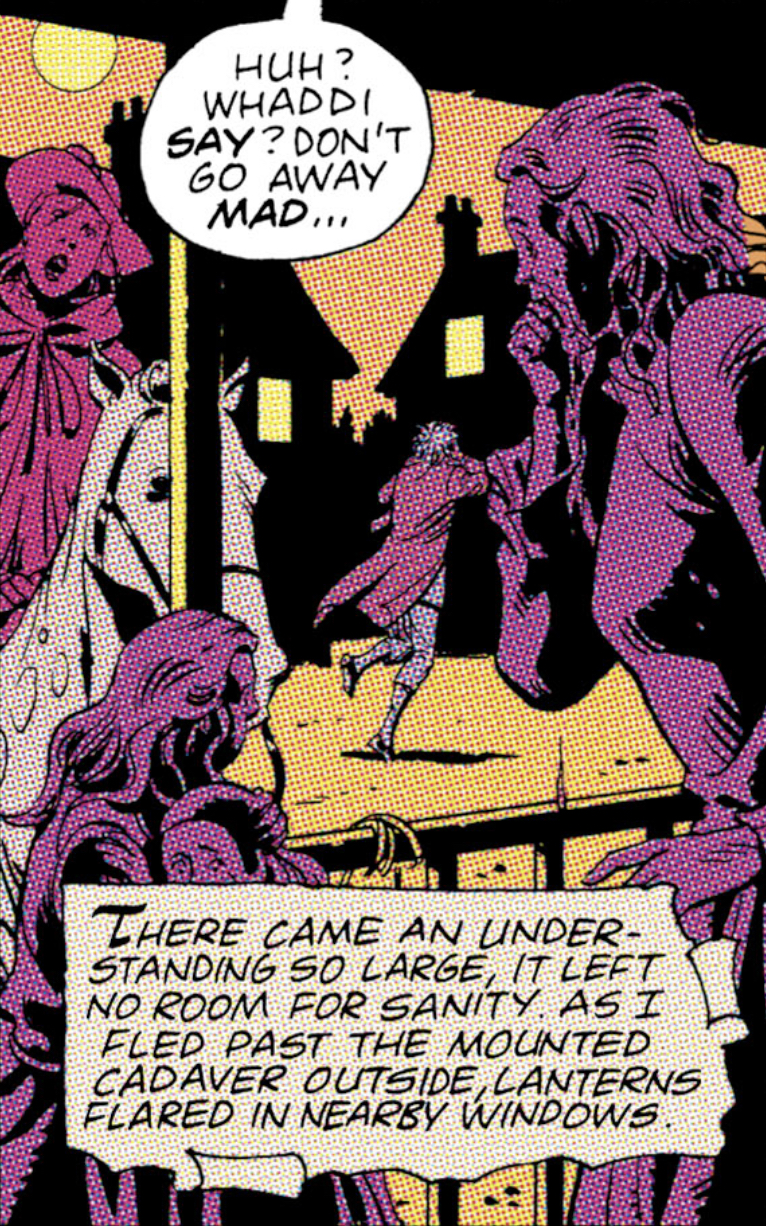
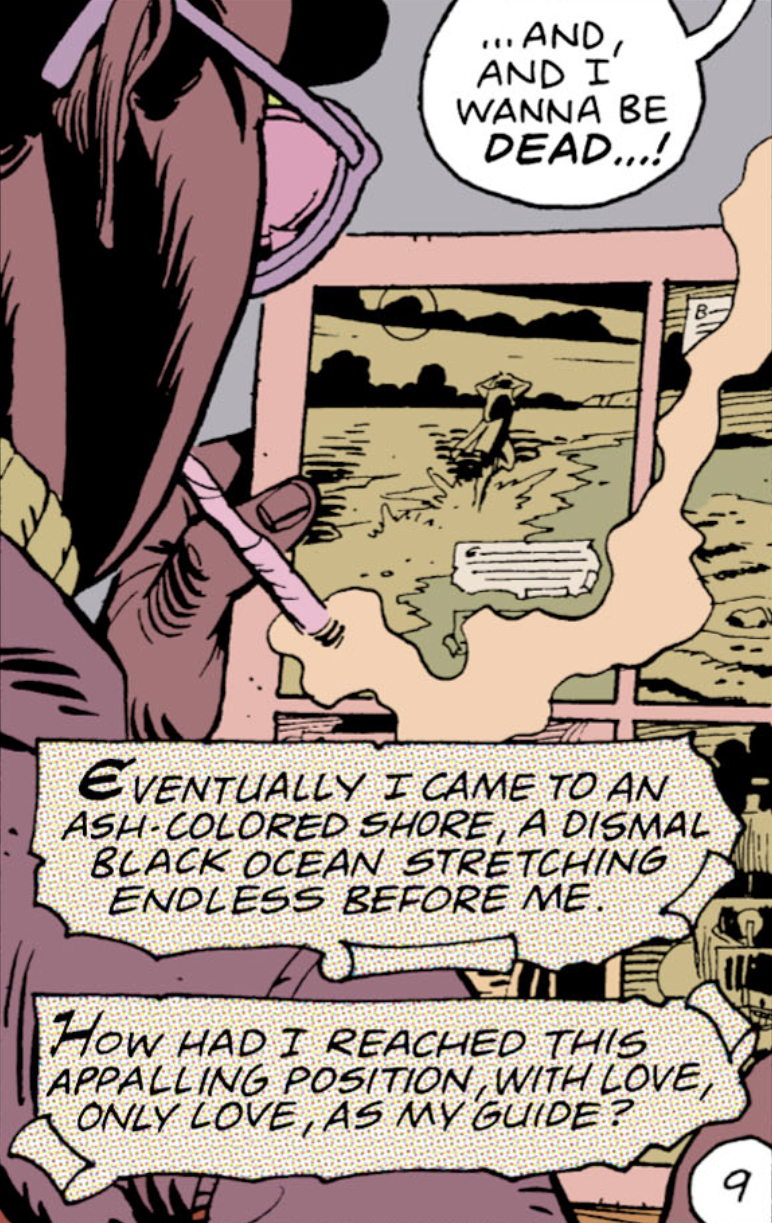
This issue has one of the most powerful openings in all comics. Six silent splash pages depicting grotesque horror.


Gibbons didn’t do any official two-page spreads in this series. But he came frustratingly close a couple of times. I just want to go in and tweak that tentacle ever so slightly to make it line up.


It was a little convenient to have all these minor characters at the same place at midnight. But it does make for a satisfying, albeit macabre finale for them.


At the center of everything is poor Bernard and Bernie — the man who read all the newspapers and the boy who read all the comic books. They, like most of the other victims of this attack, are some of the very few truly likable characters of this story. Which helps give this tragedy some real stakes.


I had previously wondered how long it took Dr. Manhattan to teleport to and from Mars. Perhaps it was usually instantaneous, but the story doesn’t specifically say. I wish Dr. Manhattan would have said something like he wanted to go back two days ago. Regardless, the tachyons somehow caused him to skip ahead in time a bit — lost in teleportation limbo from Mars for 48 hours. I can only presume that was a happy accident of Adrian’s plan.


For the first time in years, Dr. Manhattan feels the sensation of surprise. And he gets so excited by this, it takes him a minute to acknowledge Laurie’s suffering — again.


Adrian won’t stop belittling Rorschach and I am here for it!


My biggest frustration with Watchmen. If young Robert Deschaines really was the key, then why didn’t we ever get to see him?


For the first — and only — time in this story, Adrian is legitimately afraid. He does fear for his life, but I think he’s also worried that Dr. Manhattan’s arrival means that he also prevented the attack in New York.

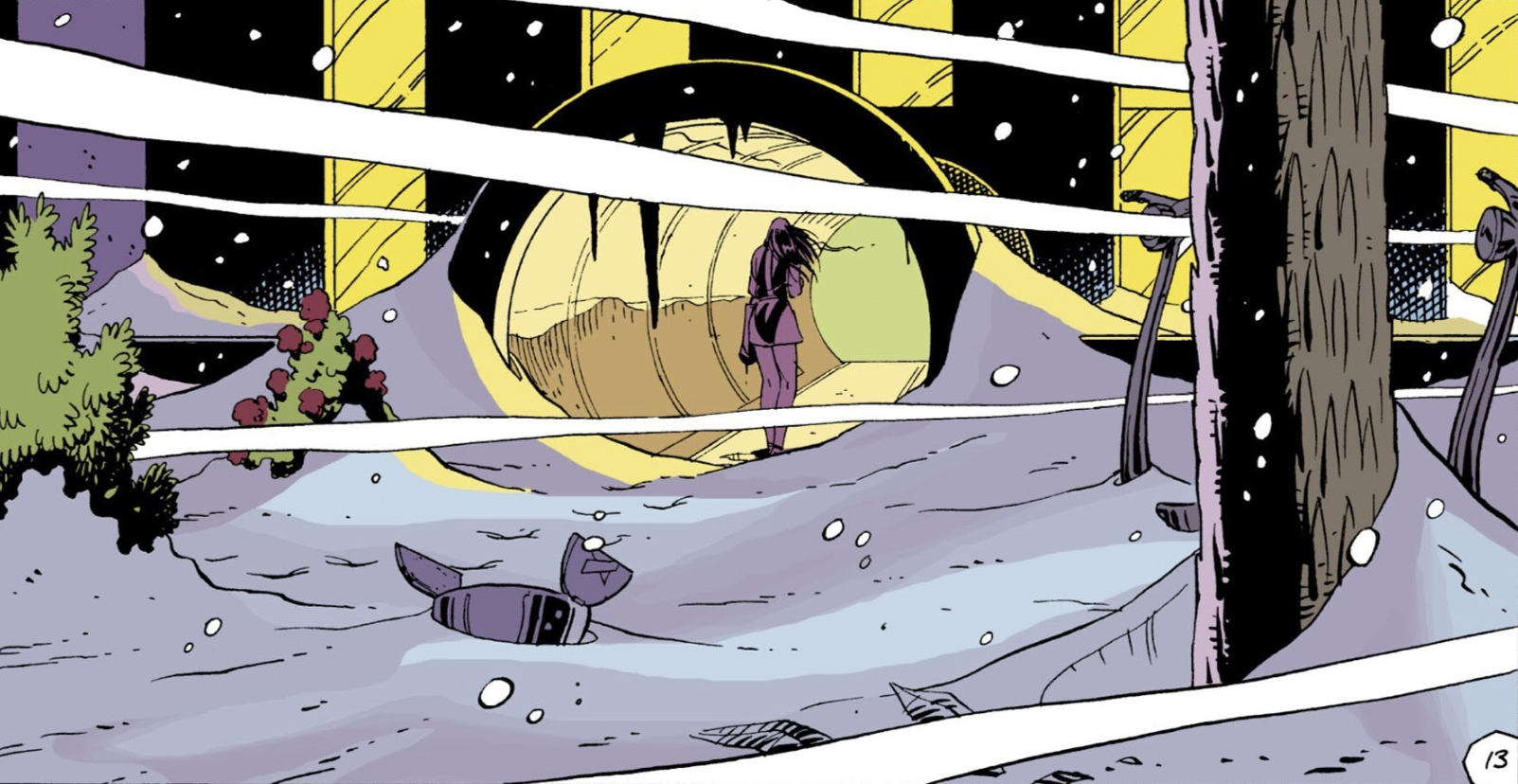

Dave Gibbons devotes a lot of space to Laurie making her way into Adrian’s lair. This highlights her continued isolation and unfortunate role as the most forgettable character in this cast. But I also think Gibbons and Moore were trying to build up the tension of Laurie bringing a gun to the final confrontation. Personally, I think that bit fell flat.


It’s quite impressive how Adrian’s preparation (and paranoia) led to him recreating the device that turned Jon Osterman into Dr. Manhattan. It’s also quite lucky that Adrian was able to put Dr. Manhattan in range of this machine.


This was unnecessary. It feels like Alan Moore saw what he concerned a plot hole in Adrian’s staged assassination and decided to justify it after the fact. But I never worried about the possibility of the gunman hitting Adrian first instead of the secretary. If Adrian knew when and where the hitman would be, he would have had ample time to protect himself. I also worry that having him “catch” a bullet makes him too powerful. I thought the only one here with real superpowers was Dr. Manhattan. Adrian’s already the smartest and the best fighter. Does he really need another physical ability outside the realm of human feasibility?


I do love this line, though. Adrian has just pulled off his decades-long scheme, easily bested Nite Owl and Rorschach in hand-to-hand combat, obliterated the most powerful being in the universe, and even caught a bullet. He has no time for Dan’s chivalry.


Dr. Manhattan hasn’t been in a real fight in a long, long time. Yes, this is a dramatic act of intimidation. But it’s not very efficient. Obviously he wanted to question Adrian before killing him, but he wastes time trying to belittle him. I guess it’s just a petty act from the allegedly emotionless being.


Hey, Jon! That termite just pulled off the greatest conspiracy of all time right under your nose! (Man, I’m really becoming an Adrian cheerleader here …)


Even though we knew Adrian’s plan worked, he had no confirmation of it until he turned on his TVs. And for the first time in this story, he permits himself to celebrate like a normal human. It’s a rather unsettling sight to see him exhibit so much emotion, especially when one considers what, exactly, he’s cheering.


I am stunned, absolutely gobsmacked that this conversation only lasted three panels. I’m not saying it’s wrong to have these characters ultimately come to these conclusions, but they needed to have a longer conversation about it! This is the story that spent an entire issue teaching Dr. Manhattan the value of life. But this incredibly complex moral problem is condensed to a few quick lines?


It’s a little surprising that Adrian didn’t kill his “guests,” considering how he coldly murdered his most loyal servants to prevent the slim possibility that one of them would expose him in the future. I suppose Adrian initially wanted someone to gloat to. And once Dr. Manhattan showed up, he probably assumed that he wouldn’t let anything bad to happen to Laurie (and maybe even Dan). As for Rorschach, well, it’s refreshing to see Adrian’s finally realized he’s not much of a threat. I’ll still maintain that Adrian needn’t have bothered conspiring to throw Rorschach in jail.


This issue has so much to get through — so many loose ends to tie up and deep conversations to have — that the pacing sometimes feels a bit jarring. Especially this moment. Adrian abruptly leaves his “guests,” Dr. Manhattan leaves to kill Rorschach, and Dan and Laurie spontaneously start making love. It’s an absolutely insane response to this moment, but I guess that’s sort of the point. How would people to a situation like this? Especially Laurie, who still hasn’t had time to reconcile with the revelation of her true father?


Rorschach may be an idiot, but he’s not stupid. (Wait, does that even mean anything?) He knows he’ll never be able to find his way back to the Owlship, get it working again, and fly it all the way back to New York. But he has to try because he can’t conceive of anything else to do. Yes, he’s made a bunch of compromises during his life, but he doesn’t count those because they were born of the cognitive dissonance in his own brain. It’s when someone else asks him to compromise that makes him dig in his heels and double down on his illusions. And finally, at the very end, he’ll pay for this obstinance with his life.


This is not the portrait of a courageous martyr fighting for his beliefs until the end. This is a terrified, defeated, sorry excuse for a man. He’s not daring Dr. Manhattan to show some backbone. He’s begging Jon to save him the indignity of freezing to death on the Antarctic plains. He’s pleading to be saved from himself.


Dr. Manhattan’s actions are rather perplexing at the end of this story. It’s almost like a new, more assertive Dr. Manhattan was born after Adrian “killed” him. Does he still see himself as a puppet bound to the predetermined future? Or does he now finally realize that he possesses the power to influence the world around him? After he reformed himself, he led the brief, yet crucial discussion on accepting Adrian’s plan. He then committed what can best be described as a mercy killing of Rorschach, before walking in on Laurie and Dan sleeping in each other’s arms. He grants a smile of approval before oddly choosing to walk across the water of Adrian’s swimming pool. Was this an unconscious act of one considering taking on the role of a god? Or was he “testing the waters” of divinity?


In one of my favorite parts of the story, Adrian allows himself to be vulnerable in private with Dr. Manhattan. He reveals the pressing doubt he surely felt during every step of his massive plan. Adrian begs the seer to tell him he did the right thing, but he only gets vague answers in reply. Dr. Manhattan is leaving this world to create a new one. Is that because this world is destined to become a utopia that won’t need his services anymore? Or is it now tainted beyond redemption? The doctor coyly will never say.


From what I understand, DC made a deal with Moore to give him back the rights to Watchmen as soon as they stopped publishing Watchmen stories. But DC quickly learned this is a cash cow that will never dry out. Every few years, they release a new collection of the core story in hard cover, paperback, oversized omnibus format, new coloring, no coloring at all, and on and on. Then there’s the adaptations, including the movie, the prequel comics, the sequel TV series, and many other little things in between. No, Watchmen will never end.


I’m a little surprised that this issue — overfilling with content it can’t fit — would devote three full pages to Sally. I guess Moore really wanted to get in that “you look like a waitress” line (which is a great line, by the way). But seriously, I do understand the need to have some closure to this relationship. Laurie’s forgiveness comes quickly and easily, which is hard to imagine happening without the apocalyptic event putting things in perspective. Maybe she would have eventually gotten there on her own, but I think it would have taken longer.


The story began with Eddie Blake dying on the street. It ends with his portrait being kissed by the woman he attempted to rape, then later fathered a child with. Sally’s relationship with Eddie is so complex and messy and confusing — a wonderful encapsulation of this entire story. Bad people don’t always do bad things. Good people don’t always do good things. We sometimes grow to love the people we hate. And even switch back and forth several times through our lives. Nothing is as neat and tidy as we’d like. And that’s part of the power of this story. It dared to feature a main cast of unlikable characters. It didn’t shy away from an unsatisfactory ending. Giving in to those conventional tropes would have robbed the readers the chance to ponder the unanswerable questions Moore asked.


I consider the last two pages an epilogue. It’s been some time since Adrian’s fake invasion — probably a year or more. New York is cleaned and repaired. There are new electric chargers on the streets and restaurants bizarrely selling American and Russian cuisine. But through all that upheaval, the radical New Frontiersman survived with the same old abusive editor and poor little Seymour who never thought to get a new job. But it’s a good thing he stuck around — he’s about to stumble upon the biggest story of the century.


What a glorious final panel. Alan Moore, Dave Gibbons and John Higgins have told their story. And now they leave it in our hands. For better and worse, “our” includes DC Comics, which has unceasingly sought to profit off this story. The slew of adaptations and reprintings isn’t necessarily a bad thing — even at their worst, terrible sequels can’t tarnish the image of a masterpiece.

Tuesday, October 3, 2023

Redrafting the Jazz: 2007


I have been cursed by a witch to repeatedly travel back through time to relive every NBA draft. Fortunately, her spell sends me directly to the Utah Jazz war room on draft night and all the executives magically know I’m from the future and will do whatever I say. Unfortunately, the curse prevents me from seeing how my advice altered the future, as I am sent back to the previous year as soon as draft night ends.

June 28, 2007 – Madison Square Garden, New York City

Previous season:

After going 51-31 in the 2006-07 season, the Jazz pulled off a dramatic 7-game victory over Houston in the first round, beat the outmatched Warriors 4-1 in the second round, before being crushed 4-1 by San Antonio. It remains the last time Utah reached the Western Conference Finals. Granted, the Jazz got incredibly lucky when Golden State upset the 67-win Mavericks in the first round. But it still was a good sign for such a young roster — only Matt Harpring and Derek Fisher had more than five years of experience. It seemed all Utah needed to do was add a solid sharpshooter and they’d be set. (Gordan Giricek was NOT getting it done.)

The draft:

With the 25th pick, Kevin O’Connor drafted a sharpshooter from Rice named Morris Almond.

With the 55th pick, the Jazz selected Providence forward Herbert Hill and immediately traded him to Philadelphia for the 38th pick, Ukrainian center Kyrylo Fesenko. Officially, the Jazz were also supposed to give the 76ers “future considerations” for this seemingly lopsided trade. However, I could find no record of what those considerations ended up being.

Previously, I had mentioned O’Connor’s unusually friendly relationship with Philadelphia, his former team. At the 2007 trade deadline, Philadelphia was in danger of going over the salary cap, so they traded Alan Henderson to Utah, along with some cash and the right to swap second-round picks in exchange for … absolutely nothing. Utah immediately waived Henderson, who promptly re-signed with Philadelphia. A few months later, the 76ers seemed to honor this trade by drafting Fesenko for Utah. But O’Connor oddly insisted that the Fesenko trade had nothing to do with the Henderson trade. Yet he refused to explain what else the 76ers wanted in exchange for swapping the 38th pick with the 55th.

My guess is that the Henderson trade was O’Connor doing a favor for his old friends. And then he sheepishly forgot to exercise the pick swap before the draft. His Philadelphia buddies were happy to grant the late swap, but it technically had to recorded as a new, separate trade. And then O’Connor was too embarrassed to admit his mistake later. This is entirely my speculation on the scenario, and it ultimately doesn’t matter.

Analysis:

Morris Almond’s career (or lack of one) remains a perplexing mystery for me. On paper, he was everything the Jazz wanted. He put up big numbers in college and was dominant in the NBA’s Development League. But for some reason, he just could not get any action in real NBA games. And this wasn’t just a case of Jerry Sloan refusing to play his rookies. After two seasons and just 34 games in Utah, Almond spent three years in basketball purgatory (D-League and Europe) before appearing in four games with Washington. And then he retired. I don’t think he had a serious injury. He just … wasn’t that good.

Luckily, I have a solid pick at shooting guard, who was drafted just two spots below Almond. UCLA’s Arron Afflalo enjoyed a productive 11-year career, shooting 38% from 3-point range. I think he would have made a bigger impact on Utah’s roster than Almond.

Herbert Hill never played in the NBA, so the Jazz truly got Fesenko for free. Unfortunately, he never made much of an impact. Perhaps partly due to his enormous size, the Jazz really seemed invested in him and allowed him to stick around for four years — he even got to start nine playoff games in 2010. But his play never rose above the level of frustrating mediocrity. He joined the Pacers after his stint with the Jazz, but only lasted three games with them before exiting the league for good.

Fortunately, at the 38th pick, I have a much, much, much better center available: Spain’s Marc Gasol. A three-time All-Star, member of an All-NBA First Team and Second Team, and a Defensive Player of the Year — I’d be insane to pass on him.

My advice:

1. Use the 25th pick on Arron Aflalo.
2. Tell Philadelphia to use the 38th pick on Marc Gasol and trade him for the 55th pick (Herbert Hill).

Of course, my plan depends entirely on the assumption that Philadelphia asked Utah who they wanted right before they made the 38th pick. If that wasn’t the case (and I’d have to confirm this before the drafting started), then I’d have to use the 25th pick on Gasol. He’s too good to risk losing over a gentleman’s agreement.

Thursday, September 28, 2023

Watchmen #11: Do the ends justify the means?


Yes, it’s true I’m gettin a bit annoyed with Dave Gibbons inserting that blood splat/10 minutes to midnight image everywhere. But I absolutely love this cover. Such a minimal, yet colorfully haunting and perplexing sight for the penultimate issue.


I’ve said it before, and I’ll say it again. Adrian Veidt would have absolutely loved social media.


It is kind of cute that Adrian thinks he’s the first person in the world to think of a moral and intellectual dilemma like this. Didn’t America drop a couple of nuclear bombs on Japan in this reality?


Believing that Veidt is trying to cause World War III, Rorschach calls this the “heart of darkness.” But what would you call it when someone’s trying to prevent World War III? I guess it all depends on if you believe the ends justify the means — a philosophy that Rorschach often supports, according to the contradictory logic only he understands.


Alan Moore, like Adrian, worked really hard to conceal everything until after the “bomb” was dropped. Then it became a frenzied rush to explain every little detail all at once. But before that fateful moment was a vast, palpable silence of tension, articulated by this enormous painting of one of Adrian’s favorite stories. According to legend, the Gordian knot was an incredibly complex tangle of rope binding an ox cart to a post, with the belief that whoever untied the knot would rule all Asia. Alexander merely cut the rope with his sword. Some might say he employed an unethical tactic in solving the challenge. But Adrian praised him as a genius ahead of his time, who was able to think outside the box. I suppose it comes down to what you believe the priority was — untangling the knot or freeing the ox cart. With Alexander’s solution, the cart was freed quicker, but the rope was damaged beyond repair. With Adrian’s solution, peace may have been brought to the world, but in what condition did he leave the people?


And here it is. The moment where everything changed. Gibbons did place this panel in the middle of the page, highlighting its significance, but other than that, it’s so quiet and subdued, it’s easy to overlook.


The mariner in the pirate comic is able to understand the horrors he’s caused at the end of his story. But this Watchmen story ends before Adrian can have a similar moment.


Apparently this was the only issue where Gibbons really pushed back on Moore. Adrian’s monologue was originally even longer and Gibbons couldn’t fit it all in. But this overly verbose, self-aggrandizing speechifying is an essential element to his character. Without it, many readers (myself included) might end up liking him. But Adrian’s enormous ego makes him a thoroughly unlikable character, even to those who might agree with his tactics.


The mariner realized that he had caused the very thing he was trying to prevent. But he can’t quite understand how that happened. My simplistic explanation: He took the principle of allowing the ends to justify the means to the extreme.


Unlike Alexander, Adrian merely sought to unite the world, not rule it. But he eventually grew disillusioned with his hero once he realized how quickly Alexander’s kingdom crumbled. Paradoxically, he swiftly became enamored with the Egyptian pharaohs, deeming them “immortal.” Didn’t he realize that the pyramids only survived by the luck of their geographical location? How much of that hallucinogen damaged Adrian’s mind? Or is he actually insane like Rorschach believes? Of course, the best answer to that question is Dan’s response: With an intelligence like Adrian’s, it may be impossible to determine insanity.


Adrian’s servants were unfailingly loyal, and there was no apparent reason for him to kill them. He tries to justify this by mentioning the pharaohs who had their servants buried with him, but if he truly subscribed to that philosophy, then he would committed suicide at this moment. But Adrian wants to live and profit off his new world. I believe he was paranoid that one of his servants would eventually feel guilty and try to prevent Adrian from growing his fortune to even more obscene levels.


The interesting with this greenhouse was that Adrian designed it with a retractable roof. But down in Antarctica, there never would have been a good time to open it. Adrian always intended to destroy that greenhouse and bury his servants there. It’s a pity that none of them realized this when they helped him build it.


One final epiphany for the mariner: Davidstown was never in danger. But Adrian never realized that even with Dr. Manhattan taken out of the picture, the Soviet Union was never going to attack America. Richard Nixon would have eventually taken the “football” off his wrist, returned to the White House, and resumed business as usual. And I think that even in this alternate reality, the USSR would have eventually collapsed on its own.


It is great to see Nite Owl and Rorschach utterly intimidated by Ozymandias. We’ve seen the two of them pull off some pretty impressive stunts during this story, most recently Dan’s remarkable flight from New York to Antarctica in a tiny owl ship he built himself. Dan and Rorschach have also had their fair share of encounters with Dr. Manhattan, but Adrian unnerves them on a whole different level. It’s the culmination of this massive, technologically advanced base, combined with the sinister plot they’ve only begun to scratch the surface of, on top of what they already know about his physical and mental prowess. They’re in way over their heads here, and they both know it.


True, Rorschach is likely suffering from frostbite and pneumonia at this point, but it still is a rather embarrassing performance for him.


I still love how fluid Adrian’s fighting style is. Not a single wasted movement, everything flowing together in one seamless motion to take out the threat as quickly and efficiently as possible. All the other characters in this story are good fighters, but none of them are nowhere near this level of perfection.


This helps confirm my belief that Eddie Blake’s murder was partially motivated by revenge. I do believe that Adrian used his first fight against the Comedian to study his moves, but it still seems like he was really upset he lost. And although he can now credit the Comedian with opening his eyes, that process had to have hurt. Adrian genuinely wanted to unite the world with a team of superheroes. But instead his dream was crushed in a rather brutal, insulting way.


It’s kind of poetic (if improbable) how Moore brings all the minor characters together at Ground Zero. Refreshingly, some of these characters actually grew over the course of the story. Dr. Malcolm Long’s career and marriage are both in shambles. And just when it seemed like he had given up on humanity, he chooses to try to help some strangers in a fight on the street, unaware that this will be his final act.


This is where Adrian talks and talks and talks. Not everything he says is essential, yet it does help keep him unlikable. And I did like this bitter realization that Richard Nixon — of all people — has his name permanently engraved on the moon.


Bernard the newsman also has another bit of growth. Even though he previously gave his hat to his constant companion, he didn’t even know the boy’s name until now. After ranting about people not connecting with each other anymore, he abruptly — and sweetly — decides to follow his own advice.


This confirms my suspicion that Eddie Blake’s murder was a little bit personal. As much as Adrian tries to play it cool, he can’t help but relish the thought of Eddie’s world collapsing.


Adrian half-heartedly tries to justify killing Blake, but he really didn’t need to. Adrian knew Blake wouldn’t tell anyone what he learned, and even if he did tell someone, they wouldn’t be able to stop him. Neutralizing Dr. Manhattan makes absolute sense, but worrying about Rorschach’s delusions doesn’t. Adrian may be the smartest man on Earth, but that doesn’t put him above paranoia and petty grievances.


One of the most chilling lines in all comic book history. Perfection.


Bernard and Bernie are the first to be vaporized. Bernie read the Black Freighter comics over and over, not realizing that its author unwittingly contributed to this mass tragedy. Bernard read the headlines every day and constantly fretted over the end of the world, never dreaming that he’d literally be at the center of it.


Our supplemental material — the last of this series — is an interview with Adrian, conducted by Doug Roth, who played a role in helping send Dr. Manhattan to Mars.


From Roth’s point of view, Adrian hiring a handful of Vietnamese refugees is a noble act. But we have the hindsight of knowing Adrian always planned on killing them from the beginning. He wasn’t looking to help political exiles — he was looking for expendable cogs that wouldn’t be missed.


I don’t think even Alan Moore was bold enough to write a superhero who truly went after the root causes of crime and poverty. These are stories being published for profit by a large corporation. Understandably, they get a little queasy about anybody really challenging the status quo. So transformative ideologies like this have to be confined to the villains — even in works like Watchmen.


I had to look up the word Manichean. It basically means black-and-white, which perfectly describes Rorschach’s limited viewpoint. Yes, this is coming from the “villain” of the story, but it is Moore once again reminding readers not to root for Rorschach.