Thursday, July 20, 2023

Watchmen #10: Hurry up and wait


The end of the series is quickly approaching for Moore and Gibbons, so they need to hurry up and get all their ducks in a row. However, there’s still an obnoxious amount of pages to fill, so there’s going to be a fair share of filler here.


We are going to take quite a bit of time to show President Nixon arriving at this secure bunker. A little strange to devote this much time to him now, as he’s almost been completely absent from this story.


Fun fact, the nuclear “football” that always travels with the president is actually just an ordinary briefcase. But a metallic football with handcuffs is a more interesting visual.


Nixon’s waiting for the end and so are we. But the story can’t end until issue #12, so we need to stall just a little bit. Granted, it’s not all bad. There is a lot of interesting stuff here and it’s beautifully illustrated as always, but the narrative has kind of stalled for now.


I’m a little disappointed in this panel. It takes up two-thirds of a page for no reason at all, and it’s rather average work from Gibbons and Higgins. I know I’m holding them to unrealistically high standards, but that’s what happens when you excel at such a high level. Picky readers like me will demand absolute perfection in every single panel.


It should surprise no one that Rorschach’s only plan for detective work is to beat up alleged criminals in a bar. Surprisingly, that tactic will actually work this time.


I still am completely baffled by this whole bit of Rorschach’s landlady claiming he propositioned her. Was she actually paid to spread that lie? To what end? Rorschach was already deeply unpopular and resented by everyone except the far-right editor of The New Frontiersman. Regardless, it was somewhat surprising that Rorschach didn’t kill this woman. And I don’t think it was because of the pressing mission, or Nite Owl’s presence, or even the fact that Rorschach was slightly humbled by his experience in prison. It was the little kids reminding him of his own horrific childhood.


Ozymandias would have loved social media! But seriously, though, I love his entrance here. We don’t get a clear look of him until he’s fully dressed in his old superhero suit. And by putting it on once he arrives at his private base shows us that his Adrian Veidt public persona was the disguise. Just like Rorschach, his real identity is that of a costumed vigilante.


If Ozymandias weren’t so obsessed with the accumulation of wealth, he might actually be a somewhat sympathetic character — despite the mass murders. But he doesn’t just want to save the world. He wants to profit off the calamity he’s causing.


It makes me laugh how Rorschach is so sensitive about his odor. And how he still doesn’t value Dan’s real detective work.


Look at this! A little bit of character growth! I guess the prison did humble him after all. Well, a tiny bit. Unfortunately, these humanizing elements of Rorschach make it easier for his fanboys to idolize him.


There we go! There’s the money shot I’ve been waiting for from this art team!


The mariner begins his horrific conclusion, just as Ozymandias does. He is incapable of acknowledging or considering that his victims might be innocent. Their motivations may be different — Ozymandias is not driven by revenge — but they both succumbed to misguided notions.


I wish we could have had a few more Jehovah’s Witnesses with their Watchtower magazines in the Watchmen comic. At any rate, it’s hilarious that their talk of the end of the world completely unnerves Bernard, even though he’d been talking about it nonstop for a week.


Rorschach is soooo happy to be back to breaking people’s hands and cracking lame puns. And frankly, that’s not too different from what Batman does on a regular basis.


The revelation of Hollis Mason’s death feels a little shoehorned in here. I’m not exactly sure what purpose it serves other than to tie a neat bow on a subplot.


I guess Moore was trying to give us an emotionally compromised Nite Owl heading into the final confrontation? But that’s not what really happens. Rorschach successfully — and surprisingly — calms him down. Maybe this was Moore’s way of showing Rorschach gaining more control by witnessing his only friend lose control.


And now we get one last check-in on Adrian’s secret island. I understand why Moore kept it so secretive, but I still say we needed to see a little bit more of it.


I do love this sequence of panels. The only thing that survived the ship’s destruction was an image of the thing that will soon destroy New York.


We all know that Adrian could have done a better job at concealing his plans. In fact, he did for several years. But at this point, the endgame was already in motion, and he confidently knew he had nothing to worry about.


This was back when Computer Passwords were a new and strange idea.


I love this panel. The stunned, calm expression of Dan lit by the green of the computer screen. So simple, yet so chilling. I’m sure the temptation was to make this a much bigger deal, but I’m glad Gibbons showed restraint.


It was quite convenient that the police didn’t take Rorschach’s real journal. Moore really wanted that final scene of someone reading it. Granted, he handled this much better than J.K. Rowling did when she wanted Harry to have the Marauder’s Map again.


Look the scarecrow against the moon is another callback to the Doomsday Clock! Seriously though, I do like the haunting visual that there is no omniscient power looking out for us. Just a silent scarecrow.


Pro tip to anyone trying to expose the greatest coverup in American history: Don’t begin your manifesto by talking about dead dogs.


One of the most unique and breathtaking panels of this series. A beautiful breath of fresh air.


The absurdly magnificent airship is even graceful when it crashes. Still is really goofy-looking, though. On a completely unrelated note, I am wondering just how long Laurie spent on Mars with Dr. Manhattan. Dan and Rorschach spent a long time hiding at the bottom of the river. And this journey to Antarctica surely took even more time. Laurie’s Martian therapy session didsn’t seem to take that long. Maybe the teleportation process wasn’t quite instantaneous? That is an awfully long way to travel.


I’m really surprised Moore didn’t show Rorschach suffer from frostbite or hypothermia. He’s usually really good about keeping on top of those little details.


Think you got enough angles there, Adrian? Perhaps a couple more closeups? You apparently have an infinite amount of security cameras, so why not?


The supplemental material is papers taken from Adrian’s desk. It is quite dull and not particularly illuminating.


OK, these toys would actually be really cool. But I do understand Adrian’s hesitation to make toys based on real people, especially the murderous Rorschach.


A brief glimpse of Adrian’s post-“invasion” plans. How much did he really want to build a utopia? Or did he merely want to profit off the calamity he caused? I don’t think the two are mutually exclusive, but his relentless pursuit of money does undercut some of his loftier aims.


Was this self-improvement course a scam or a genuine attempt to improve the world? It seems like Ozymandias could have easily trained up a group of dedicated acolytes who were almost as strong as he was, and who certainly shared his insane worldview. Would have been an interesting addition, but this story was fine without it.

Thursday, June 29, 2023

Redrafting the Jazz: 2009


I have been cursed by a witch to repeatedly travel back through time to relive every NBA draft. Fortunately, her spell sends me directly to the Utah Jazz war room on draft night and all the executives magically know I’m from the future and will do whatever I say. Unfortunately, the curse prevents me from seeing how my advice altered the future, as I am sent back to the previous year as soon as draft night ends.

June 25, 2009 – Madison Square Garden, New York City

Previous season:

The Jazz underperformed in 2008-09, limping along to a 48-34 record and getting knocked out of the first round by the Lakers in five games. Injuries limited Carlos Boozer to just 37 games, and when he did play, it was at a level far below his usual All-Star self. And he wasn’t the only one playing below his potential. Two of Utah’s highest-paid players — Andrei Kirilenko and Matt Harpring — were little more than shells of their former selves. I only bring up the money because that was a major concern for the Jazz this year. They were over the salary cap and had no intentions of paying the luxury tax. This severely limited everything the team tried to do this year. Which, I suppose we could say, made this draft all the more important.

The draft:

This was the year of the point guard, with 11 point guards being taken in the first round (Minnesota bizarrely drafted three of them). Utah also joined in on the fun, taking VCU’s Eric Maynor with the 20th pick.

The Jazz then used the 50th pick on Michigan State’s Goran Suton, a center from Bosnia and Herzegovina.

Analysis:

Deron Williams played in 68 games in 2008-09, and the Jazz quickly learned that Ronnie Price was not an adequate fill-in. So it makes sense that Utah would take a point guard here. Unfortunately, Eric Maynor never got much of a chance to develop with the Jazz. After just 26 games, Utah traded Maynor and Harpring to Oklahoma City for the draft rights to Peter Fehse, a German center who never made it to the NBA. Harpring had suffered a career-ending injury and the cash-strapped Jazz didn’t want to pay his substantial salary. The Thunder had the cap space to absorb Harpring’s contract, but they demanded a valuable young asset as compensation. 

At the time, it really felt like the Jazz robbed themselves of Maynor’s potential, but in hindsight, I don’t think they missed out on too much. Maynor never developed into a great player, partly due to an ACL tear he sustained in Oklahoma City. He bounced around the league before ultimately dropping out in 2014.

So now the question is should I even bother trying to find a better replacement for Maynor. Would Utah have traded whomever was drafted at this spot to dump off Harpring’s contract? Well, for the sake of argument, let’s pretend that’s not the case, and that I can find someone that will impress Jerry Sloan so much in the first 26 games that he’ll demand the Jazz dump off Ronnie Price instead. 

And the best guy I can think of to fill that role is Patrick Beverley. He was named to the All-Defensive First Team once and the Second Team twice. He was also the inaugural winner of the Hustle Award, for whatever that’s worth. But what I’m getting at is I think his defense would have endeared him in Sloan’s eyes, and he probably could have even played alongside Deron Williams in smaller lineups.

Now for Goran Suton. He was cut during preseason and never made it on with another NBA team. So we can definitely do better. But I have another dilemma here. Two important Jazz players were undrafted rookies from this class: Wesley Matthews and Joe Ingles. Matthews did join the Jazz in 2009 and was elevated to the starting lineup after Kevin O’Connor dumped Ronnie Brewer off in another cash-saving move. But then O’Connor refused to match the offer Portland made him, and he went off to have a very productive career away from the Jazz. I don’t see how any of that would have changed if the Jazz did draft Matthews instead of Suton.

Ingles eventually became one of the most important — and beloved — players on the Jazz. But he didn’t join the NBA until 2014. Were those years playing overseas crucial to his development? If I brought him in as a second-round pick in 2009, would he have been absolutely terrible and suffered the same fate as Suton? Or would Sloan have seen what Quin Snyder saw in Ingles, and the Jazz could have enjoyed a younger, more energetic Ingles five years earlier? There’s no way to know. But I think it’s worth taking a chance on him.

My advice:

1. Use the 20th pick on Patrick Beverley.
2. Use the 50th pick on Joe Ingles.

This was a really tough draft for me. Because even as I make this advice, I know in the back of my mind that O’Connor will likely send Beverley to the Thunder and Sloan would cut Ingles in the preseason and then Portland would still snag Matthews the next year. But maybe, just maybe, that dire scenario won’t happen and I would have actually been able to help the Jazz.

Wednesday, June 28, 2023

Watchmen #9: More nostalgia and some filler


After spending most of last issue showing the dangers of spending too much time living in the past, Moore focuses this issue on the dangers of avoiding the past. Unfortunately, he didn’t have quite enough material and once again had to rely on a fair amount of filler to reach that high page count.


This is an interesting attempt to show what it would look like for someone to be teleported.


I don’t think the effect works very well within the limitations of the comic book medium. But I do appreciate Dave Gibbons trying something new.


This is kind of funny, but mostly horrifying. A god-like being has spontaneously teleported a woman to another planet (mostly against her will), and completely forgot that she needs oxygen to breathe. How is Laurie supposed to convince him to save humanity when he is this far removed from the human race?


The god of Mars has constructed a cathedral to himself, bizarrely using pink glass to pay homage to his first true love — watchmaking. Gibbons perfectly captures the awe-inspiring absurdity of this world.


We long to see Laurie take a stand here — to openly defy Dr. Manhattan and the predestination he espouses. But, predictably, Laurie once again falls into doing exactly what the people around her told her to do. She ends up climbing Dr. Manhattan’s stairs, just as she helped Dan break out Rorschach, and just as she became the Silk Spectre in the first place.


The reflected face in the snow globe is another experiment of Gibbons’ that I don’t think works in a comic book. A valiant effort, but not for me.


It is understandable that the memory Laurie clings to as her “first” was a rare moment of solitude, as much of the rest of her life would be deprived of that secret and enchanted feeling.


Dr. Manhattan may experience the past, present and future simultaneously, and he may be removed from humanity to the point of forgetting about the necessity of oxygen, but he still has a little bit of human in him that is susceptible to jealousy and occasionally engaging in a little revisionist history.


This image took up two-thirds of the page. It’s nice, but it seems to me like Moore was running out of things to say.


I’m not sure why Laurie is so shocked to see Dr. Manhattan conjure water out of nothing. Hasn’t she seen enough of his powers to not be amazed anymore?


For all the Hollis Mason fans out there, let me present that time he casually asked a 16-year-old girl if she’d read a book about her mother’s attempted rape. Yes, even the most likable, admirable character in this story is fundamentally flawed.


One of the great tragedies of Laurie’s story is how at a young age she saw first-hand the horrific effects of a life spent being a “superhero.”  But she was unable to break free of the life her mother laid out for her.


I want to show this panel to all the developers who insist on building in the Utah desert. Do we have to fill up every available spot of land? Can’t we just let the empty desert be an empty desert?


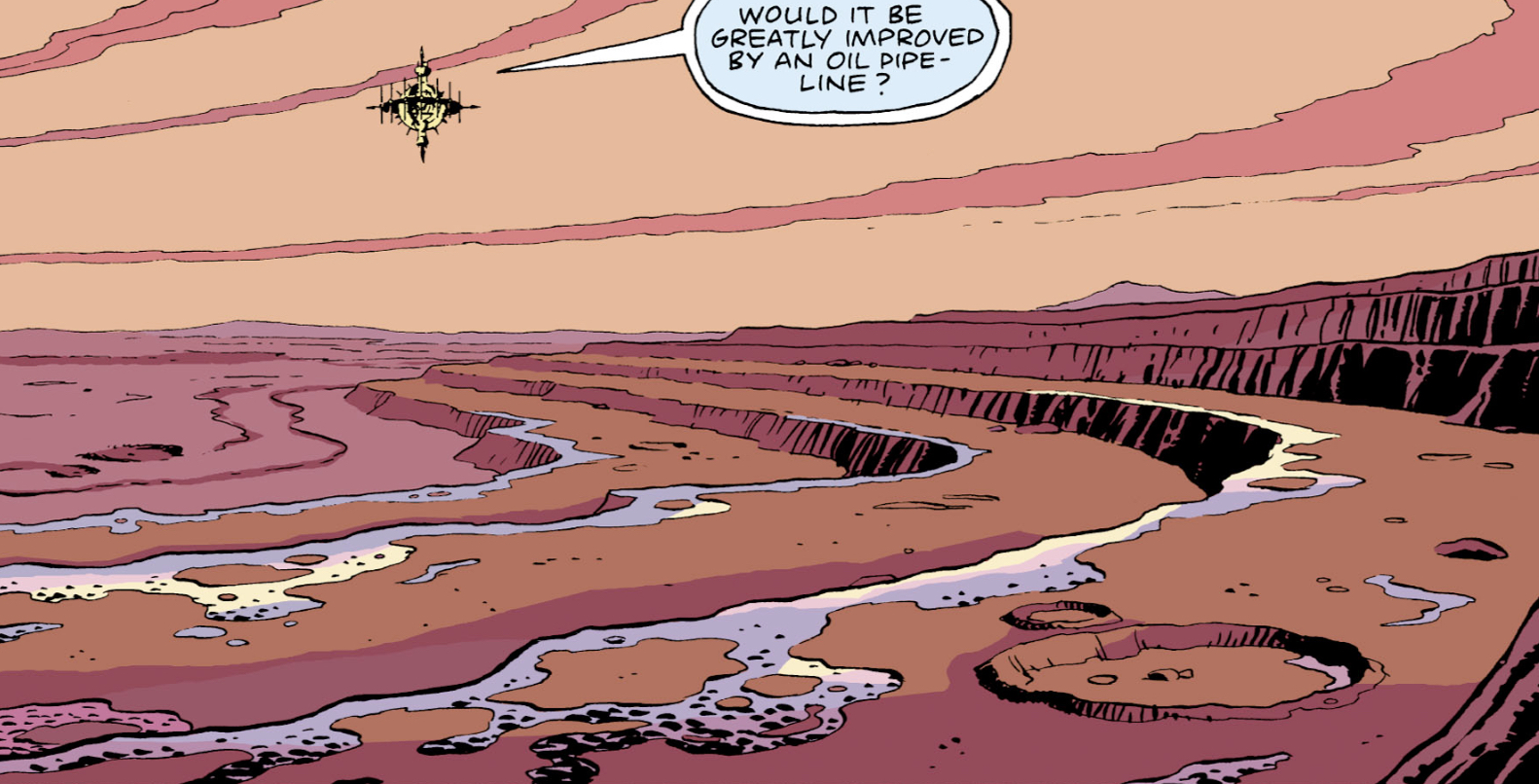
A landscape worthy of Spaceman Spiff. Yes, this is another needlessly massive panel eating up more space for this sparse story. But at least it’s pretty filler.


Man, teenage Laurie was horny! After spending a solid 10 minutes ogling Dr. Manhattan, she immediately starts flirting with the incredibly creepy Comedian.


Sally’s “not long enough” comment is interesting here. By the time of Eddie’s murder, it will have been long enough and she will look back on him with a sad fondness.


Another horrifying aspect of Dr. Manhattan’s passivity is the fact that he knows there’s an ominous gap in his future, but he doesn’t care to investigate it. He just accepts it as part of his otherworldly existence.


Fun fact: Olympus Mons doesn’t actually look like that. It’s so big, and its slope is so gradual, that the curvature of Mars prevents you from seeing it from the surface. Also, if you were on top it, you wouldn’t realize you were on a 13-mile high volcano because the top is so enormously wide.


Most of these artistic transitions work. But some of them, like this one, are a bit cheesy.


Finally! Laurie shows a little backbone! Unfortunately, this was the scene she referred to as “acting like an idiot.” But she was completely in the right here, especially considering Eddie’s wildly inappropriate behavior at this party.


It seems like Eddie genuinely regretted what he did to Sally. But before you feel too bad for him, remember the story of that gruesome scar. He murdered a woman that was pregnant with his child. So his “only once” line can’t carry very much weight.


Another spectacular image by Gibbons and colorist John Higgins. I really haven’t been giving Higgins the credit he deserves, but his work is truly astounding.


Believe it or not, Dr. Manhattan actually becomes a fairly decent therapist here. I love the line, “You’re deliberately shutting out understanding.”


This was a powerful reveal. Maybe a little more drawn out than I would like, but still effective. And I think Gibbons did a great job with the reflected face in the perfume bottle.


There was no logical reason for Dr. Manhattan’s cathedral to shatter like this. It was strong enough to support Laurie’s weight no problem. A little bottle of perfume shouldn’t bring it down. I guess Dr. Manhattan chose to destroy it for symbolic purposes.


I am really surprised that Moore and Gibbons chose an extreme zoom out in this moment. Dr. Manhattan has just realized that human life is a miracle and worth preserving — perhaps the most significant realization he’s ever had. But instead of closing in on these two individuals in this powerful, emotional moment, the comic keeps pulling away until they’re tiny specks.


Yes, there is a smiley face on Mars. Actually, there’s a couple of them, but this, the Galle crater, is the most prominent. Granted, it doesn’t look this clean and orderly, but it was really neat that Moore and Gibbons were able to use it in Watchmen.


The comic keeps on zooming out from this point until Mars and even the sun are just tiny, imperceptible dots in the cold, uncaring vastness of space. It’s an interesting juxtaposition to Dr. Manhattan tenderly telling Laurie to dry her eyes and rejoice in the miracle of life. Was Moore trying to say that Dr. Manhattan’s revelation was wrong? That he should have stayed away and given up on life? I don’t get it.


The supplemental material is pages from Sally’s old scrapbook — a collection of literal scraps of paper that anything to do with the Silk Spectre, no matter how unflattering the coverage. There really isn’t anything significant here — just another reminder of how shallow Sally was.


Sally openly mocked Captain Metropolis’ over-the-top cheesiness, yet she still agreed to join the Minutemen merely for the publicity. She primarily used her role as a “superhero” to become a celebrity. At least, as much of a celebrity as she could muster.


To show just how desperate Sally was for any attention whatsoever, she even preserved an incredibly negative review of the movie about her life. Normal people don’t do this. But in Moore’s world, the only who would become superheroes are the mentally unstable.


We do end on a thoughtful and heartbreaking look at the complicated emotions of so many victims of sexual assault. Part of me wishes we had more on that topic, but the other part says we got just enough here. Moore is exploring a lot of ideas in this story, and we don’t need too many diversions away from the main plot.