Friday, December 29, 2023

Redrafting the Jazz: 2002


I have been cursed by a witch to repeatedly travel back through time to relive every NBA draft. Fortunately, her spell sends me directly to the Utah Jazz war room on draft night and all the executives magically know I’m from the future and will do whatever I say. Unfortunately, the curse prevents me from seeing how my advice altered the future, as I am sent back to the previous year as soon as draft night ends.

June 26, 2002 – Madison Square Garden, New York City

Previous season:

With Utah’s core of Karl Malone, John Stockton and Bryon Russell past their prime, the Jazz limped along to a 44-38 record in 2001-02, before losing to Sacramento in four games in the first round of the playoffs (it was a best-of-five series back then). The roster had quite a bit of dead weight on it, with the only bright spots being rookies Andrei Kirilenko and Jarron Collins. Well, mostly Kirilenko, but Collins did prove he could be a dependable role player.

The draft:

General Manager Kevin O’Connor spent both of Utah’s picks on big men — No. 19 on Ryan Humphrey from Notre Dame and No. 47 on Jamaal Sampson from Cal. O’Connor then immediately traded those two picks to Orlando for the 18th pick, Stanford’s Curtis Borchardt.

Analysis:

Trading two draft picks to move up just one spot is a pretty stupid thing to do. But apparently the Jazz were quite enamored with Borchardt and believed he had slipped in the draft, despite the injury concerns surrounding the 7-footer. Turns out the teams that passed on him made the right choice. Borchardt had extensive feet problems and even had to have screws implanted in his foot. He sat out his entire rookie season, played only 16 games the next, and 67 in what became his final year in the NBA. Luckily, the Jazz didn’t miss out too much on Humphrey and Sampson. They both had extremely subpar careers that lasted 85 and 72 games, respectively.

Watching the draft live as an impressionable youth, I was shocked the Jazz didn’t take Carlos Boozer. I had followed the power forward’s career at Duke and felt he could conceivably be the next Karl Malone. Utah obviously didn’t think that — at first — but following a strong start in Cleveland (and a sudden need to rebuild on the fly), they offered Boozer quite a bit of money to take Malone’s place. True, he did fall quite short of the Hall of Famer’s standards, but Boozer was an All-Star and helped take the Jazz to the Western Conference Finals one year. I think having him start his career in Utah and learning directly from the Mailman himself could have helped Boozer maximize his potential.

Obviously, I want to keep that second-round pick, but I don’t have that many decent options to choose from. So I’m going to go with Rasual Butler, who had an unremarkable, but productive 14-year career. He wasn’t too bad of a shooter, and maybe Jerry Sloan could have taught him to be the next Bryon Russell.

My advice:

1. Keep the 19th pick and use it on Carlos Boozer.
2. Keep the 47th pick and use it on Rasual Butler.

I was frustrated by Boozer’s many injuries and apparent lack of effort during his stay in Utah. But I like to imagine that an aging Karl Malone could have taken a young rookie under his wing and molded him into something truly great. Maybe. Truthfully, I mainly picked Boozer because he was best player available. And sometimes, that’s all it comes down to.

Thursday, December 28, 2023

The Unwatchable Watchmen Motion Comic


After the last bit of role-playing material in 1990, DC went nearly two decades without producing any major adaptations of Watchmen. But not for lack of trying. Work on a film began even before the comic was finished. (It continues to astound me how so many people instantly knew this was going to be an all-time classic!) Alan Moore was initially supportive of a cinematic adaptation, but quickly soured on the project when the initial script butchered the ending with convoluted time-travel nonsense.

Moore wasn't the only one, who had doubts, and Watchmen spent the next 15 years in development hell, being passed around from studio to studio, and director to director. It earned the reputation of being "unfilmable" — a reputation encouraged by Moore himself. But DC never gave up, and in 2006, for whatever strange reason, things fell into place. Zack Snyder was chosen as the director and given a budget of $100 million (which later swelled to $150 million). This led to a flurry of Watchmen content. The comics were remastered, recolored and recollected; Dave Gibbons and John Higgins worked with Snyder on the film; Gibbons wrote a book about the making of the graphic novel; video game tie-ins and soundtracks were commissioned, the whole nine yards. Including this motion comic.

The digitization of comic books led to a lot of experimenting from Marvel and DC — and not all of it was good. Motion comics sought to find the middle ground between animation and traditional, static images. Something less expensive than an out-right cartoon, but more immersive than a typical reading experience. The end result was little more than an old-fashioned radio drama accompanied with puppets cut out from the comics, bouncing around on the screen. Ultimately, the motion comic experiment proved to be just a brief fad that died out in 2010.

However, the motion comic does allow for the most faithful, most literal adaptation possible — if that's your goal. Going panel by panel, word by word seems like the best way to preserve the original creators' intentions. Of course, Moore refused to be involved in anything regarding Watchmen at this point, even insisting that his share of the royalties go to Gibbons. I don't know if Gibbons was involved in this motion comic at all, but it appears he may have at least given it his blessing as he worked so closely with the filmmakers and promotion team.

Director John Strider Hughes made one 30-minute episode for each issue of Watchmen. The first was released on July 17, 2008, but the second didn't come out until October 6. I wonder if DC initially made just one episode to gauge the audience's reaction. And apparently it was good enough to greenlight the rest of the episodes, which were released every two weeks like clockwork, with the final episode coming out on February 23, 2009, just in time for the movie's debut in London. I don't know what the budget or timeframe for this project was, but it feels cheap and rushed.

The motion comic is technically an abridged production, but as far as I can tell, that's only because it omits all the supplemental material. Every panel from the main story seems to be included, presented with very limited animation, camera zooms and pans, sound effects and a light soundtrack by Lennie Moore. But the most bizarre choice was to have a single narrator, Tom Stechschulte, who provided the voice for each character in the story. He handled the male voices just fine, but was woefully out of his depth with the female voices. Distractingly so.

The second most bizarre choice this production made was the inclusion of the speech bubbles. They showed up just like they do in the comic, sometimes dramatically moving on their own to provide emphasis, other times awkwardly sliding along with a character who was "walking" out of the frame. This created a rather pointless distraction, seeing as how Stechschulte was already reading every single word for us. These two bizarre choices made this motion comic unbearable for many audiences, myself included. I know there are quite a few fans of this out there, but I simply cannot get over Stechschulte's grating falsetto, the unnecessary speech bubbles and — most importantly — the sheer pointlessness of the entire exercise.

What's the point in adapting a story if you're not going to change a single thing about it? With this motion comic, I'm basically just paying someone else to read it to me. The animation is so crude and static, I have to use my imagination to visualize in my mind's eye how a fully animated story would look. And I can already do that just by reading the comic. Same for the sound effects and voices. But the benefit of the voices in my head is that they're more authentic than a voice actor who cannot convincingly mimic a woman's voice. So ultimately, while this may technically be the most accurate adaptation of Watchmen you'll find, I can't recommend that anyone subject themselves to the five hours of viewing it. It truly is unwatchable.

Thursday, December 21, 2023

Redrafting the Jazz: 2003


I have been cursed by a witch to repeatedly travel back through time to relive every NBA draft. Fortunately, her spell sends me directly to the Utah Jazz war room on draft night and all the executives magically know I’m from the future and will do whatever I say. Unfortunately, the curse prevents me from seeing how my advice altered the future, as I am sent back to the previous year as soon as draft night ends.

June 26, 2003 – Madison Square Garden, New York City

Previous season:

The Stockton-Malone era in Utah sadly ended with a whimper. In 2002-03, the Jazz went 47-35 and lost to the Kings in five games in the first round. Shockingly, nobody realized it was the end of the dynasty until John Stockton abruptly announced his retirement in May. Karl Malone was a free agent, but not ready to retire yet. However, at the time of the draft, he still wasn't sure if he wanted to return to Utah for his 19th season. The entire organization wasted most of the offseason waffling on whether to start the rebuild or try to use their cap room to make one more run at the Finals. Ultimately, Malone went to the Lakers, leaving Utah with only two good young players — Matt Harpring and Andrei Kirilenko. In other words, completely unprepared for life without Stockton and Malone.

The draft:

General manager Kevin O'Connor used the 19th pick on a Montenegrin swingman named Aleksander "Sasha" Pavlovic.

With the 47th pick, the Jazz took a point guard from Alabama named Maurice "Mo" Williams.

Analysis:

Pavlovic only spent one quiet season in Utah before he was snatched up by the Charlotte Bobcats in the expansion draft. The Jazz didn't want to lose him, but they had to make somebody available for the new team, and Pavlovic seemed the most expendable. They ultimately didn't miss out on much. Pavlovic did linger around the NBA for about a decade, but had a rather mediocre career.

There are quite a few decent, respectable players available in this draft, but there aren't any replacements for Stockton and Malone. So I'm going to simply grab a superior version of Pavlovic — Kyle Korver. He eventually did join the Jazz — twice, in fact — but both times were at the wrong time of his career. Korver was plagued by injuries during his two-and-a-half seasons, and he was simply too old when he came back for 54 games in 2019. But in between those stints, Korver underwent a rigorous training program, finally became healthy, and was named to the All-Star team for Atlanta. He was a fan favorite in Utah, and ended his career as one of the greatest shooters in NBA history. Even though he wasn't taken until the 51st pick, I'd like him to start his career in Utah, and I don't feel bad about grabbing him at No. 19.

Williams also had a quiet rookie campaign for Utah, but he showed just enough promise for the Jazz to protect him from the expansion draft. However, O'Connor shockingly refused to match Milwaukee's offer once Williams became a restricted free agent. He went on to have a terrific career and become an All-Star. O'Connor lamented this as one of his greatest mistakes, and brought Williams back in 2012, but he was old and injured by that point. So I am going to recommend that the Jazz go ahead and draft him like they wanted to. But I'm also going to give O'Connor strict instructions to hold on to him this time.

My advice:

1. Use the 19th pick on Kyle Korver.
2. Use the 47th pick on Mo Williams.

This draft wasn't a huge game changer for a team about to be thrust into a massive rebuild. But I have given them two nice pieces that fill in around Harpring, Kirilenko and whoever else O'Connor can pick up in free agency. The biggest thing is to make sure Korver and Williams are protected from the expansion draft. I'd rather lose Jarron Collins (as nice as he was) than either of All-Stars.

Thursday, December 14, 2023

The Watchmen Sourcebook: The last of the role-playing material


In 1990, Watchmen made one last foray into the DC Heroes role-playing game. But instead of writing another adventure, Ray Winninger was tasked with creating a comprehensive sourcebook for every single character seen or mentioned in the Watchmen comic book series. This was probably a good idea, seeing how difficult it was to make a decent campaign for these characters — not to mention all the editorial interference that crippled the last one. Frankly, I'm a bit surprised that Winninger returned for this project. But I guess his love for this material (and his friendship with Alan Moore) outweighed his disappointment from Taking Out the Trash (which he wanted to call The Harlot's Curse).

Of course, I wonder exactly how much new material Winninger wrote for this. The whole book is basically just an encyclopedia of all the Watchmen characters, providing their DC Heroes statistics and their background information. The vast majority of the background info is regurgitated supplemental material from the Watchmen issues and the previous role-playing adventures. The new stuff that Winninger did write tried to follow the format of newspaper clippings, letters, etc. This may help preserve the "flavor" of Watchmen, but I think this book would have been a lot more usable had all the text been presented in a straight-forward way.

It also hurts that this is a visually unappealing book. It's filled with the bland stock images of the characters and random panels from the comic, presented in black, white and an off-putting shade of orange that was used way too much. Dave Gibbons did provide an original cover, which was strong enough to be reused for the Watchmen Companion in 2019. But beyond that, this is an ugly, boring and bland book.

The worst part was the Villains section. Watchmen doesn't have any traditional villains, but role-playing games need them. Beyond Moloch (who was prominently featured in both the adventures), Winninger really had to scrape the bottom of the barrel. He included every single villain mentioned in casual passing throughout the series, and the whole exercise reeks of inauthenticity.

On a random note, I was surprised by Winninger's omissions in the Hooded Justice section. In Taking Out the Trash, Winninger came right out and said that not only was Hooded Justice a gay white man, but that he was also secretly killed by the Comedian. But none of that is mentioned here, falling back to the ambiguous backstory originally presented by Moore. I prefer the wiggle room created by Moore, especially because I like what the HBO series did with the character. But that review is for another day.

I'm sure this sourcebook would have been quite valuable for obsessive nerds like me in a pre-Wikipedia age. It would have been incredible to have all the backstories of all the Watchmen characters in one place without having to flip through the comics. Unfortunately, this information was not presented nearly as well as it could have, or should have been. In fact, I'd even go as far as to declare this book unreadable, which may have contributed to DC's decision to stop trying to create more role-playing material for Watchmen.

Thursday, December 7, 2023

Redrafting the Jazz: 2004


I have been cursed by a witch to repeatedly travel back through time to relive every NBA draft. Fortunately, her spell sends me directly to the Utah Jazz war room on draft night and all the executives magically know I’m from the future and will do whatever I say. Unfortunately, the curse prevents me from seeing how my advice altered the future, as I am sent back to the previous year as soon as draft night ends.

June 24, 2004 – Madison Square Garden, New York City

Previous season:

The 2003-04 season was the first after the Stockton-Malone era. Many people expected the Jazz to be absolutely dreadful, but they surprisingly went 42-40 and only missed the playoffs by one game. This was largely due to the emergence of Andrei Kirilenko, Carlos Arroyo and Raja Bell, as well as a timely midseason trade that turned DeShawn Stevenson into Gordan Giricek. If Matt Harpring hadn't been limited to 31 games, Utah may have been a playoff team. There were certainly a few intriguing players to build around, but the Jazz desperately needed a consistent presence in the low post.

The draft:

Utah's strong record put them at the very bottom of the lottery, and with the 14th pick, they drafted power forward Kris Humphries, a freshman from Minnesota.

In February 2004, general manager Kevin O'Connor made one of the best trades of his career, sending Keon Clark and Ben Handlogten to Phoenix for Tom Gugliotta's bloated contract, some cash and three draft picks. One of those picks ended up being Gordon Hayward in 2010. But the first pick given to the Jazz was the 16th in this draft, which Utah used on Nevada swingman Kirk Snyder.

Thanks to the 2003 John Amaechi trade, Utah also owned the 21st pick, which they used on Russian center Pavel Podkolzin. But because O'Connor didn't want to add three rookies to the roster, he immediately traded Podkolzin to Dallas for a 2005 first-round pick (which was used to help the Jazz trade up for Deron Williams).

Utah didn't own their second-round pick because they had traded it to Sacramento in 2003 for Clark. Which I suppose worked out great for O'Connor, since he definitely wouldn't have wanted four rookies.

Analysis:

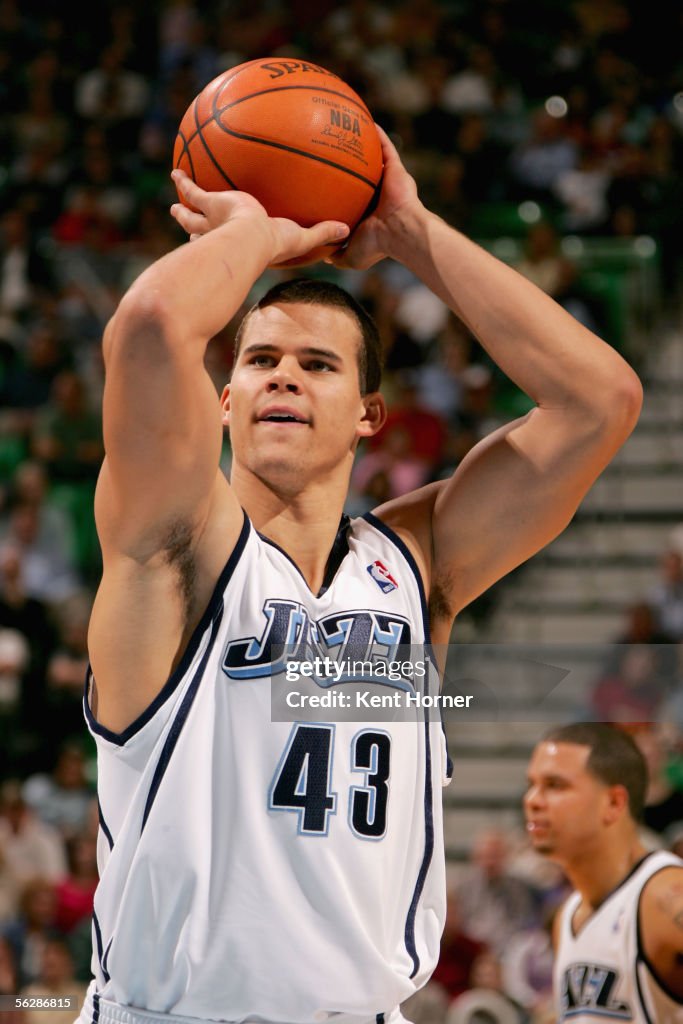
Humphries, perhaps best known for marrying (and promptly divorcing) Kim Kardashian, only lasted two seasons in Utah before being traded for Rafael Araujo (who only played 28 games before dropping out of the NBA). So that really wasn't the best pick the Jazz made. Humphries did go on to have a fairly productive career — he even averaged a double-double for two straight years in New Jersey. But he just wasn't a great fit in Utah, especially after the signing of Carlos Boozer and Mehmet Okur.

I really struggled deciding who to take with this pick. There are so many good options this year! Ultimately, I think I'm going to go with Al Jefferson, the high schooler taken just one spot after Humphries. Jefferson ended up having the career everyone hoped Humphries would have — even making the All-NBA Third Team once. Of course, every good Jazz fans remembers well the three year rather disappointing years he spent in Utah as Boozer's replacement. But that was during a period of intense turmoil for the Jazz — Jerry Sloan's abrupt retirement put the frankly incompetent Tyrone Corbin in as head coach and Jefferson was unable to play up to his full potential. My theory is that a rookie Jefferson, developing behind Boozer and under Sloan's tutelage, could turn into a very valuable player for the Jazz. I hope.

Snyder's athleticism made him an exciting prospect — Jazz fans even gave him the nickname Snyder-Man. But after just one year, Utah dumped him off in an insane five-team trade. By 2008, he was out of the league. Back in 2004, I remember being shocked that the Jazz didn't draft Jameer Nelson. He had an impressive pre-draft workout and interview with Utah, and certainly seemed like a perfect fit for the Jazz. Nelson's career was hampered by injuries, but he did make one All-Star game and was the starting point guard of an Orlando Magic team that reached the Finals. I suppose the Jazz were pretty happy with their three young point guards — Arroyo, Raul Lopez and Mo Williams — but I know that Arroyo's arguments with Sloan would soon get him traded, Lopez would quickly suffer a career-ending injury, and O'Connor would fail to resign Williams (which he later called his biggest mistake). So even though it feels weird in the moment, I'm going to recommend drafting a point guard.

The 7-foot-5 Podkolzin was a pretty big bust for Dallas. He played just six games in two seasons before being waived. Naturally, I'm not upset the Jazz missed out on him. But I am quite upset that O'Connor gave away a perfectly good first-round pick just because he didn't want to add too many rookies to the roster. So first I'd have to explain to him that that's a ridiculous philosophy, especially when you're rebuilding a team and that just lost last year’s first-round pick (Sasha Pavlovic) to the Charlotte Bobcats’ expansion draft. Plus, there are quite a few good options still available at No. 21. Options like Tony Allen, a three-time All Defensive First Team member. I know that Raja Bell will leave the Jazz after just two seasons, and Allen would not only fill the void he left, but even be an upgrade.

My advice:

1. Use the 14th pick on Al Jefferson.
2. Use the 16th pick on Jameer Nelson.
3. Keep the 21st pick and use it on Tony Allen.

I'm quite excited by the prospect of adding Tony Allen and Jameer Nelson to the Jazz. Al Jefferson still has me a bit worried, though. It really comes down to the belief that putting a player in a different situation at the start of their career can dramatically alter the course of their career. Jefferson had the potential to be one of the best power forwards in the league. Maybe being drafted by Utah could have helped. Sadly, I'll never get to see the results of my experiment. As soon as draft night ends, I'm teleported back to the year 2003.

Thursday, November 30, 2023

Taking Out the Trash: One more Watchmen role playing module


The second Watchmen module for the DC Heroes role playing game was also developed before the comic series was finished. This module's author, Ray Winniger, says he spent hours on the phone with Alan Moore, discussing the plot of the soon-to-be published issues. Moore is also given credit in this module for contributing "special design assistance and concepts." Perhaps this is why Taking Out the Trash: Curses and Tears feels even more like a Watchmen story than Who Watches the Watchmen. Unfortunately, I don't think this is as strong an adventure as its predecessor.

Part of this module's problem was not Winneger's fault. His work was heavily edited, with some pages printed out of order and every reference to a real world place or person was removed. This was especially problematic for Richard Nixon, who was known only as the Vice President in this story about the Republican nomination for president. It frankly makes the text nearly unreadable at parts.

The other problems of this module lie squarely with Winnegar, though. He tried really hard to mimic Moore's writing style and presentation, but it just didn't quite work. Winnegar sprinkled the text with quotations from William Blake's poem "London," and he even tried writing some passages from Rorschach's journal. This created a rather cheesy effect, especially since Winnegar's prose is nowhere near on the level of Moore's. Granted, it is nearly impossible to get into the mind of a younger Rorschach, one described as "not nearly as unstable or schizophrenic as he will one day become." And since Moore never really explored this era of Rorschach's life, Winnegar had nothing to build on. It was a noble effort, I suppose, but not executed too well.

Anyway, the story features Moloch working with a corrupt presidential candidate. Oddly, the adventure is largely split up between a solo mission for the Comedian and a mission for Rorschach and Nite Owl. Silk Spectre and Ozymandias can be awkwardly shoehorned in if you have more than three players at the table, but there's no compelling narrative reason for them to be there. And, as was expected, Winniger issues strong warnings about using Doctor Manhattan. He simply does not work for games like this.

Dave Gibbons did not provide any new art for this module, so we're stuck with images pulled from the comics and promotional materials. Some of the supplemental material looks fairly nice — like actual letters and newspaper clippings, for example — but all the maps are extremely rudimentary. The most interesting part, by far, was the section on the Minutemen. Winnegar came up with stats for all their characters and pulled from the backup pages of Watchmen to provide short bios on each of them. Truthfully, I think a role-playing module based on the Minutemen would be a lot more interesting (and functional). Sadly, DC never published one, but they did provide the tools for any ambitious game master out there.

As far as an adaptation of Watchmen goes, this module suffers from the same limitations of the first one. None of the Watchmen characters are likable. But if you want players to play them, then you need to clean them up a bit. This forces the game to take place in an unexplored setting, almost entirely separate from the source material. And every character description carries notes about how this adventure takes place before they became too violent or too insane or began a plot to reshape the entire world. It all leaves a rather awkward and unsatisfying taste in your mouth, despite Winniger's (and Moore's) best efforts to make this feel like a Watchmen story. From what I can tell, neither one of these modules were particularly well received.

Thursday, November 16, 2023

Redrafting the Jazz: 2005


I have been cursed by a witch to repeatedly travel back through time to relive every NBA draft. Fortunately, her spell sends me directly to the Utah Jazz war room on draft night and all the executives magically know I’m from the future and will do whatever I say. Unfortunately, the curse prevents me from seeing how my advice altered the future, as I am sent back to the previous year as soon as draft night ends.

June 28, 2005 – Madison Square Garden, New York City

Previous season:

The 2004-05 season was the worst of Jerry Sloan’s coaching career (and that includes his unremarkable stint in Chicago). Utah was rebuilding, and pieces were beginning to come into place. The Jazz brought in big men Carlos Boozer and Mehmet Okur to form the foundation of a decent frontcourt with Andrei Kirilenko and Matt Harpring. But Boozer only played in 51 games and Kirilenko just 41. And as promising as Utah’s frontcourt was, their backcourt was horrendous — especially at point guard. Carlos Arroyo had shown promise in previous years, but by 2005, his relationship with Sloan had deteriorated to the point of being traded away for absolutely nothing. All this led to a 26-56 record for the Jazz, which was unfortunately not quite bad enough to land a coveted spot in the lottery.

The draft:

Owner Larry H. Miller wanted to end the rebuilding process as quickly as possible and ordered General Manager Kevin O’Connor to be as aggressive as possible. The Jazz tried to trade for the No. 1 pick, but Milwaukee wouldn’t budge. However, Portland was surprisingly willing to part with the No. 3 pick, which would guarantee Utah’s ability to grab one of the top two point guards in this draft and solve their roster’s biggest problem. Hours before the draft, the Jazz gave the Blazers their own No. 6 pick, the No. 27 pick (which they acquired from Dallas in 2004 for Pavel Podkolzin) and the 2006 first-round pick they got from Detroit in the Arroyo trade.

With the third pick, the Jazz selected Deron Williams from Illinois. Portland used Utah’s picks on Martell Webster (No. 6), Linas Kleiza (No. 27) and Joel Freeland (No. 30 in 2006).

Utah used their No. 34 on high school swing man C.J. Miles.

Thanks to a 2003 trade involving John Amaechi, the Jazz also owned the 51st pick, which they used on Walsh big man Robert Whaley.

Analysis:

Do I even need to say it? The Jazz should have drafted Chris Paul. Yes, I defended the Williams pick, and for the first few years, there was a legitimate argument to be had. But Paul quickly outpaced Williams in every way and is still playing at a high level today, while Williams is long since retired. I’m beginning to wonder if the Jazz never really considered taking Paul because they assumed (like everyone else) that Atlanta would draft him. But the Hawks shocked the world by picking Marvin Williams instead.

But even though the Jazz chose the wrong point guard, they still got the better end of that trade with Portland. None of those three players developed into half the player Deron Williams was. So I wouldn’t recommend canceling that trade, even if I could. I’ll just point out which point guard will have a far superior career. I can pretend that Paul would have gotten along better with Sloan and that his time in Utah wouldn’t have ended as abruptly as Williams’ did. But I don’t honestly know how that would have played out. I just know Paul is a better player, and I want the Jazz to draft him.

C.J. Miles was a rather frustrating player for me. The Jazz committed wholeheartedly to him right from the beginning by giving him a guaranteed contract that’s normally only for first-round picks. And a few years later, they matched a rather exorbitant deal offered by Oklahoma City. I just felt like the first four or five years of his seven-year Utah stint were filled with a lot of talk about how young he was and how everyone needed to be patient with him. Look, he wasn’t a bad player by any means (he lasted 15 years in the league), but he wasn’t particularly dynamic. So I’m going to save Jazz fans from seven years of meandering mediocrity and roll the dice on Monta Ellis. This undersized shooting straight out of high school eventually developed into one of the top scorers in the league. Yeah, personality issues might have hampered his time playing under Sloan, but I’m willing to risk a second-round pick on the slim chance of adding a dynamic player to Utah’s roster.

Robert Whaley only played 23 games his rookie season, earning more attention for what he did off the court. He and Deron Williams were involved in an altercation in Park City, where Whaley sustained a six-inch cut on his hand and he lied to the team about how he got the injury. Utah traded him to Toronto in the offseason, and the Raptors immediately waived him, ending his NBA career. But a few years later, Whaley chose to return to Utah, where he was arrested a few more times on various marijuana and burglary charges. Needless to say, the Jazz could have made a better pick here. Luckily, we have a half-decent center available: Marcin Gortat. This Polish big man enjoyed a 13-year NBA career, twice averaging a double-double during the season. And, as far as I know, he does not have an arrest record.

My advice:

1. Use the 3rd pick on Chris Paul.
2. Use the 34th pick on Monta Ellis.
3. Use the 51st pick on Marcin Gortat.

It’s kind of interesting how Deron Williams is still regarded as one of the best Jazz players in franchise history (his jersey was the only one I’ve ever owned), and yet he will go down as one of the biggest draft mistakes the Jazz ever made. Chris Paul was just that good. And plenty of people were saying it at the time, but the Jazz didn’t listen. Luckily, my witch’s curse compels Kevin O’Connor to heed my warnings. Unluckily, I never got to see that a Paul-Boozer duo in action.